You can watch a shortened version of my talk at the Cognitive Science in Science Education conference (CogSciSci 2022) here.
Some of the content is also in this post.
The PowerPoint is also available here.
You can watch a shortened version of my talk at the Cognitive Science in Science Education conference (CogSciSci 2022) here.
Some of the content is also in this post.
The PowerPoint is also available here.
When I was an A-level physics student (many, many years ago, when the world was young LOL) I found the derivation of the centripetal acceleration formula really hard to understand. What follows is a method that I have developed over the years that seems to work well. The PowerPoint is included at the end.

Let’s consider an object moving in circular path of radius r at a constant angular speed of ω (omega) radians per second.
The object is moving anticlockwise on the diagram and we show it at two instants which are time t seconds apart. This means that the object has moved an angular distance of ωt radians.

The linear velocity is the speed in metres per second and acts at a tangent to the circle, making a right angle with the radius of the circle. We have called the first velocity v1 and the second velocity at the later time v2.
Since the object is moving at a constant angular speed ω and is a fixed radius r from the centre of the circle, the magnitudes of both velocities will be constant and will be given by v = ωr.
Although the magnitude of the linear velocity has not changed, its direction most certainly has. Since acceleration is defined as the change in velocity divided by time, this means that the object has undergone acceleration since velocity is a vector quantity and a change in direction counts as a change, even without a change in magnitude.

We have simply extracted v1 and v2 from the original diagram and placed them nose-to-tail. We have kept their magnitude and direction unchanged during this process.

The dark blue arrow is the result of adding v1 and v2. It is not a useful operation in this case because we are interested in the change in velocity not the sum of the velocities, so we will stop there and go back to the drawing board.

Since we are interested in the change in velocity, let’s flip the direction of v1 so that it going in the opposite direction. Since it is opposite to v1, we can now call this -v1.
It is preferable to flip v1 rather than v2 since for a change in velocity we typically subtract the initial velocity from the final velocity; that is to say, change in velocity = v2 – v1.

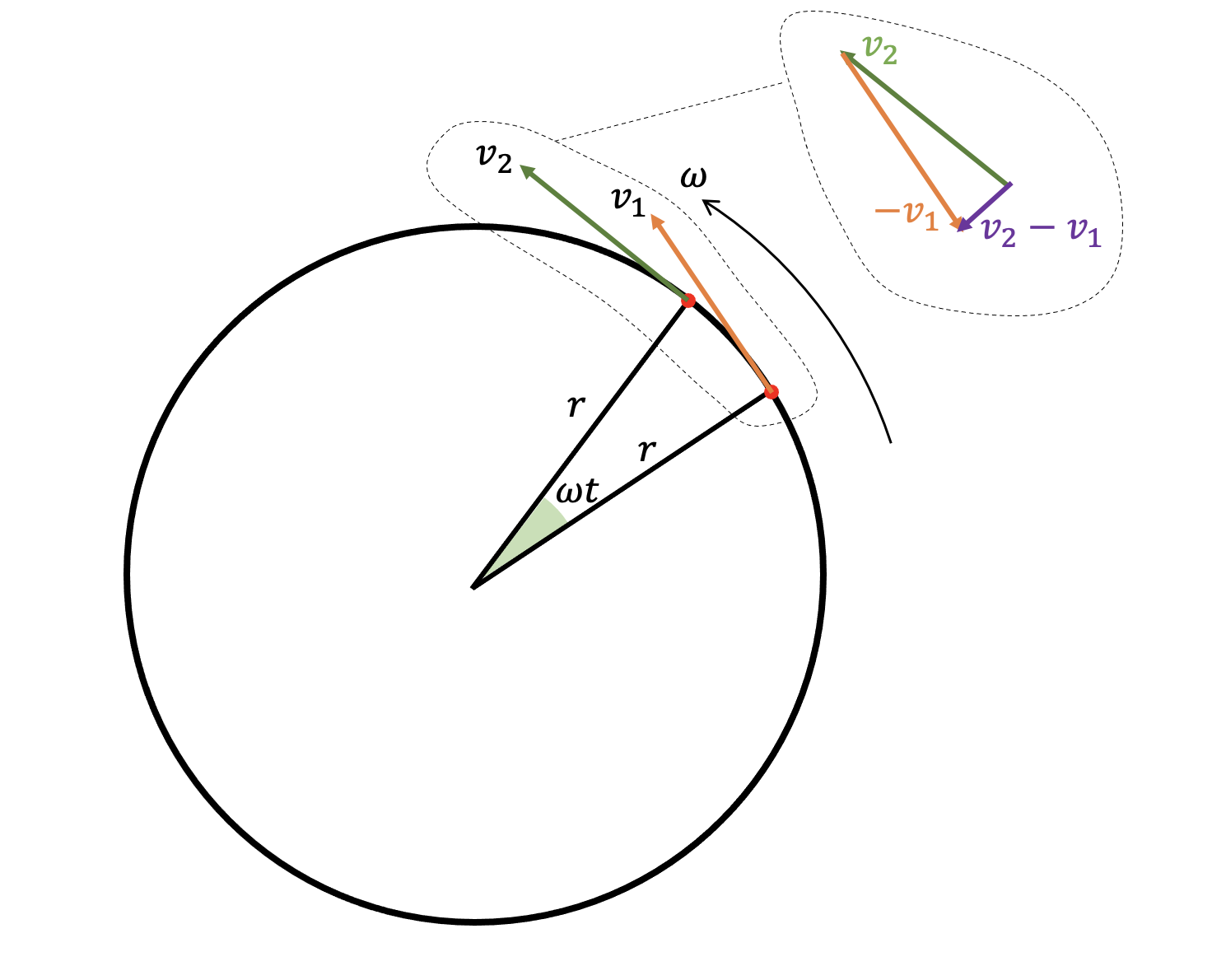
The purple arrow shows the result of adding v2 + (-v1); in other words, the purple arrow shows the change in velocity between v1 and v2 due to the change in direction (notwithstanding the fact that the magnitude of both velocities is unchanged).
It is also worth mentioning that that the direction of the purple (v2 –v1) arrow is in the opposite direction to the radius of the circle: in other words, the change in velocity is directed towards the centre of the circle.

The angle between v2 and (-v1) will be ωt radians.

If we assume that ωt is a small angle, then the line representing v2-v1 can be replaced by the arc c of a circle of radius v (where v is the magnitude of the vectors v1 and v2 and v=ωr).
We can then use the familiar relationship that the angle θ (in radians) subtended at the centre of a circle θ = arc length / radius. This lets express the arc length c in terms of ω, t and r.

And finally, we can use the acceleration = change in velocity / time relationship to derive the formula for centripetal acceleration we a = ω2r.
Well, that’s how I would do it. If you would like to use this method or adapt it for your students, then the PowerPoint is attached.
Please Like or leave a comment if you find this useful 🙂
Gustav Robert Kirchhoff (1824 – 1887) was a pioneer in the study of the radiation given off by hot objects and was the first person to use the term ‘black body radiation’. He also made groundbreaking contributions to what was then the ‘new’ science of spectroscopy.
High school students first encounter his name when studying electric circuits. Kirchhoff developed laws which describe the behaviour of electric circuits and, rightly, these laws still bear his name.
Newton needed three laws to explain the whole of motion; Kirchhoff needed only two to explain the behaviour of all circuits.
This law is a consequence of the Principle of Conservation of Electric Charge.
The algebraic sum of all the currents flowing through all the wires in a network that meet at a point is zero
Oxford Dictionary of Physics (2015)
‘Algebraic sum’ means that we must take account of whether the electric currents are positive or negative; or, in other words, their direction.
This can be stated more simply as: the sum of electric currents flowing into a junction is equal to the sum of the electric currents flowing out of the junction.
This law is a consequence of the Principle of Conservation of Energy.
The algebraic sum of the e.m.f.s within any closed circuit is equal to the sum of the products of the currents and the resistances in the various portions of the circuit.
Oxford Dictionary of Physics (2015)
This can be more directly understood as saying that in any closed loop of the circuit, the sum of the energies gained by the charge carriers as they pass through parts of the loop with a positive potential difference is equal to the sum of the energies lost by the charge carriers as they pass through parts of the circuit with electrical resistance.
In other words, the sum of the positive potential differences (e.m.f.s) is equal to the sum of the negative potential differences around any closed loop of a circuit.


But wait — is the current I2 flowing in the right way? Surely it should be coming out of the positive terminal of the 7 V battery, no?
Perhaps. The direction of I2 is simply my semi-educated guess at its direction given the relative strength of the 27 V cell and the 7 V cell.
But the happy truth of using Kirchhoff’s First Law is that . . . it doesn’t matter. Even if we have guessed the direction wrong, after we have gone through the process all that will happen is that we will get the correct numerical value for I2 but our mistake will be revealed by the fact that it will have a negative value.
If we look at the junction highlighted in yellow, we can see that the algebriac sum of currents is: I1 – I2 – I3 = 0.
We can rewrite this as: I1 = I2 + I3.
And that’s about as far as we can get using just Kirchhoff’s First Law. We have three unknowns so somehow we need to obtain two more independent expressions of their relationships to solve this circuitous conundrum.
Luckily, we still have Kirchhoff Second Law to bring into play…
Before starting, I find it immensely helpful to indicate which ends of the components have a positive potential and which have a negative potential. This process is part of a general maxim that I try to apply to all areas of physics problem solving: why think hard when your diagram can do the thinking for you? (See here for a similar process applied to dynamics problems.)
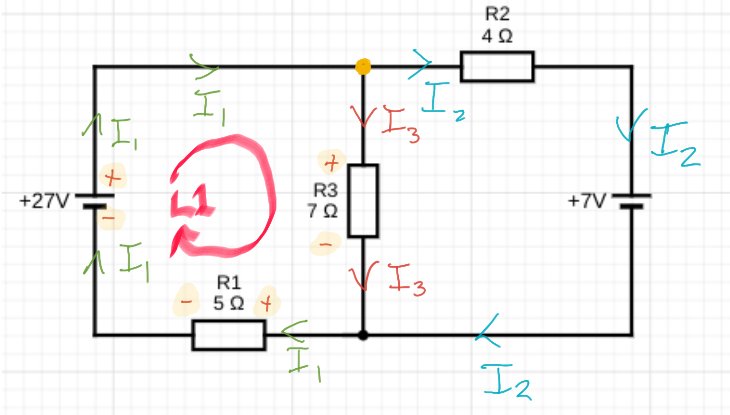
Going around loop L1 in the direction shown by the arrow:
This gives us:


Going around Loop L2 we find that:
This gives us:

Going through a rather involved process of using simultaneous equations for solving for I1, I2 and I3 . . .
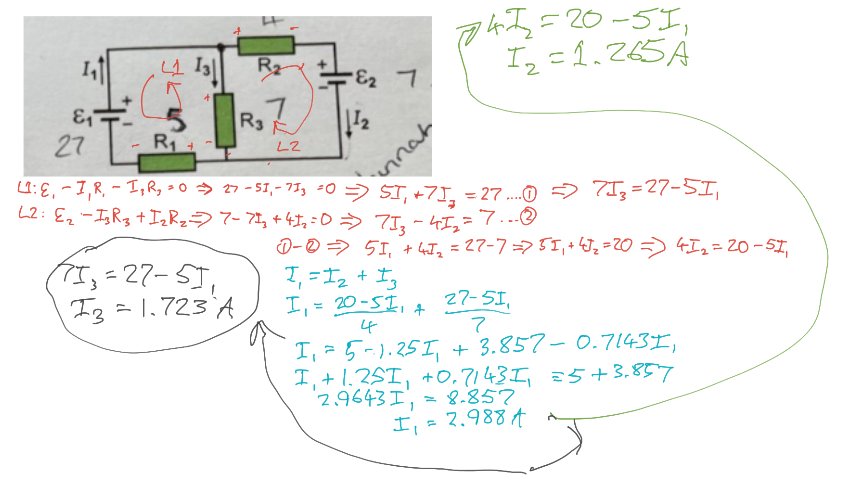
(NB There’s probably a quicker way than the way I chose, but I got there in the end and that’s the important thing. AND I guessed the direction of I2 correctly. *Pats himself on the back*).
Kirchhoff’s Laws: I hope you give them a spin, whether or not you decide to use the procedure outlined above 🙂
It is a truth universally acknowledged that student misconceptions about waves are legion. Why do so many students find understanding waves so difficult?
David Hammer (2000: S55) suggests that it may, in fact, be not so much a depressingly long list of ‘wrong’ ideas about waves that need to be laboriously expunged; but rather the root of students misconceptions about waves might be a simple case of miscategorisation.
Hammer (building on the work of di Sessa, Wittmann and others) suggests that students are predisposed to place waves in the category of object rather than the more productive category of event.
Thinking of a wave as an object imbues them with a notional permanence in terms of shape and location, as well as an intuitive sense of ‘weightiness’ or ‘mass’ that is permanently associated with the wave.
Looking at a wave through this p-prim or cognitive filter, students may assume that it can be understood in ways that are broadly similar to how an object is understood: one can simply look at or manipulate the ‘object’ whilst ignoring its current environment and without due consideration of its past or its future
For example, students who think that (say) flicking a slinky spring harder will produce a wave with a faster wave speed rather than the wave speed being dependent on the tension in the spring. They are using the misleading analogy of how an object such as a ball behaves when thrown harder rather than thinking correctly about the actual physics of waves.
Hammer suggests that perhaps a more productive cognitive resource that we should seek to activate in our students when learning about waves is that of an event.
An event can be expected to have a location, a duration, a time of occurrence and a cause. Events do not necessarily possess the aspects of permanence that we typically associate with objects; that is to say, an event is expected to be a transient phenomenon that we can learn about by looking, yes, but we have to be looking at exactly the right place at the right time. We also cannot consider them independently of their environment: events have an effect on their immediate environment and are also affected by the environment.
If students think of waves as a series of events propagating through space they are less likely to imbue them with ‘permanent’ properties such as a fixed shape that can be examined at leisure rather than having to be ‘captured’ at one instant. Hammer suggests using a row of falling dominoes to introduce this idea, but you might also care to use this suggested procedure.
You can access an editable copy of the slides that follow in Google Jamboard format by clicking on this link.
I like to start by anchoring the idea of changing wave speed in a context that students may be familiar with: waves on a beach. However, we should try and separate the general idea of an undulating water wave from that of a breaking wave. Begin by asking this question:

Give thirty seconds thinking time and then ask students to hold up either one or two fingers on 3-2-1-now! to show their preferred answer. (‘Finger voting’ is a great method for ensuring that every student answers without having to dig out those mini whiteboards).
The correct answer is, of course, the top diagram. This is because the bottom diagram shows a breaking wave.
In short, because waves slow down as they hit the beach. The top part of the wave is moving faster than the bottom so the wave breaks up as it slides off the bottom part. In effect, the wave topples over because the bottom is moving more slowly than the top part.

It is important that students appreciate that although the wavelength of the wave does change, the frequency of the wave does not. The frequency of the wave depends on the weather patterns that produced the wave in the deep ocean many hundreds or thousand of miles away. The slope of the beach cannot produce more or fewer waves per second. In other words, the frequency of a wave depends on its history, not its current environment.
All the beach can do is change the wave speed, not the wave frequency.
We can check our students’ understanding by asking them to comment or annotate a diagram similar to the one below.

Some good questions to ask — before the wavelength annotations are added — are:

Physics teachers often assume that the operation and principles of a ripple tank are self-evident to students. In my experience, they are not and it is worth spending a little time exploring and explaining how a ripple tank works.
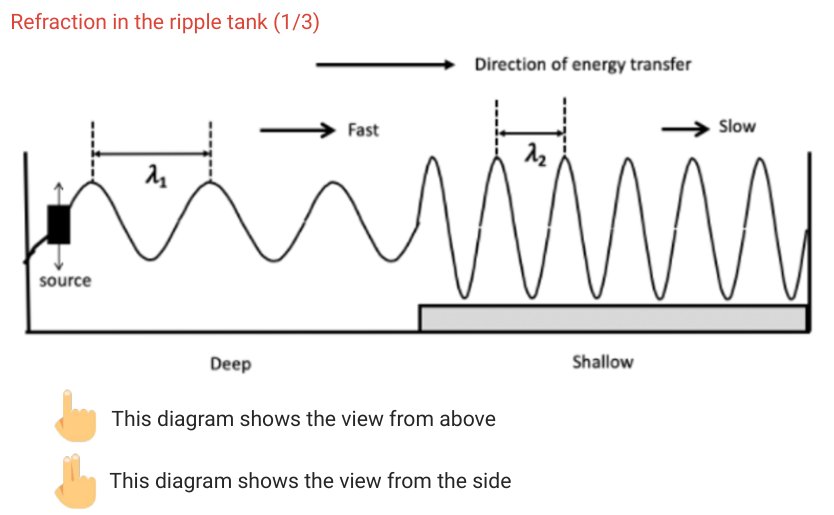
It’s a good idea to first show what happens when the waves hit the boundary at right angles; in other words, when the direction of travel of the waves is parallel to the normal line.
I like to add the annotations live with the class using Google Jamboard. (The questions can be covered with a blank box until you are ready to show them to the students.)

You can access an animated, annotable version of this and the other slides in this post in Google Jamboard format by clicking on this link.
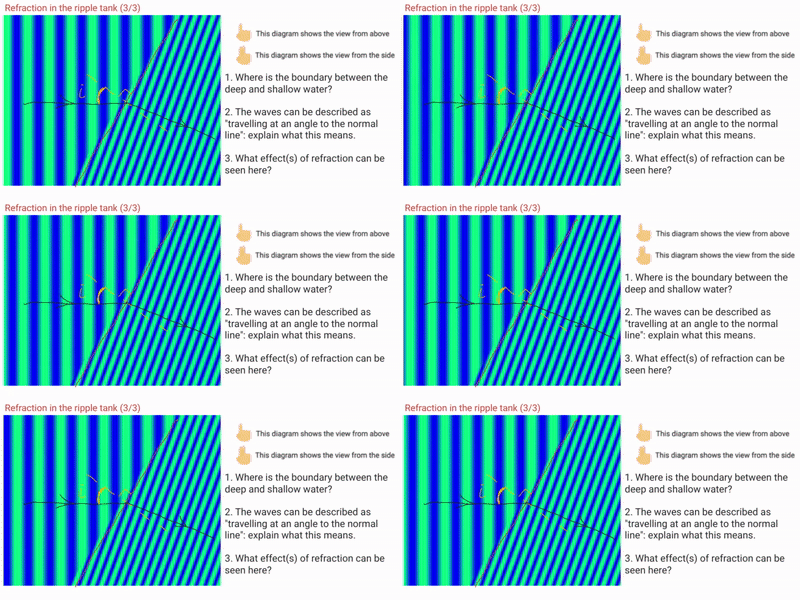
The next step is to show what happens when the water waves arrive at the boundary at an angle i; in other words, the direction of travel of the waves makes an angle of i degrees with the normal line.
Again, I like to add the annotations live using Google Jamboard.
Hammer, D. (2000). Student resources for learning introductory physics. American Journal of Physics, 68(S1), S52-S59.
Wittmann, M. C., Steinberg, R. N., & Redish, E. F. (1999). Making sense of how students make sense of mechanical waves. The physics teacher, 37(1), 15-21.
We all adore a Kia-Ora
Advertising slogan for ‘Kia-Ora’ orange drink (c. 1985)
Energy is harder to define than you would think. Nobel laureate Richard Feynman defined ‘energy’ as
a numerical quantity which does not change when something happens. It is not a description of a mechanism, or anything concrete; it is just a strange fact that we can calculate some number and when we finish watching nature go through her tricks and calculate the number again, it is the same. […] It is important to realize that in physics today, we have no knowledge of what energy is. […] It is an abstract thing in that it does not tell us the mechanism or the reasons for the various formulas.
Feynman Lectures on Physics, Vol 1, Lecture 4 Conservation of Energy (1963)
Current secondary school science teaching approaches to energy often picture energy as a ‘quasi-material substance’.
By ‘quasi-material substance’ we mean that ‘energy is like a material substance in how it behaves’ (Fairhurst 2021) and that some of its behaviours can be modelled as, say, an orange liquid (see IoP 2016).

And yet, sometimes these well-meaning (and, in my opinion, effective) approaches can draw some dismissive comments from some physicists.

To begin with, there was never a ‘Caloric Theory of Energy’ since the concept of energy had not been developed yet; but the Caloric Theory of Heat was an important step along the way.
Caloric was an invisible, weightless and self-repelling fluid that moved from hot objects to cold objects. Antoine Lavoisier (1743-1794) supposed that the total amount of caloric in the universe was constant: in other words, caloric was thought to be a conserved quantity.
Caloric was thought to be a form of ‘subtle matter’ that obeyed physical laws and yet was so attenuated that it was difficult to detect. This seems bizarre to our modern sensibilities and yet Caloric Theory did score some notable successes.
It began with Count Rumford in 1798. He published some observations on the manufacturing process of cannons. Cannon barrels had to be drilled or bored out of solid cylinders of metal and this process generated huge quantities of heat. Rumford noted that cannons that had been previously bored produced as much heat as cannons that were being freshly bored for the first time. Caloric Theory suggested that this should not be the case as the older cannons would have lost a great deal of caloric from being previously drilled.
The fact that friction could seemingly generate limitless quantities of caloric strongly suggested that it was not a conserved quantity.
We now understand from the work James Prescott Joule (1818-1889) and Rudolf Clausius (1822-1888) that Caloric Theory had only a part of the big picture: it is energy that is the conserved quantity, not caloric or heat.
As Feynman puts it:
At the time when Carnot lived, the first law of thermodynamics, the conservation of energy, was not known. Carnot’s arguments [using the Caloric Theory] were so carefully drawn, however, that they are valid even though the first law was not known in his time!
Feynman Lectures on Physics, Vol 1, Lecture 44 The Laws of Thermodynamics
In other words, the Caloric Theory is not automatically wrong in all respects — provided, that is, it is combined with the principle of conservation of energy, so that energy in general is conserved, and not just the energy associated with heat.
We now know, of course, that heat is not a form of attenuated ‘subtle matter’ but rather the detectable, cumulative result of the motion of quadrillions of microscopic particles. However, this is a complex picture for novice learners to absorb.
David Hammer (2000) argues persuasively that certain common student cognitive resources can serve as anchoring conceptions because they align well with physicists’ understanding of a particular topic. An anchoring conception helps to activate useful cognitive resources and a bridging analogy serves as a conduit to help students apply these resources in what is, initially, an unfamiliar situation.
The anchoring conception in this case is students’ understanding of the behaviour of liquids. The useful cognitive resources that are activated when this is brought into play include:
The bridging analogy which serves as a channel for students to apply these cognitive resources in the context of understanding energy transfers is the idea of ‘energy as a quasi-material substance’ (which can be considered as an iteration of the ‘adapted’ Caloric Theory which includes the conservation of energy).
The bridging analogy helps students understand that:
Of course, a bridging analogy is not the last word but only the first step along the journey to a more complete understanding of the physics involved in energy transfers. However, I believe the ‘energy as a quasi-material substance’ analogy is very helpful in giving students a ‘sense of mechanism’ in their first encounters with this topic.
Teachers are, of course, free not to use this or other bridging analogies, but I hope that this post has persuaded even my more reluctant colleagues that they need a more substantive argument than a knee jerk ‘energy-as-substance = Caloric Theory = BAD’.
Fairhurst P. (2021), Best Evidence in Science Teaching: Teaching Energy. https://www.stem.org.uk/sites/default/files/pages/downloads/BEST_Article_Teaching%20energy.pdfhttps://www.stem.org.uk/sites/default/files/pages/downloads/BEST_Article_Teaching%20energy.pdf [Accessed April 2022]
Hammer, D. (2000). Student resources for learning introductory physics. American Journal of Physics, 68(S1), S52-S59.
Institute of Physics (2016), Physics Narrative: Shifting Energy Between Stores. Available from https://spark.iop.org/collections/shifting-energy-between-stores-physics-narrative [Accessed April 2022]
As noted earlier, some students struggle with unit conversions. To take a simple example: if we need to convert 3.7 kilojoules (or ‘killer-joules’ as some insist on calling them *shudders*) into joules, then whilst many students know that the conversion involves applying a factor of one thousand, they do not know whether to multiply 3.7 by a thousand or divide 3.7 by a thousand.
Michael Porter shared a brilliant suggestion for helping students over this hurdle. He suggests that we break down the operation into two parts:
Let’s look at using the Porter system for the example shown above.
(Note: I have used kilojoules for our first example since, at least for GCSE Science calculation contexts, students are unlikely to have to convert kilograms into grams. This is because, of course, the kilogram (not the gram) is the base unit of mass in the SI System.)
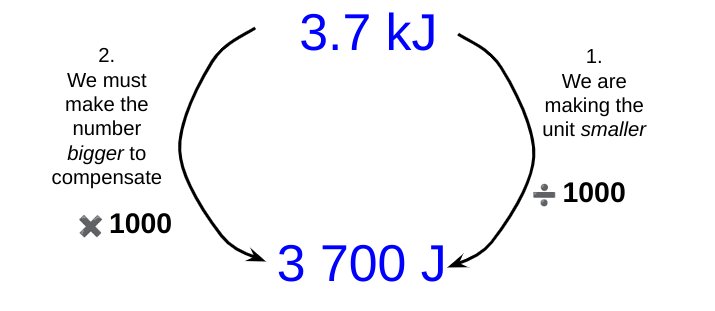
By changing from kilojoules to joules we are making the unit smaller, since one kilojoule is larger than one joule.

To keep the measured quantity of energy the same magnitude, we must therefore make the number part of the measurement bigger to compensate for the reduction in size of the unit.
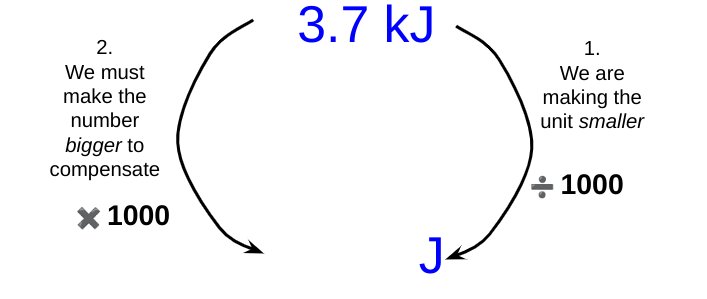
This leads us to the final answer.
Now let’s look if we had to convert 830 microamps into amps:

Obviously 1 minute is a very small quantity of time compared with a whole week. Indeed, our forefathers considered it small as compared with an hour, and called it “one minùte,” meaning a minute fraction — namely one sixtieth — of an hour. When they came to require still smaller subdivisions of time, they divided each minute into 60 still smaller parts, which, in Queen Elizabeth’s days, they called “second minùtes” (i.e., small quantities of the second order of minuteness).
Silvanus P. Thompson, “Calculus Made Easy” (1914)
It is probable that the division of units of time into sixtieths dates back many thousands of years to the ancient Babylonians(!) Is it any wonder that some students find it hard to convert units of time?
We can use the Porter system to help students with these conversions. For example, what is 7 hours in seconds?

This type of diagram is, I think, very useful for showing students explicitly what we are doing.
The S.I. System of Units is a thing of beauty: a lean, sinewy and utilitarian beauty that is the work of many committees, true; but in spite of that common saw about ‘a camel being a horse designed by a committee’, the S.I. System is truly a thing of rigorous beauty nonetheless.
Even the pedestrian Wikipedia entry on the 2019 Redefinition of the S.I. System reads like a lost episode from Homer’s Odyssey. As Odysseus tied himself to the mast of his ship to avoid the irresistible lure of the Sirens, so in 2019 the S.I, System tied itself to the values of a select number of universal physical constants to remove the last vestiges of merely human artifacts such as the now obsolete International Prototype Kilogram.
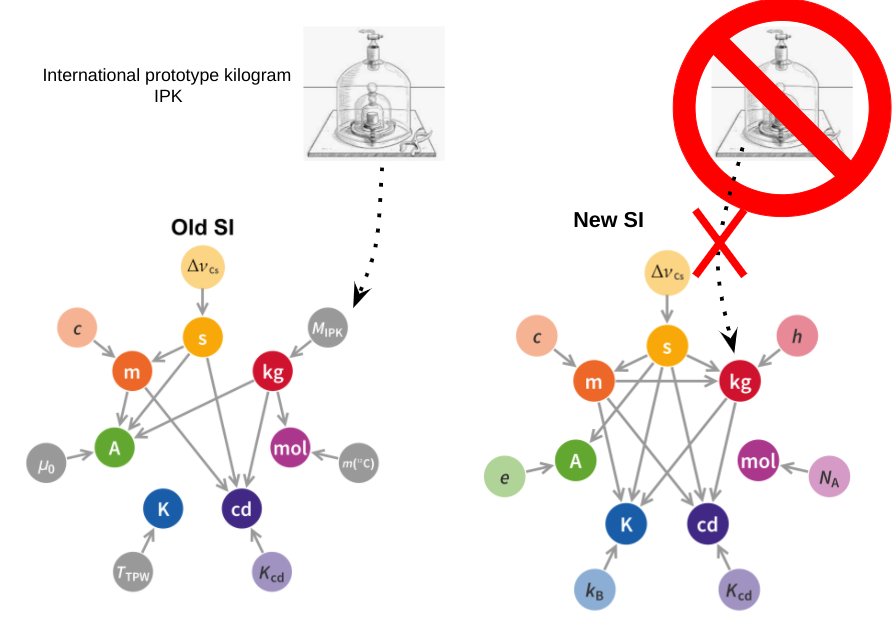
However, the austere beauty of the S.I. System is not always recognised by our students at GCSE or A-level. ‘Units, you nit!!!’ is a comment that physics teachers have scrawled on student work from time immemorial with varying degrees of disbelief, rage or despair at errors of omission (e.g. not including the unit with a final answer); errors of imprecision (e.g. writing ‘j’ instead of ‘J’ for ‘joule — unforgivable!); or errors of commission (e.g. changing kilograms into grams when the kilogram is the base unit, not the gram — barbarous!).
The saddest occasion for writing ‘Units, you nit!’ at least in my opinion, is when a student has incorrectly converted a prefix: for example, changing millijoules into joules by multiplying by one thousand rather than dividing by one thousand so that a student writes that 5.6 mJ = 5600 J.
This odd little issue can affect students from across the attainment range, so I have developed a procedure to deal with it which is loosely based on the Singapore Bar Model.

One millijoule is a teeny tiny amount of energy, so when we convert it joules it is only a small portion of one whole joule. So to convert mJ to J we divide by 1000.
One joule is a much larger quantity of energy than one millijoule, so when we convert joules to millijoules we multiply by one thousand because we need one thousand millijoules for each single joule.
In time, and if needed, you can move to a simplified version to remind students.

Strangely, one of the unit conversions that some students find most difficult in the context of calculations is time: for example, hours into seconds. A diagram similar to the one below can help students over this ‘hump’.
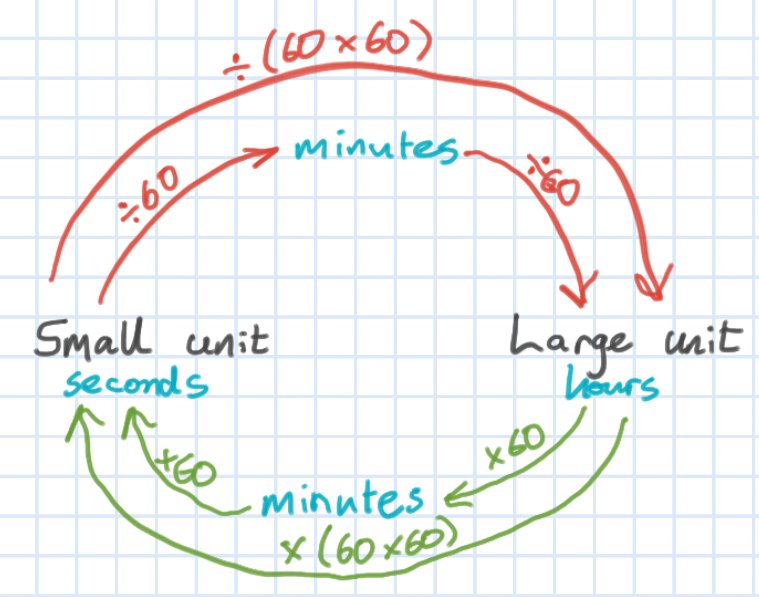
These diagrams may seem trivial, but we must beware of ‘the Curse of Knowledge’: just because we find these conversions easy (and, to be fair, so do many students) that does not mean that all students find them so.
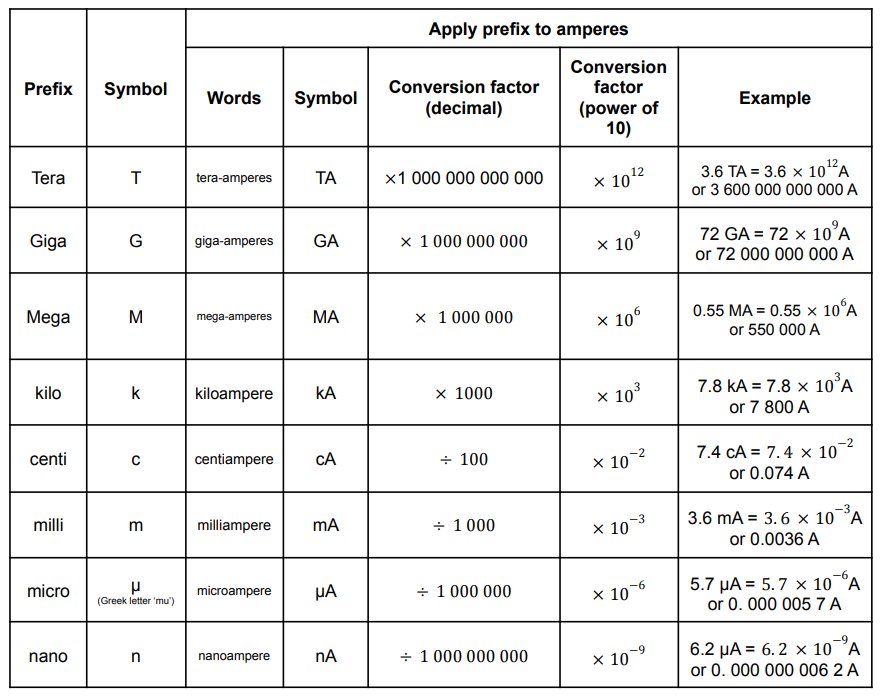
The conversions that students may be asked to do from memory are listed below (in the context of amperes).
The burned hand teaches best. After that, advice about fire goes to the heart.
J. R. R. Tolkein, The Two Towers (1954)
As is often the case in an educational context, and with all due respect to Tolkein, I think Siegfried Engelman actually said it best.
The physical environment provides continuous and usually unambiguous feedback to the learner who is trying to learn physical operations . . .
Siegfried Engelmann and Douglas Carnine, Theory of Instruction (1982)
I am going to outline a practical approach that will help students understand that black objects are good emitters and good absorbers of infrared radiation.
What I propose is a simple, inexpensive and low risk procedure (similar to this one from the IoP) that won’t actually inflict any actual “burned hands” but will, hopefully, through a clever (imho) manipulation of the physical environment, speak directly to the heart — or at least to students’ “sense of mechanism” about how the world works.
Obtain tubes of matt black and white facepaint. (These are typically £5 or less.) Choose a brand that is water based for easy removal and is compliant with EU and UK regulations.
We also need a good source of infrared radiation. Some suppliers such as Nicholl and Timstar can supply a radiant heat source that is safe to use in schools. Although these can be expensive to purchase, there may already be one hiding in a cupboard in your school. If you don’t have one, use a 60W filament light bulb mounted in desk lamp (do not use a fluorescent or LED lamp — they don’t produce enough IR!). Failing that, you could use a raybox with a 24W, 12V filament lamp to act as the infrared source. [UPDATE: Paul Bushen also recommends a more economical option — an infrared heat lamp.)
Use the facepaint to make 2 cm by 2 cm squares on the back of one hand in black and in white on the other. Hold each square up to the infrared source so they are a similar distance from it.
Hold the hands still in front of the source for a set time. This could be anywhere between five seconds and a few tens of seconds, depending on the intensity of the source. You should run through this experiment ahead of time to make sure that there is minimal risk of any serious burns for the time you intend to allocate. If you are using rayboxes then you might need a separate one for each hand.
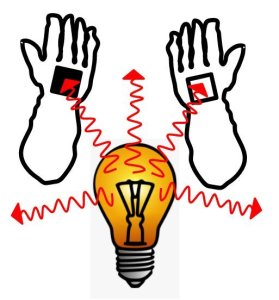
The hand with the black paint becomes noticeably warmer when exposed to infrared radiation. We can deduce that this is because the colour black is better and absorbing the infrared than the white colour.
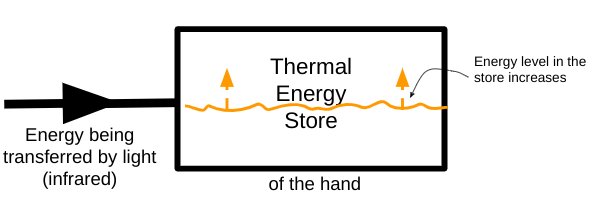
Energy is being transferred via light into the thermal energy store of the hand.
We can use a black painted hand as a rudimentary detector for infrared. The hotter it gets, the more infrared is being emitted.

Fill a Leslie’s cube with hot water from a kettle and then get students to place the hand with the black square a couple of centimetres away from the black face of the cube. After a few seconds, ask them to place the same hand by the white face of the cube. (Although, for the best contrast, you should maybe try the polished silver side). Make sure the student’s hand does not actually touch the face of the Leslie’s cube, otherwise they may end up with an actual burned hand!
The fact that the black face emits more infrared radiation is immediately directly perceivable by the “infrared detector” hand which feels distinctly warmer than when it’s placed next to the black coloured face rather than the white face.
This procedure is, I think, more convincing to many students as opposed to merely using (say) a digital infrared detector and reading off a larger number from the dark side compared to the white side.
It is a thing plainly repugnant . . . to Minister the Sacraments in a Tongue not understanded of the People.
Gilbert, Bishop of Sarum. An exposition of the Thirty-nine articles of the Church of England (1700)
How can we help our students understand physics better? Or, in more poetic language, how can we make physics a thing that is more ‘understanded of the pupils’?
Redish and Kuo (2015: 573) suggest that the Resources Framework being developed by a number of physics education researchers can be immensely helpful.
In summary, the Resources Framework models a student’s reasoning as based on the activation of a subset of cognitive resources. These ‘thinking resources’ can be classified broadly as:
I have previously used aspects of the Resources Framework in my teaching and have found it thought provoking and helpful to my practice. However, the ideas are novel and complex — at least to me — so I have been trying to think of a way of conveniently organising them.
What follows in my ‘first draft’ . . . comments and suggestions are welcome!

The red circle (the longest wavelength of visible light) represents Embodied Cognition: the foundation of all understanding. As Kuo and Redish (2015: 569) put it:
The idea is that (a) our close sensorimotor interactions with the external world strongly influence the structure and development of higher cognitive facilities, and (b) the cognitive routines involved in performing basic physical actions are involved in even in higher-order abstract reasoning.
The green circle (shorter wavelength than red, of course) represents the finer-grained and highly-interconnected Encyclopedic Knowledge cognitive structures.
At any given moment, only part of the [Encyclopedic Knowledge] network is active, depending on the present context and the history of that particular network
Redish and Kuo (2015: 571)
The blue circle (shortest wavelength) represents the subset of cognitive resources that are (or should be) activated for productive understanding of the context under consideration.
A human mind contains a vast amount of knowledge about many things but has limited ability to access that knowledge at any given time. As cognitive semanticists point out, context matters significantly in how stimuli are interpreted and this is as true in a physics class as in everyday life.
Redish and Kuo (2015: 577)
A common preconception held by students is that the summer months are warmer because the Earth is closer to the Sun during this time of year.
The combination of cognitive resources that lead students to this conclusion could be summarised as follows:
Both of these cognitive resources, considered individually, are true. It is their inappropriate selection and combination that leads to the incorrect or ‘Suboptimal Understanding Zone 1’.
To address this, the RF(RGB) suggests a two pronged approach to refine the contextualisation process.
Firstly, we should address the incorrect selection of encyclopedic knowledge. The Earth’s orbit is elliptical but the changing Earth-Sun distance cannot explain the seasons because (1) the point of closest approach is around Jan 4th (perihelion) which is winter in the northern hemisphere; (2) seasons in the northern and southern hemispheres do not match; and (3) the Earth orbit is very nearly circular with an eccentricity e of 0.0167 where a perfect circle has e = 0.
Secondly, the closer-is-warmer p-prim is not the best embodied cognition resource to activate. Rather, we should seek to activate the spread-out-is-less-intense ‘sense of mechanism’ as far as we are able to (for example by using this suggestion from the IoP).
Another common preconception held by students is all waves have similar properties to the ‘breaking’ waves on a beach and this means that the water moves with the wave.
The structure of this preconception could be broken down into:
Considered in isolation, both of these cognitive resources are unproblematic: they accurately describes our everyday, lived experience. It is the contextualisation process that leads us to apply the resources inappropriately and places us squarely in Suboptimal Understanding Zone 2.
The RF(RGB) Model suggests that we can address this issue in two ways.
Firstly, we could seek to activate a more useful embodied cognition resource by re-contextualising. For example, we could ask students to imagine themselves floating in deep water far from the shore: do the waves carry them in any particular direction or simply move them up or down as they pass by?
Secondly, we could seek to augment their encyclopaedic knowledge: yes, the waves on a beach are water waves but they are not typical water waves. The slope of the beach slows down the bottom part of the wave so the top part moves faster and ‘topples over’ — in other words, the water waves ‘break’ leading to what appears to be a rhythmic back-and-forth flow of the waves rather than a wave train of crests and troughs arriving a constant wave speed. (This analysis is over a short period of time where the effect of any tidal effects is negligible.)
Both processes try to ‘tug’ student understanding into the central, optimal zone.
Redish and Kuo (2015: 585) recount trying to help a student understand the varying brightness of bulbs in the circuit shown.

The student said that they had spent nearly an hour trying to set up and solve the Kirchoff’s Law loop equations to address this problem but had been unsuccessful in accounting for the varying brightnesses.
Redish suggested to the student that they try an analysis ‘without the equations’ and just look at the problems in simpler physical terms using just the concept of electric current. Since current is conserved it must split up to pass through bulbs B and C. Since the brightness is dependent on the current, the smaller currents in B and C compared with A and D accounts for their reduced brightness.
When he was introduced to [this] approach to using the basic principles, he lit up and was able to solve the problem quickly and easily, saying, ‘‘Why weren’t we shown this way to do it?’’ He would still need to bring his conceptual understanding into line with the mathematical reasoning needed to set up more complex problems, but the conceptual base made sense to him as a starting point in a way that the algorithmic math did not.
Analysing this issue using the RF(RGB) it is plausible to suppose that the student was trapped in Suboptimal Understanding Zone 3. They had correctly selected the Kirchoff’s Law resources from their encyclopedic knowledge base, but lacked a ‘sense of mechanism’ to correctly apply them.
What Redish did was suggest using an embodied cognition resource (the idea of a ‘material flow’) to analyse the problem more productively. As Redish notes, this wouldn’t necessarily be helpful for more advanced and complex problems, but is probably pedagogically indispensable for developing a secure understanding of Kirchoff’s Laws in the first place.
The RGB Model is not a necessary part of the Resources Framework and is simply my own contrivance for applying the RF in the context of physics education at the high school level. However, I do think the RF(RGB) has the potential to be useful for both physics and science teachers.
Hopefully, it will help us to make all of our subject content more ‘understanded of the pupils’.
Redish, E. F., & Gupta, A. (2009). Making meaning with math in physics: A semantic analysis. GIREP-EPEC & PHEC 2009, 244.
Redish, E. F., & Kuo, E. (2015). Language of physics, language of math: Disciplinary culture and dynamic epistemology. Science & Education, 24(5), 561-590.

Are physics teachers following the Way of the Sith? Are we all crossing over to the Dark Side when we talk about ‘series circuits’ and ‘parallel circuits’?
I think that, without meaning to, we may be presenting students with what amounts to a false dichotomy: that all circuits are either series circuits or parallel circuits.
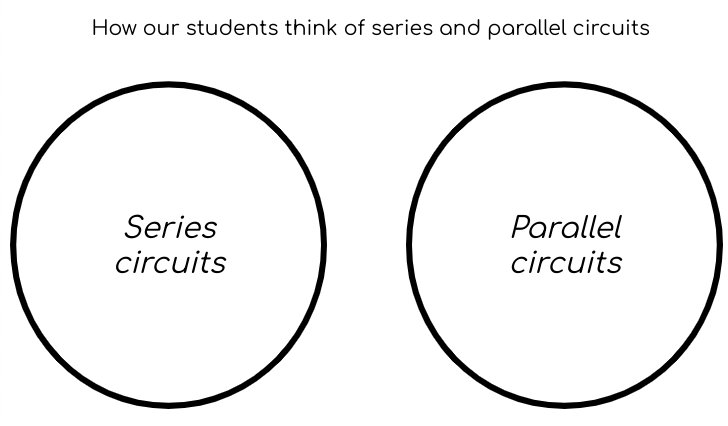
The actual situation is more like this:

The confusion may stem from our usage of the word ‘circuit’: are we referring holistically to the entire assemblage of components (highlighted in red) or the individual ‘complete circuits’ (highlighted in green and blue)?

I think we should always refer to components in series or components in parallel rather than ‘series circuits’ or ‘parallel circuits’.
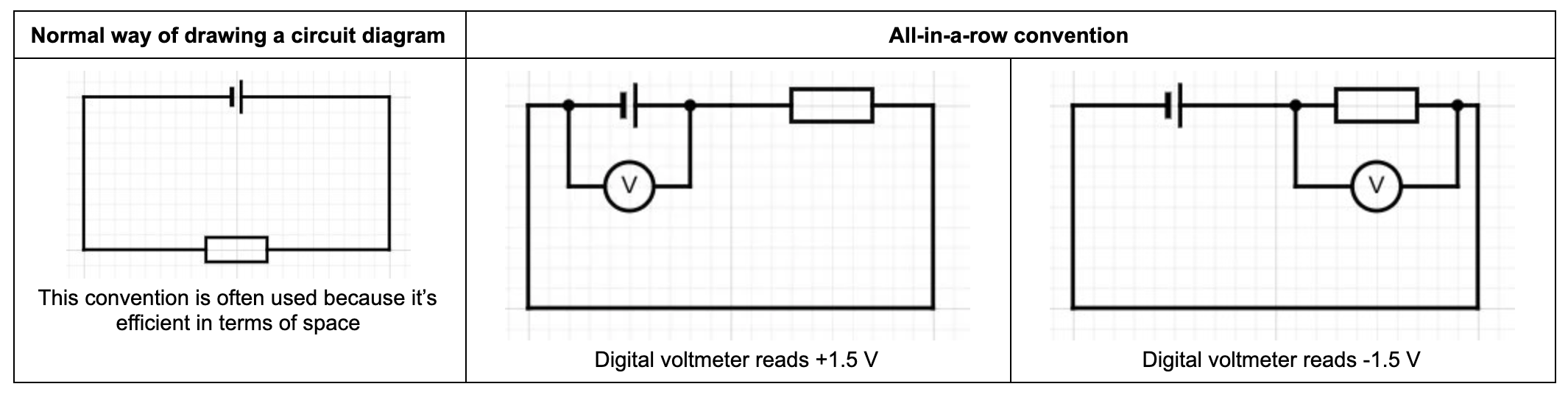
I’ve written before about what I think is the confusing ‘hidden rotation’ present in normal circuit diagrams. I find redrawing circuit diagrams using the ‘all-in-a-row’ convention useful for explaining circuit behaviour. For simplicity, we’ll assume that all the resistors in the diagrams that follow have a resistance of one ohm.
This can be shown using the Coulomb Train Model like this (coulombs pictured as moving clockwise):
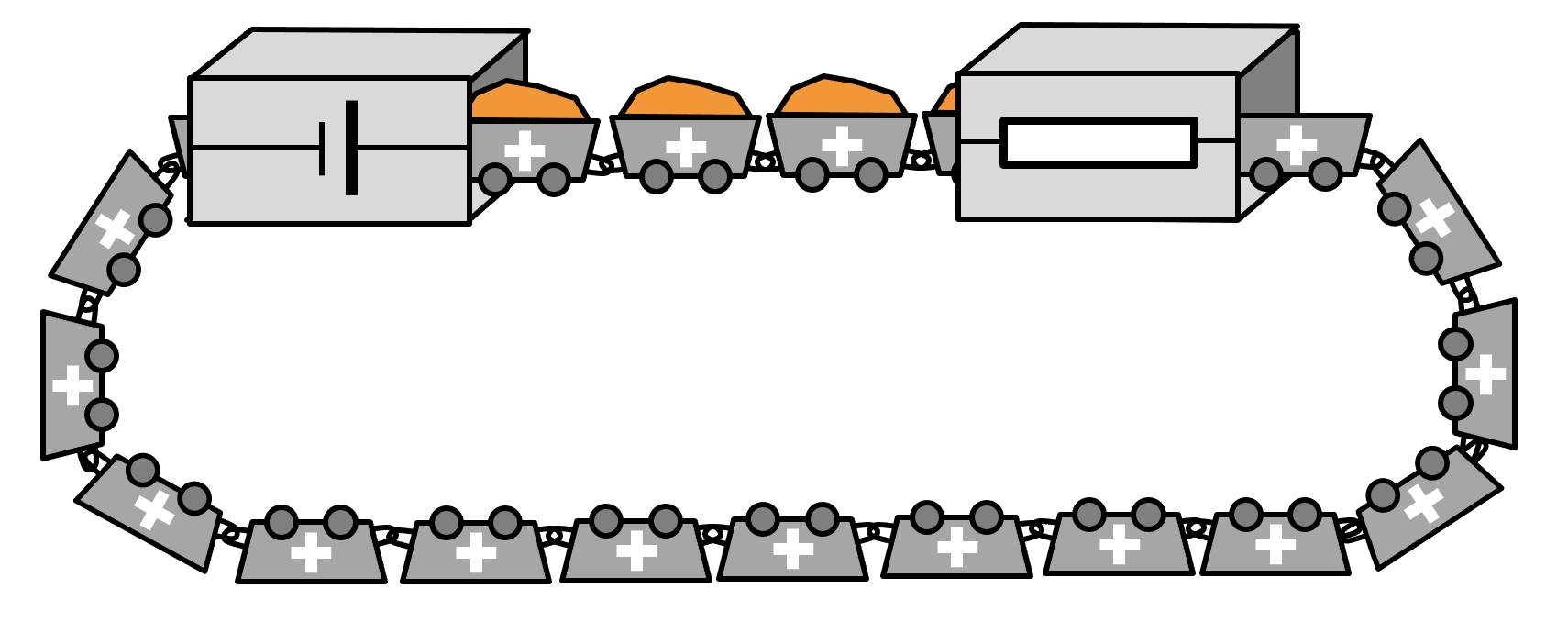
The current passing through the resistor using I = V/R = 1.5 V / 1 = 1.5 amperes.
Now let’s apply this convention when two resistors are in parallel.

This can be represented using the Coulomb Train Model like this:

I think it’s far clearer that ammeter W is measuring the total current in the circuit while X and Y are measuring the ‘part-current’ passing through R1 and R2 using this convention. (Note: we are assuming that each resistor has a resistance of one ohm.)
Each resistor has a potential difference of -1.5 V because 1.5 J of energy is being shifted from each coulomb as they pass through each resistor.
Also, it is clearer that the cell’s chemical energy store is being drained more quickly when there are two resistors in parallel: two coulombs have to be filled with 1.5 J of energy for each one coulomb in the single resistor circuit.
Thinking about current, the total current in the circuit is 3.0 amperes; so the resistance R = V / I = 1.5 / 3.0 = 0.5 ohms. So two resistors in parallel have a smaller resistance than a single resistor — this is a result that is well worth emphasising for students as so many of them find this completely counterintuitive!

This circuit can be represented using the Coulomb Train Model like this:
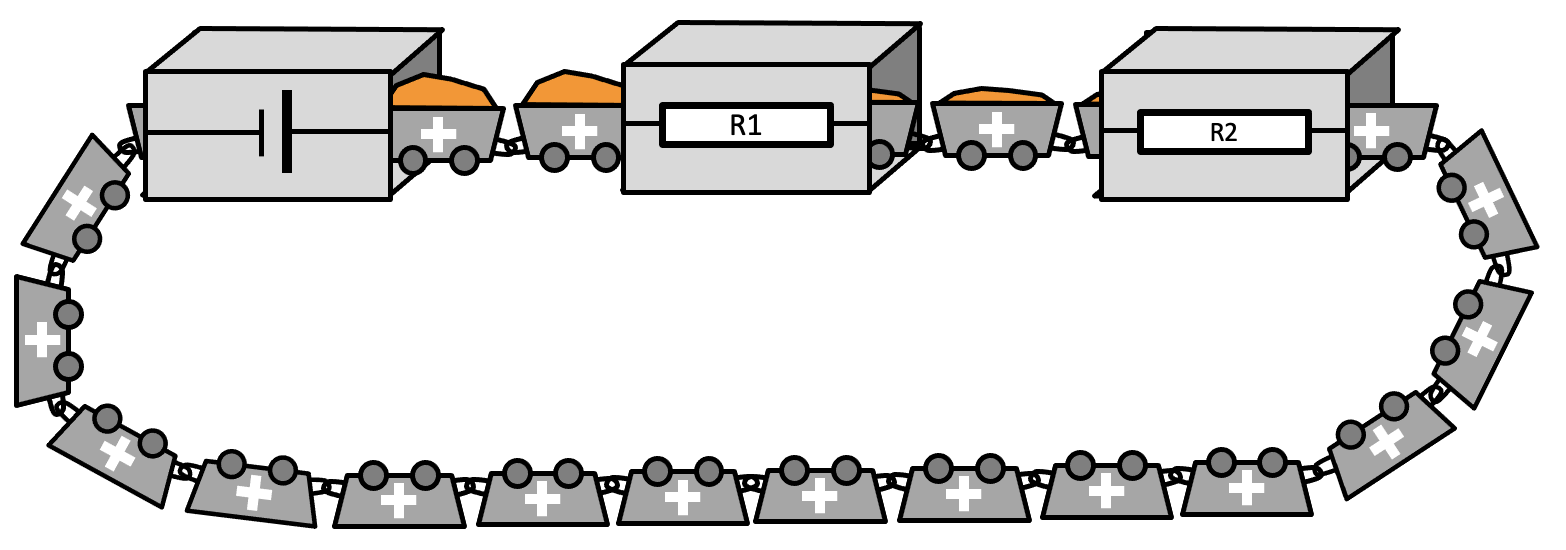
The pattern of potential difference can be explained by looking at the orange ‘energy levels’ carried by each coulomb.
A current of one amp is one coulomb passing per second, so we can see that an ammeter reading would have the same value wherever the ammeter is placed in the circuit.
But look closely at R1: it only has 0.75 V of potential difference across. From I = V/R = 0.75 / 1 = 0.75 amperes.
This means that the total resistance of the circuit from R = V/I is, of course, 2 ohms.
I regret to say that I have probably been teaching ‘series circuits’ and ‘parallel circuits’ on autopilot for much of my career; the same may even be true of some readers of this blog(!)
The Coulomb Train Model has been considered in depth in previous blogs, but I think it’s a good model to encourage students to use their physical intuition (aka ’embodied cognition’) to understand electric circuits.
Whether you agree with the suggested outlines above or not, I hope that it has given you some fruitful food for thought.

