Applying Lenz’s Law

Nature abhors a change of flux.

D. J. Griffiths’ (2013) genius re-statement of Lenz’s Law, modelled on Aristotle’s historically influential but now debunked aphorism that ‘Nature abhors a vacuum’

A student recently asked for help with this AQA A-level Physics multiple choice question:

AQA A-level Physics question from 2019 Paper 2

This question is, of course, about Lenz’s Law of Electromagnetic Induction. The law can be stated easily enough: ‘An induced current will flow in a direction so that it opposes the change producing it.’ However, it can be hard for students to learn how to apply it.

What follows is my suggested explanatory sequence.

Step 1: simplify the diagram using the ‘dot and cross’ convention

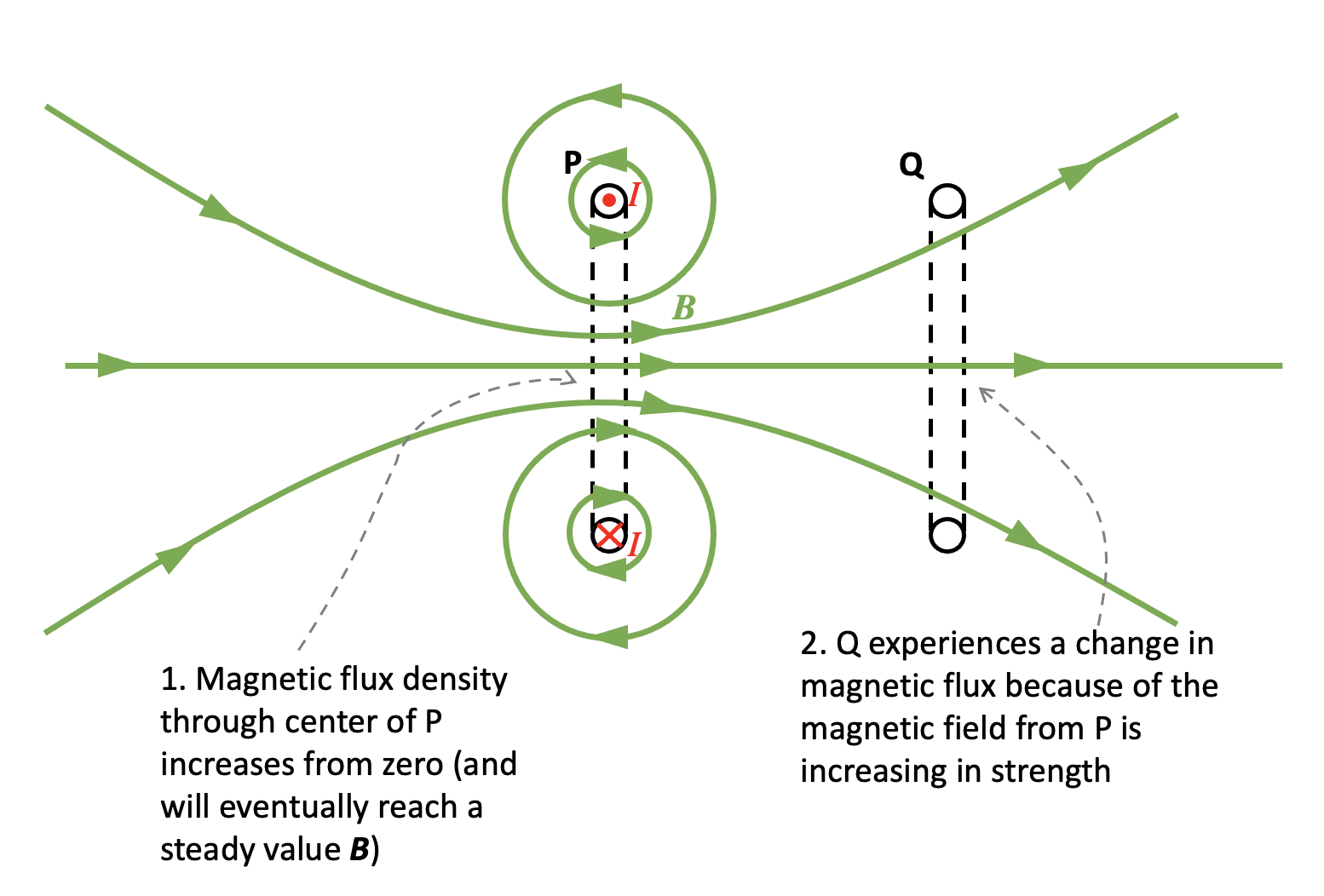
When the switch is closed, a current I begins to flow in coil P. We can assume that I starts at zero and increases to a maximum value in a very small but not negligible period of time.

Simplified 2D representation of the top diagram. The current directions I are arbitrary based on my ‘best guess’ interpretation of the 3D diagram and could be reversed if desired.

Step 2: consider the magnetic field produced by P
You can read more about a simple method of deducing the direction of the magnetic field produced by a coil or a solenoid here.

Step 3: apply Faraday’s Law to coil Q

Since Q is experiencing a change in magnetic flux, then an induced current will flow through it.

Step 4: apply Lenz’s Law to coil Q

The current in coil Q must flow in such a direction so that it opposes the change producing it.
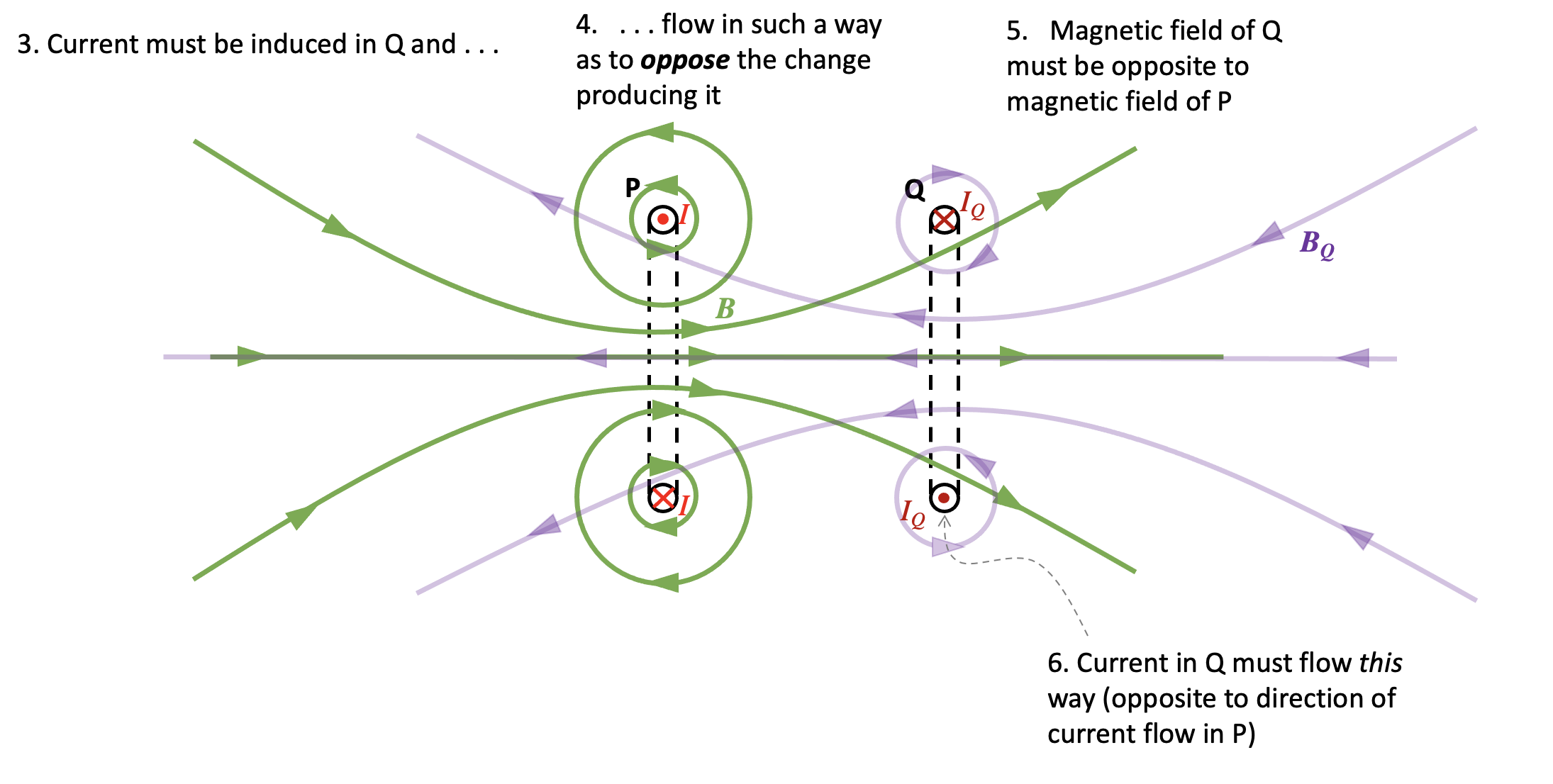
Since P is producing an increasing magnetic flux through Q, then the current in Q must flow in such a way so that it tries to prevent the increase in magnetic flux which is inducing it. The direction of the magnetic field BQ produced by Q must therefore be opposite to the direction of the magnetic field produced by P.

Step 5: consider the polarity of the magnetic fields of P and Q
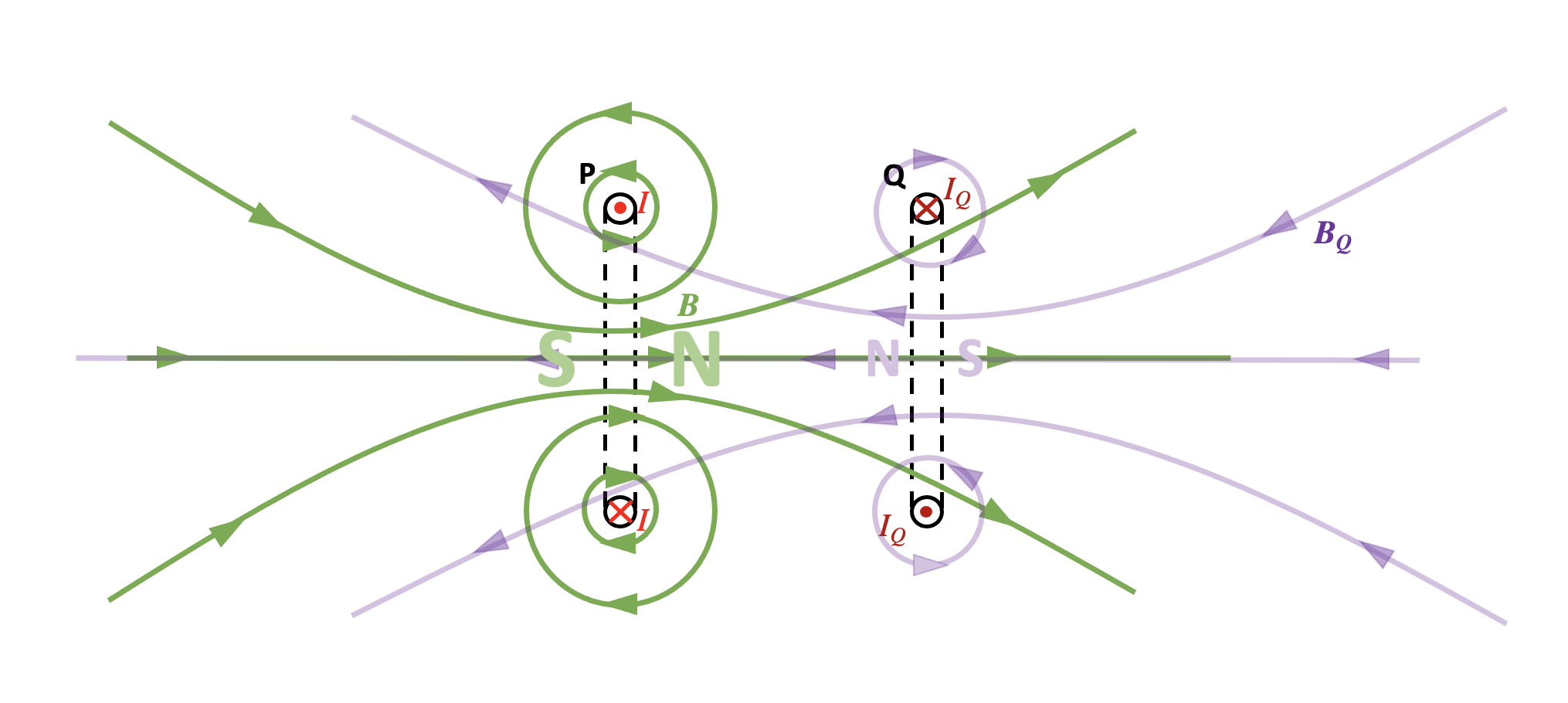
We can see the magnetic field lines of coil P produce a north magnetic field on its right hand side. The magnetic field of Q will produce a north magnetic field on its left hand side. Coil P will therefore push coil Q to the right.

It follows that we can eliminate options A and C from the question.

Step 6: What happens when the magnetic field of P reaches its steady value?
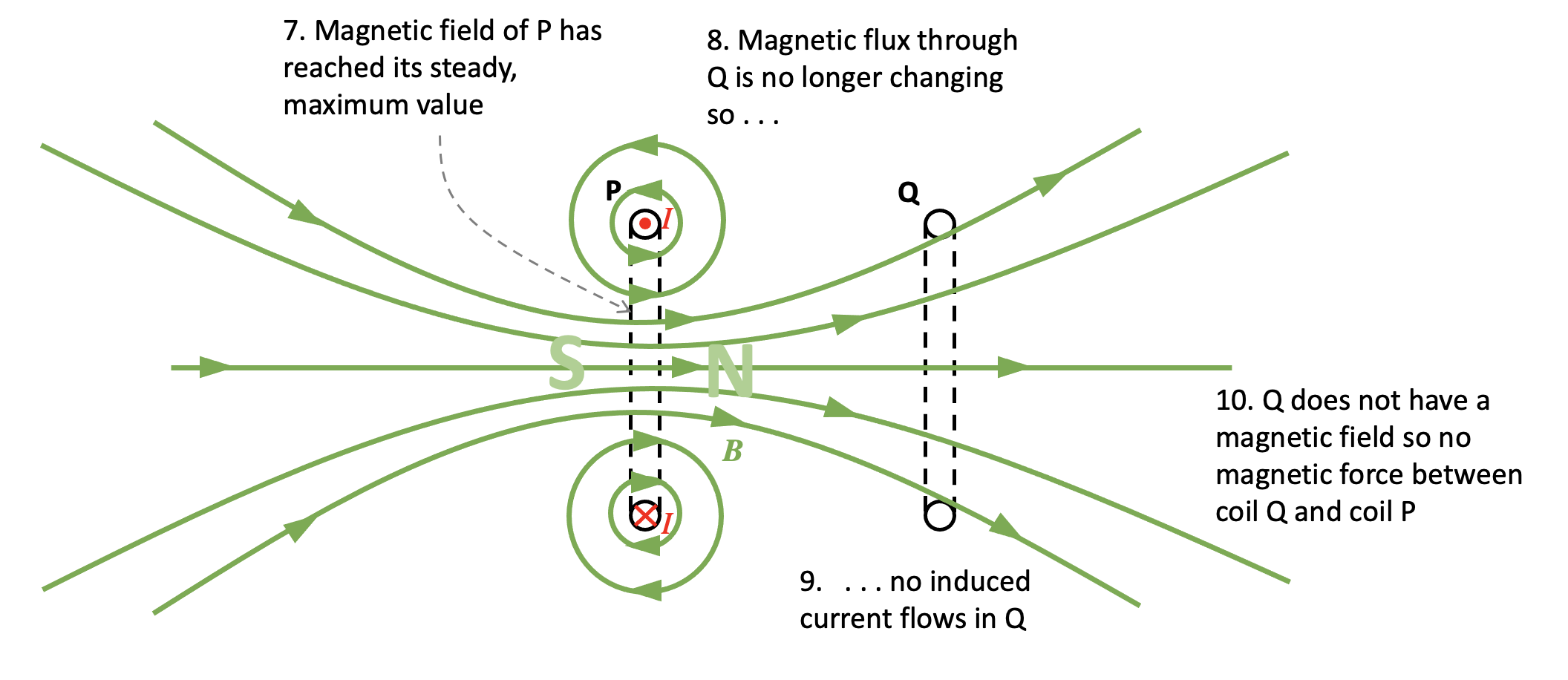
Because the magnetic field produced by coil P has how reached its steady maximum value, this means that the magnetic flux through coil Q also has a constant, unchanging value. Since there is no change in magnetic flux, then this means that no emf is induced across the coil so no induced current flows. Since Q does not have a magnetic field it follows that there is no magnetic interaction between them.

The answer to the question must therefore be D.

Step 7: check student understanding

For the alternative question, the correct answer of C can be explained by going through a process similar to the one outlined above.

  • When the switch is opened, the magnetic flux through Y begins to decrease.
  • A changing magnetic flux through Y induces current flow.
  • Lenz’s Law predicts that the direction of this current is such that it opposes the change producing it.
  • The current through Y will therefore be in the same direction as the current through X to produce a magnetic field in the same direction.
  • The coils will attract each other.
  • Eventually, the magnetic flux produced by coil X drops to a constant value of zero.
  • Since there is no change in magnetic flux through Y, there is no induced current flow through Y and hence no magnetic field.
  • There is no magnetic interaction between X and Y and therefore the force on Y is zero.

Conclusion

I hope teachers find this detailed analysis of a Lenz’s Law question useful! As in much of A-level Physics, the devil is not in the detail but rather in the application of the detail. Students who encounter more examples will have a more secure understanding.

Reference

Griffiths, David (2013). Introduction to Electrodynamics. p. 315.

The worst circuit in the world (part 2)

What is the worst circuit in the world? Many teachers think it is the one below.

This is the circuit that AQA (2018: 47) strongly suggest should be used to capture the data for plotting IV characteristics (aka current against potential difference graphs) for a fixed resistor, a filament lamp and a diode. The reasons why it is ‘the worst circuit in world’ were outlined in part one; and also some reasons why, nonetheless, schools teaching the 2016 AQA GCSE Physics / Combined Science specifications should (arguably) continue to use it.

The procedure outlined isn’t ‘perfect’ but works well using the equipment we have available and enables students to capture (and plot using a FREE Excel spreadsheet!) the data with only minor troubleshooting from the teacher.

Step the first: ‘These are the graphs you’re looking for.’

I find this required practical runs more smoothly if students have some awareness of what kind of graphs they are looking for. So, to borrow a phrase, I usually just tell ’em.

You can access an unannotated version of the slides on Google Jamboard and pdf below.

Step the second: capture the data for the fixed resistor

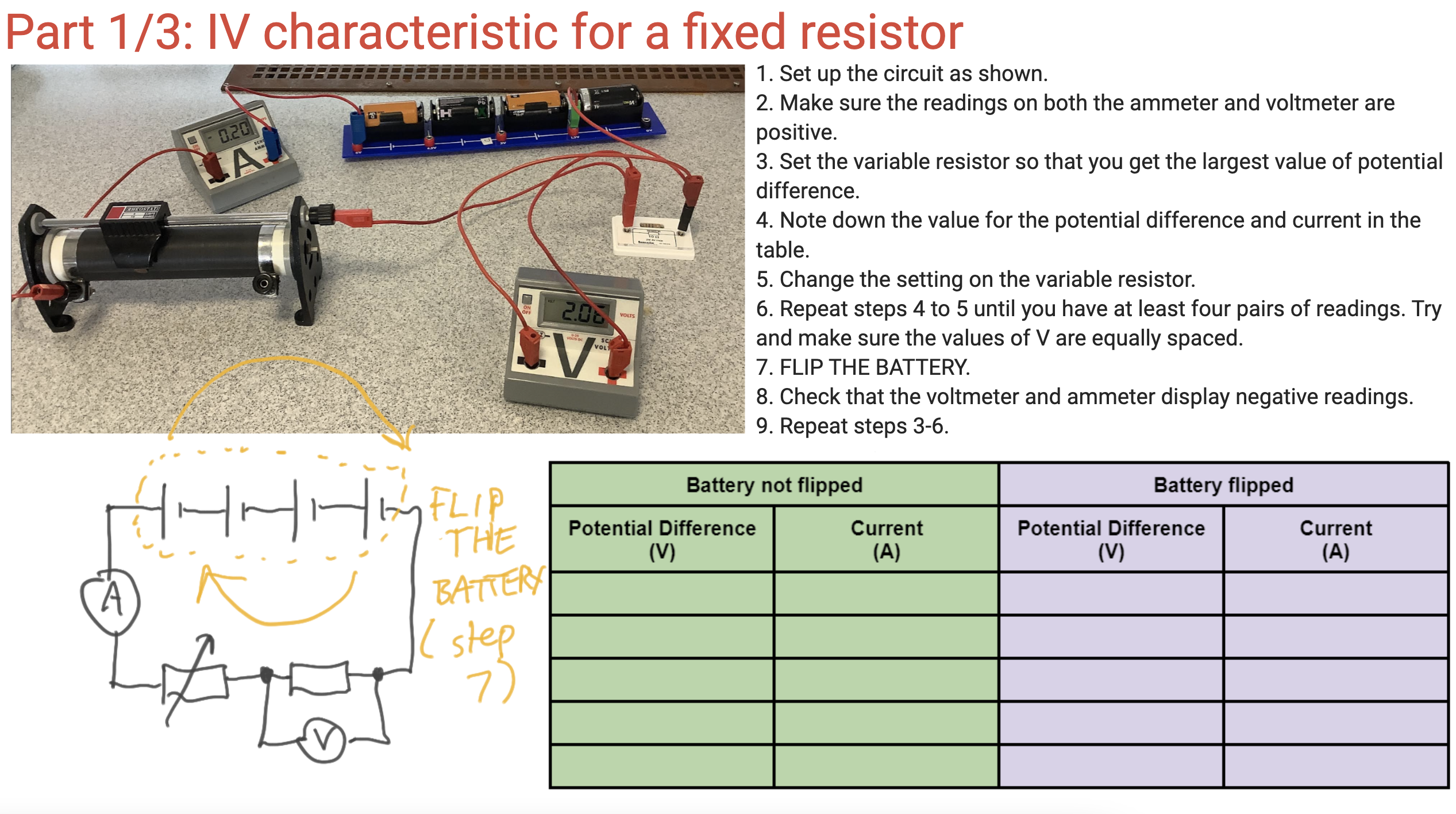
It is a continual source of amazement to me that students seem to find a photograph of a circuit easier to interpret than a nice, clean, minimalist circuit diagram, so for an easier life I present both.

You can, if you have access to ICT, get the students to plot their results ‘live’ on an Excel spreadsheet (link below). I think this is excellent for helping to manage the cognitive demand on our students (as I have argued before here). Please note that I have not used the automated ‘line of best fit’ tools available on Excel as I think it is important for students to practice drawing lines of best fit — including, especially, curved lines of best fit (sorry, Maths teachers, in science there are such things as curved lines!)

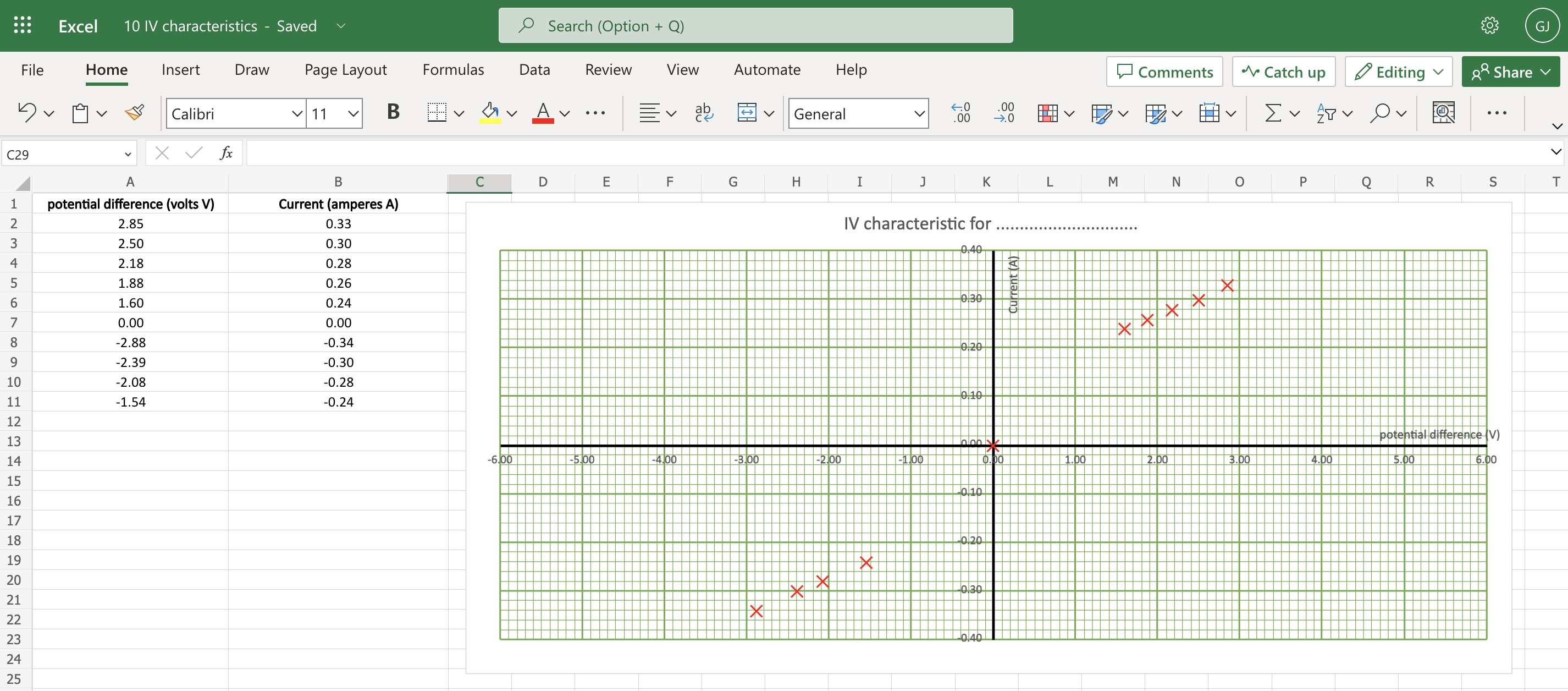
Results for a fixed resistor from a typical group of students. These results are clearly consistent with a straight line of best fit going through the origin. However, they can be criticised for not being evenly spaced across the range — but this is a limitation of using the ‘worst circuit in the world’ and, happily(!), gives the students something to write about in their evaluation.

Step the second: capture the data for the filament lamp

In this circuit, we replaced the previous 0-16 ohm variable resistor with a 0 – 1000 ohm variable resistor paired with 2.5 V, 0.2 A filament lamp because the bulb has a resistance of about 60 ohms when run at 2.5 V and so the 0-16 ohm variable resistor is often ineffective. We allowed a maximum potential difference of just over 3.0 V to ‘over run’ the bulb so as to be sure of obtaining the ‘flattening’ of the graph. The method calls for very small adjustments of the variable resistor to obtain noticeable changes of brightness of the bulb. Note that the cells used in the photograph had seen many years of service with our physics department(!) and so were fairly depleted such that three of them were needed to produce a measly three volts; you would likely only need two ‘fresher’, ‘newer’ cells to achieve the same.

These are the results obtained by a typical student group. The results are clearly consistent with the elongated ‘S’ shaped curve predicted from theory. The results can be criticised for clustering, but this can be addressed by students in their evaluation of the experiment.

Step the third (sub-parts a and b): capturing the data for a diode

Results for diode captured by a group of students following the procedure outlined above.

Resources

Click here to get a clean copy of the Google Jamboard.

You can download a clean pdf of the slides here:

You can download the Excel spreadsheet used to plot the graphs here:

And, by popular request, a copy of the PowerPoint below (although, trust me, I think Google Jamboard is superior when using ‘live’ in front of a class)

REFERENCES

AQA (2018). Practical Handbook: GCSE Physics. Retrieved from https://filestore.aqa.org.uk/resources/physics/AQA-8463-PRACTICALS-HB.PDF on 7/5/23

‘Isn’t it ionic?’: Showing the circular motion of charged particles in magnetic fields in the school laboratory

Charged particles which are stationary within a magnetic field do not experience a magnetic force; however, charged particles which are moving within a magnetic field most definitely do. And, what is more, this magnetic force or Lorentz force always makes them move on circular paths or semicircular paths. (Note: for simplicity we’re only going to look at particles whose velocity is perpendicular to the magnetic field lines in this post.) The direction of the Lorentz force can be predicted using Fleming’s Left Hand Rule.

An understanding of this type of interaction is essential for A-level Physics as far the physics of particle accelerators and cyclotrons are concerned. It is, of course, desirable to be able to demonstrate this to our students in the school laboratory. Your school may be lucky enough to own an electron beam tube and a pair of Helmholtz coils that is the usual way of displaying this phenomenon.

Bob Worley (@UncleBo80053383) recently made me aware of a low cost, microscale chemistry demonstration that I believe shows this phenomenon to good effect. If the electrolysis of sodium sulfate is carried out over a strong neodymium magnet then the interaction between the electric and magnetic fields creates clear patterns of circulation that are consistent with the directions predicted by the movement of the ions within the electric field produced by the electrodes and the Fleming’s Left Hand Rule force on the ions produced by the external magnetic field.

Please note that in the following post, any errors, omissions or misconceptions are my own (especially with the chemistry ‘bits’).

Why do charged particles move on circular paths when they travel through magnetic fields?

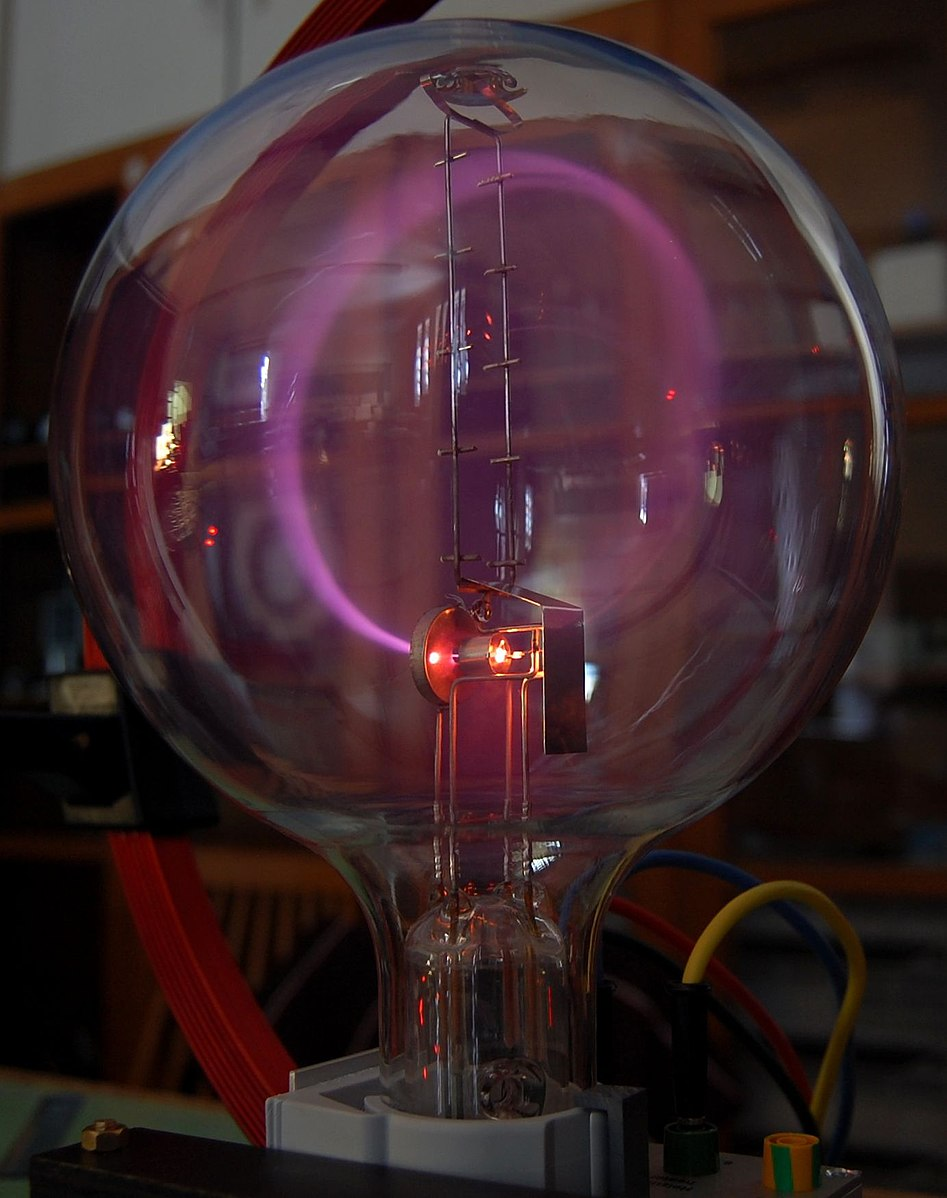
An electron beam tube. The electron beam is being made to move on a circular path by an external magnetic field.

In the diagram below, the green area represents a region of uniform magnetic flux density B. The field lines are directed into the plane of the diagram. Let’s consider an electron (1) fired at a horizontal velocity v from an electron gun as shown.

Fleming’s Left Hand Rule predicts that an upward force F will be produced on the electron. (Remember that the current in FLHR is conventional current so the ‘I’ finger should be pointed in the opposite direction to v because electron have a negative charge!) This will alter the direction of v so that the electron moves to position (2). Note that the magnitude of v is unaltered since F is acting at right angle to it. In position (2), FLHR again predicts a force F will act on the moving electron, and this force will again be at right angles to v resulting in the electron moving to position (3). Since the magnitude of v remains unaltered and F is always perpendicular to it, this means that F acts as a centripetal force which means that the electron travels at uniform speed around a circular orbit of radius r.

It can be shown that r = mv/Bq where m is the mass of the particle and q is its charge.

Setting up the electrolysis of sodium sulfate in a magnetic field

Electrolysis of sodium sulfate influenced by a magnet (side view)

The equipment is set up as shown in the diagram above. This can be seen from 0:00 to 0:10 seconds on the video. The magnetic field produced by the magnet can be thought of as a uniform vertical field through the volume of the drop.

Next, a few drops of red litmus are added. Since the sodium sulfate solution is neutral, the red litmus does not change colour.

At 0:15 seconds, the electrodes are introduced to the solution. Note that the anode is on the left and the cathode is on the right.

Observing the circular motion of charged particles in a magnetic field (part 1)

Almost immediately, we see indicator change colour next to the cathode. Since sodium sulfate is a salt produced using a reactive metal and an acid containing oxygen, the electrolysis will result in hydrogen gas at the cathode and oxygen at the anode. In other words, water will be electrolysed.

At the cathode, water molecules will be reduced to form H2 and OH.

It is the OH ions that produce the colour change to purple.

From 0:23 to 0:27 we can clearly an anticlockwise circulation pattern in the purple coloured region.

This can be explained by considering the forces on an OH ion as shown on the diagram below.

Electrolysis of sodium sulfate under the influence of a magnetic field (plan view)

As soon as it is created, the OH ion will be repelled away from the cathode along an electric field line (blue dotted lines). This means that it will be moving at a velocity v at the instant shown. However, due to the external magnetic field B it will also be subject to a Lorentz force F as shown (and whose direction can be predicted using Fleming’s Left Hand Rule) which will make it move on an anticlockwise circular path.

Because of the action of the electric field, the magnitude of v will increase meaning that that radius of circulation r of the OH ion will increase. This means that OH ion will travel on an anticlockwise spiral path of gradually increasing radius, as observed. This is analogous to paths followed by charged particles in a cyclotron.

Observing the circular motion of charged particles in a magnetic field (part 2)

At 0:29 seconds, we observe a second circulation pattern. We see the purple coloured solution begin a clockwise circulation around the anode.

This is because the OH ions gradually move towards the anode and eventually will begin moving at a radial velocity v towards it as shown. Fleming’s Left Hand Rule predicts a Lorentz force F will act on the ion as shown which means that it will move on a clockwise circular path.

The video from 0:30 to 0:35 shows at least some the ions moving on clockwise spiral path of decreasing radius. This is most likely because the magnitude of v of a number of ions is decreasing. The mechanism which produces this decrease of v is unknown (at least to me) but it seems plausible to suppose that a large number of OH ions arriving in the smaller region around the anode might produce a ‘traffic jam’ that would reduce the mean velocity of the ions here.

Conclusion

I hope physics teachers find this demonstration as useful and intriguing as I do. Please leave a comment if you decide to use it in your physics classroom. Many thanks to Bob Worley for posting the fascinating video!

Gravitational potential: the ‘bottom of a hole’ perspective

The surface of Mars imaged by NASA’s Curiosity rover in 2013

April 20, 2112: The sky is flat, the land is flat, and they meet in a circle at infinity. No star shows but the big one, a little bigger than it shows through most of the [asteroid] Belt, but dimmed to red, like the sky. It’s the bottom of a hole, and I must have been crazy to risk it. […] The stars are gone, and the land around me makes no sense. Now I know why they call planet dwellers ‘flatlanders’. I feel like a gnat on a table. I’m sitting here shaking, afraid to step outside. […] I’M AT THE BOTTOM OF A LOUSY HOLE!

Larry Niven, ‘At The Bottom of a Hole’ (1966)

Redish and Kuo (2015: 586) suggest that tapping into our students’ innate physical intuitions can be a very productive teaching strategy. For example, Redish observed some physics instructors teaching non-physics majors how to interpret a potential energy U against the separation r between particles graph (diagram 8(a) below).

From Redish and Kuo (2015)

The students were finding it difficult to answer the question of whether the particles would attract or repel each other when they had energy E and were at a separation of C. Redish noted that the instructors advised the students to consider the derivative of the curve at C (diagram 8(b) above) and, since it had a positive gradient, to surmise that the force between the particles would therefore be attractive since F=-dU/dr. Redish suggested:

A more effective approach for this population might be to begin with an embodied analogy and implicitly supporting epistemologies valuing physical intuition. Start with treating a potential energy curve as a track or hill and, using the analogy of gravitational potential energy, then place a ball on the hill as shown in Fig. 8c.

Redish and Kuo (2015)

Which way would the ball roll in 8(c) roll? Redish said that the students had no problem deducing that the particles would exert an attractive force on each other at C (and a repulsive force when their energy is E at the smaller value of r) after using this analogy.

Using students’ physical intuitions to help understand gravitational potential

The episode outlined above reminded me of a science fiction story by Larry Niven that I had read many years ago. In ‘At the Bottom of a Hole’, Niven imagined what landing on a planet would feel like to a ‘Belter’; that is to say, to a human being who had spent their entire life navigating between the small worlds of the asteroid Belt: small planetoid-sized worlds whose shallow gravitational fields required only a low-intensity burn for a spaceship to slip free of their influence forever. An extract from the story is quoted as an introduction to this post: in essence, the ‘Belter’ who has lived his life voyaging between the low mass and low gravity worldlets of the asteroid belt finds it emotionally and psychologically disturbing to find himself at the bottom of a deep gravitational hole.

Gravitational Fields are always ‘holes’

Gravitational fields are always holes (unlike electric fields, of course, which can be either ‘holes’ or ‘mountains’; this may well form the basis of a later post).

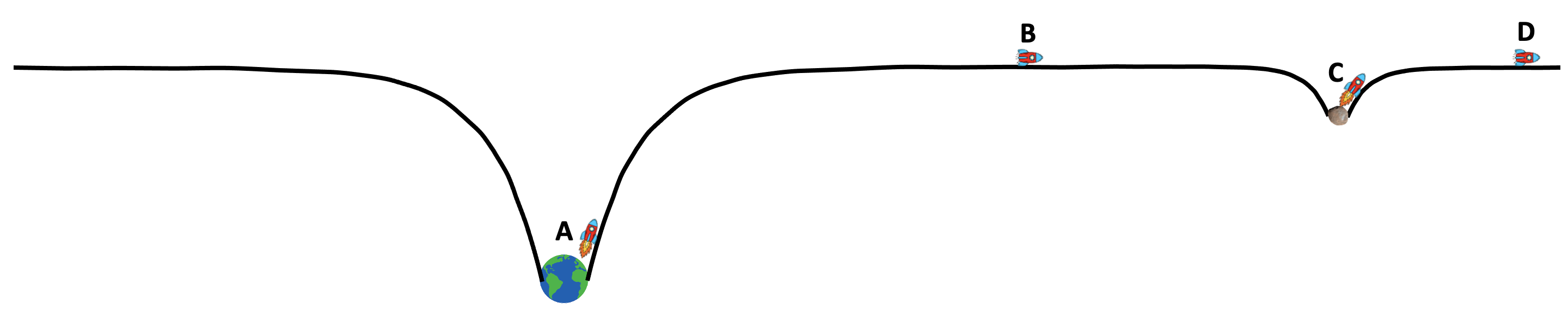
The mass of the Earth produces a much deeper gravitational hole than the much smaller mass of an asteroid.

As a consequence, a spaceship near the Earth’s surface (A) needs to burn a lot more fuel (i.e. do a lot more work) to completely escape the gravitational influence of the Earth (B) then a spaceship near to the surface of an asteroid. The spaceship closer to the asteroid (C) needs a much smaller burn to completely escape its gravitational influence (D).

To a mature space-faring civilisation, living on the surface of a planet could well be likened (and seem as eccentric) as living at the bottom of a spectacularly deep hole.

Gravitational potential

The gravitational potential of an object of mass M is given by:

where G is the Gravitational Constant and r is the displacement from the centre of mass of the object. The units of V would be joules per kilogram J/kg.

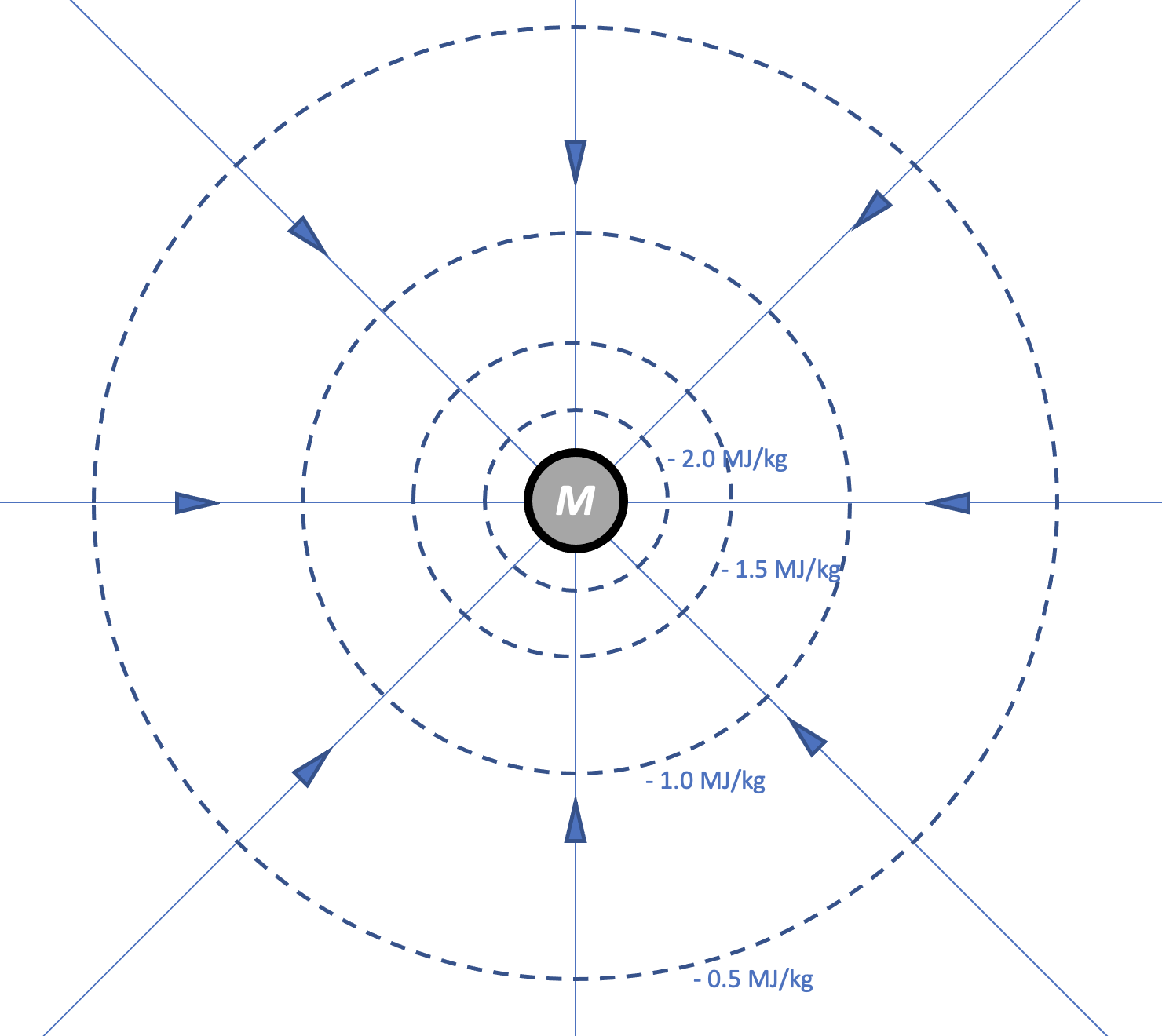
Note that the magnitude of V gets larger as r decreases. This allows us to represent a gravitational field in terms of equipotential lines (dotted on the diagram below) as well as field lines (solid).

Modelling gravitational potential as a three dimensional hole

We can engage our own and our students’ physical intuitions by picturing the equipotential lines as being contour lines indicating the depth of a three dimensional hole.

An object represented as a ball at position A will not tend to roll down into the hole since there is no discernible downhill ‘slope’ at A; in effect, as r tends towards infinity then the object is beyond the effects of M’s gravity. A position outside the gravitational field of a massive object has a gravitational potential of zero.

Let’s think about what happens as r decreases until the object is at B. Here we can intuitively surmise that it will experience a small force tending to make it fall deeper into the hole. How much work will the gravitational field have done moving an object from infinity to this position? The answer is, of course, 0.5 MJ for each kilogram of mass.

How much work will be done by the gravitational field moving the object from B to C? The answer is again an extra 0.5 MJ/kg but note that this happens over a much smaller change in r than before because the gravitational field is becoming more intense. Again, we can intuit that the object will experience a stronger gravitational force at C than at B.

We can go on to argue that a similar pattern of behaviour will also occur at D and E.

But the real value of this representation is, in my opinion, helping students understand how much energy a body needs to escape the influence of a gravitational field.

If we start at B, we would have to do 0.5 MJ/kg of work on it to make it escape. In other words, it needs 0.5 MJ/kg to climb out of the hole.

If we started at C, then we would need 1.0 MJ/kg; and D, 1.5 MJ/kg and so on.

If we were considering a spacecraft operating in the vacuum of space, then transferring 2.0 MJ/kg of kinetic energy would allow ot to completely escape the gravitational influence of M; or, in other words, to reach a value of r such that its gravitational potential is zero.

Near the Earth’s surface where r = 6.38 x 10⁶ m, the gravitational potential can be calculated as follows:

That is to say, a body would need to gain 64.4 MJ of kinetic energy for each kilogram of its mass to completely escape from the influence of the Earth’s gravity.

We can therefore calculate the escape velocity for a body near the Earth surface as follows:

As I mentioned above, I think the real power of this way of tapping into physical intuition for understanding fields comes when we use it to represent electric fields. I will cover that in a later post.

Reference

Redish, E. F., & Kuo, E. (2015). Language of physics, language of math: Disciplinary culture and dynamic epistemologyScience & Education24, 561-590.