The worst circuit in the world

“The most miserable latch that’s ever been designed in the history of mankind or before.”

Astronaut Jack R. Lousma commenting on some equipment issues during the NASA Skylab 3 mission (July to September 1973), quoted in Cooper 1976: 41

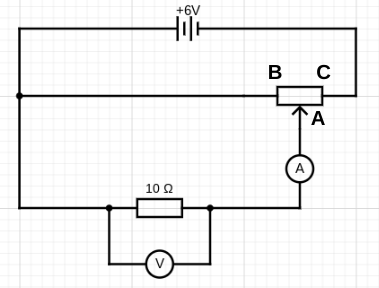
What does the worst circuit that’s ever been designed in the history of humankind or before look like? Without further ado, here it is:

‘But wait,’ I hear you say, ‘isn’t this the circuit intended for obtaining the data for plotting current-potential difference characteristic curves as recommended by the AQA exam board in their GCSE Physics and GCSE Combined Science specifications?’ (AQA 2018: 47)

Sadly, it is indeed.

Why is ‘the standard test circuit’ a *bad* circuit?

The point of this required practical is to get several paired readings of potential difference across a component and the current through a component to enable us to plot a graph (aka ‘characteristic’) of current against potential difference. Ideally, we would like to start at 0.0 volts across the resistor and measure the current at (say) 1.0, 2.0, 3.0, 4.0, 5.0 and 6.0 volts. That is to say, we would like to treat the potential difference as the independent variable and adjust it in consistent, regular increments.

Now let’s say we use a typical school rheostat such as the one shown below as the variable resistor in series with the 10 ohm resistor. The two of them will behave as a potential divider circuit (see here and here for posts on this topic).

The resistance of the variable resistor can be varied between 0 and 16 ohms by moving the slider. When the slider is at A it will have the maximum resistance of 16 ohms and zero when it is at C, and in-between values at any other point.

A typical school rheostat. To use as a simple variable resistor, connect only terminals A and C into the circuit. (Please note: using terminals B and C will make it behave as a fixed resistor.)

When the slider is at C, the 10 ohm resistor gets the full potential difference from the supply and so the voltmeter will read 6.0 V and the ammeter will read (using I=V/R) 6.0 / 10 = 0.6 amps.

When the slider is at A, the total resistance of the circuit is 10 + 16 = 26 ohms so the ammeter reading (again using I=V/R) will be 6.0/26 = 0.23 amps. This means that the voltmeter reading (using V=IR) will be 0.23 x 10 = 2.3 volts.

This means that the circuit as presented will only allow us to obtain potential differences between a minimum of 2.3 V and a maximum of 6.0 V across the component by moving the slider between B and C, which is less than ideal.

‘It is a far, far better circuit that I build than I have ever built before…’

It is a far, far better thing that I do, than I have ever done.

Charles Dickens, ‘A Tale of Two Cities’
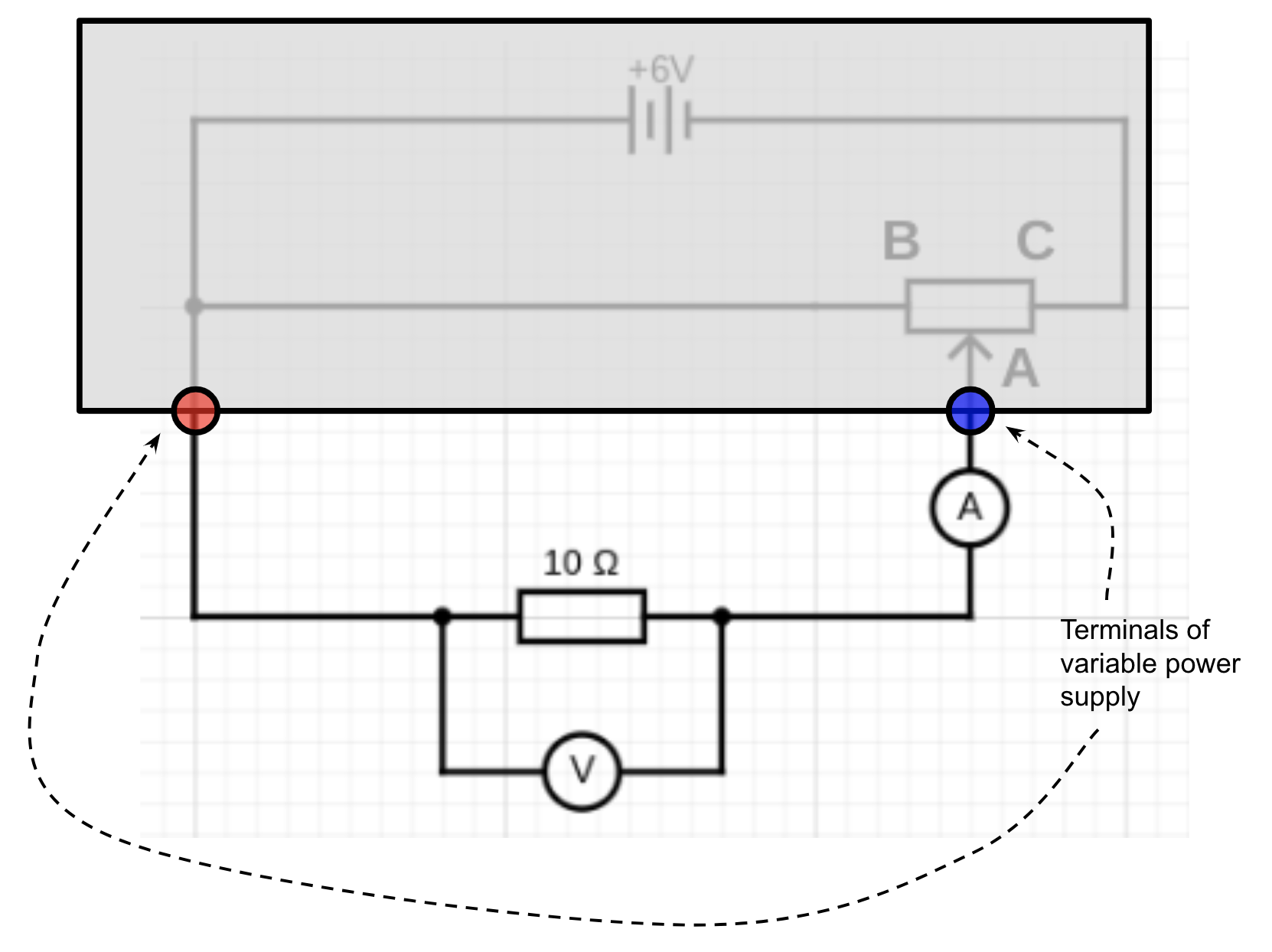
This circuit is a far better one for obtaining the data for a current-potential difference graph. This is because we can access the full 0.0 V to 6.0 V of the supply simply by adjusting the position of the rheostat slider. The rheostat is being used as a potential divider in this circuit rather than as a simple variable resistor.

When the slider is at B, the voltmeter will read 0.0 V and the current through the 10 ohm resistor will be 0.0 amps. A small movement of the slider from B towards C will increase the reading of the voltmeter to (say) 1.0 V and the ammeter would read 0.1 A. Further small movements of the slider will gradually increase the potential difference across the resistor until it reaches the full 6.0 V when the slider is at C.

A-level Physics students are expected to be able to use this circuit and enumerate its advantages over the ‘worst circuit in the world’.

And, to be fair, AQA do suggest a workaround that will allow GCSE student to side-step using ‘the worst circuit in the world’:

If a lab pack is used for the power supply this can remove the need for the rheostat as the potential difference can be varied directly. The voltage should not be allowed to get so high as to damage the components, check the rating of the components you plan to suggest your students use.

AQA 2018: 16

A ‘lab pack’ i.e. a power supply with a variable output potential difference

If this method is used, then in effect you would be using the ‘built in’ rheostat inside the power supply.
So why not use the superior potential divider circuit at GCSE?

The arguments in favour of using ‘the worst circuit in the world’ as opposed to the more fit for purpose potential divider circuit are:

  1. The ‘worst circuit in the world’ is (arguably) conceptually easier than the potential divider circuit, especially if students have not studied series and parallel circuit before. This allows more freedom in sequencing when IV characteristics are taught.
  2. A fuller range of potential differences can be accessed even using the ‘worst circuit in the world’ if the maximum value of the variable resistor is much larger than the resistance of the component. For example, if we used a 0 – 1 kilo-ohm variable resistor in series with the 10 ohm resistor then very fine adjustments of the variable resistor would allow a suitable range of potential difference to be applied across the component.
  3. Students are often asked direct questions about the ‘worst circuit in world’.
Question from AQA Paper 1 (2021) where students who have used ‘the worst circuit in the world’ for their investigation would (imo) have an advantage over those that have not.

In the next post, I will outline how I introduce and teach this required practical — using, to my shame, ‘the worst circuit in the world’ — and also supply some useful resources.

You can read part 2 here.

REFERENCES

AQA (2018). Practical Handbook: GCSE Physics. Retrieved from https://filestore.aqa.org.uk/resources/physics/AQA-8463-PRACTICALS-HB.PDF on 7/5/23

Cooper, H. S. F. (1976). A House In Space. New York: Bantam Books

We all adore Caloric

We all adore a Kia-Ora

Advertising slogan for ‘Kia-Ora’ orange drink (c. 1985)

Energy is harder to define than you would think. Nobel laureate Richard Feynman defined ‘energy’ as

a numerical quantity which does not change when something happens. It is not a description of a mechanism, or anything concrete; it is just a strange fact that we can calculate some number and when we finish watching nature go through her tricks and calculate the number again, it is the same. […] It is important to realize that in physics today, we have no knowledge of what energy is. […] It is an abstract thing in that it does not tell us the mechanism or the reasons for the various formulas.

Feynman Lectures on Physics, Vol 1, Lecture 4 Conservation of Energy (1963)

Current secondary school science teaching approaches to energy often picture energy as a ‘quasi-material substance’.

By ‘quasi-material substance’ we mean that ‘energy is like a material substance in how it behaves’ (Fairhurst 2021) and that some of its behaviours can be modelled as, say, an orange liquid (see IoP 2016).

The eight energy stores as suggested by the IoP

And yet, sometimes these well-meaning (and, in my opinion, effective) approaches can draw some dismissive comments from some physicists.

The Simpsons Comic Book Guy character saying "Picturing energy as a quasi-material substance? That teaching approach smacks of the oh-so-discredited 'Caloric' theory of energy to me . . ."
The Simpsons’ Comic Book Guy weighs in the ‘Teaching Energy’ debate

What was the ‘Caloric Theory of Energy’?

To begin with, there was never a ‘Caloric Theory of Energy’ since the concept of energy had not been developed yet; but the Caloric Theory of Heat was an important step along the way.

Caloric was an invisible, weightless and self-repelling fluid that moved from hot objects to cold objects. Antoine Lavoisier (1743-1794) supposed that the total amount of caloric in the universe was constant: in other words, caloric was thought to be a conserved quantity.

Caloric was thought to be a form of ‘subtle matter’ that obeyed physical laws and yet was so attenuated that it was difficult to detect. This seems bizarre to our modern sensibilities and yet Caloric Theory did score some notable successes.

  • Caloric explained how the volume of air changed with temperature. Cold air would absorb caloric and thus expand.
  • The Carnot cycle which describes the maximum efficiency of a heat engine (i.e. a mechanical engine powered by heat) was developed by Sadi Carnot (1796-1832) on the basis of the Caloric Theory

Why Caloric Theory was replaced

It began with Count Rumford in 1798. He published some observations on the manufacturing process of cannons. Cannon barrels had to be drilled or bored out of solid cylinders of metal and this process generated huge quantities of heat. Rumford noted that cannons that had been previously bored produced as much heat as cannons that were being freshly bored for the first time. Caloric Theory suggested that this should not be the case as the older cannons would have lost a great deal of caloric from being previously drilled.

The fact that friction could seemingly generate limitless quantities of caloric strongly suggested that it was not a conserved quantity.

We now understand from the work James Prescott Joule (1818-1889) and Rudolf Clausius (1822-1888) that Caloric Theory had only a part of the big picture: it is energy that is the conserved quantity, not caloric or heat.

As Feynman puts it:

At the time when Carnot lived, the first law of thermodynamics, the conservation of energy, was not known. Carnot’s arguments [using the Caloric Theory] were so carefully drawn, however, that they are valid even though the first law was not known in his time!

Feynman Lectures on Physics, Vol 1, Lecture 44 The Laws of Thermodynamics

In other words, the Caloric Theory is not automatically wrong in all respects — provided, that is, it is combined with the principle of conservation of energy, so that energy in general is conserved, and not just the energy associated with heat.

We now know, of course, that heat is not a form of attenuated ‘subtle matter’ but rather the detectable, cumulative result of the motion of quadrillions of microscopic particles. However, this is a complex picture for novice learners to absorb.

Caloric Theory as a bridging analogy

David Hammer (2000) argues persuasively that certain common student cognitive resources can serve as anchoring conceptions because they align well with physicists’ understanding of a particular topic. An anchoring conception helps to activate useful cognitive resources and a bridging analogy serves as a conduit to help students apply these resources in what is, initially, an unfamiliar situation.

The anchoring conception in this case is students’ understanding of the behaviour of liquids. The useful cognitive resources that are activated when this is brought into play include:

  • the idea of spontaneous flow e.g. water flows downhill;
  • the idea of measurement e.g. we can measure the volume of liquid in a container; and
  • the idea of conservation of volume e.g. if we pour water from a jug into an empty cup then the total volume remains constant.

The bridging analogy which serves as a channel for students to apply these cognitive resources in the context of understanding energy transfers is the idea of ‘energy as a quasi-material substance’ (which can be considered as an iteration of the ‘adapted’ Caloric Theory which includes the conservation of energy).

The bridging analogy helps students understand that:

  • energy can flow spontaneously e.g. from hot to cold;
  • energy can be measured and quantified e.g. we can measure how much energy has been transferred into a thermal energy store; and
  • energy does not appear or disappear: the total amount of energy in a closed system is constant.

Of course, a bridging analogy is not the last word but only the first step along the journey to a more complete understanding of the physics involved in energy transfers. However, I believe the ‘energy as a quasi-material substance’ analogy is very helpful in giving students a ‘sense of mechanism’ in their first encounters with this topic.

Teachers are, of course, free not to use this or other bridging analogies, but I hope that this post has persuaded even my more reluctant colleagues that they need a more substantive argument than a knee jerk ‘energy-as-substance = Caloric Theory = BAD’.


References

Fairhurst P. (2021), Best Evidence in Science Teaching: Teaching Energy. https://www.stem.org.uk/sites/default/files/pages/downloads/BEST_Article_Teaching%20energy.pdfhttps://www.stem.org.uk/sites/default/files/pages/downloads/BEST_Article_Teaching%20energy.pdf [Accessed April 2022]

Hammer, D. (2000). Student resources for learning introductory physicsAmerican Journal of Physics68(S1), S52-S59.

Institute of Physics (2016), Physics Narrative: Shifting Energy Between Stores. Available from https://spark.iop.org/collections/shifting-energy-between-stores-physics-narrative [Accessed April 2022]