Never Mind The Data, Feel The Noise (or, seek the signal, young Jedi)

Everyone in education loves data.

image
This is the only time it is correct to use the word "Data" in the singular...

Or at least claims to. One sometimes wonders what would happen to the UK education system if a computer virus disabled every Excel spreadsheet overnight — h’mmm, perhaps someone should get in touch with those nice hacker people at Anonymous . . .

image

However, I digress. I wanted to share a recent epiphany that I’d had about data, particularly educational data. Perhaps it’s not much of an epiphany, but I’ve started so I’ll finish.

It came when I was listening to an interview on the evergreen The Jodcast (a podcast produced by the Jodrell Bank Radio Observatory). Dr Alan Duffy was talking about some of the new technologies that need to be invented in order to run the new massive Square Kilometre Array radio telescope (due to begin observing in 2018):

And then we have to deal with some of the data rates . . . essentially we recreate all of the information that exists on the internet today, and we do that every year without fail, it just keeps pouring off the instrument. And what you’re looking for is the proverbial needle in the haystack . . . how do you pick out the signal that you’re interested in from that amount of data?
The Jodcast, October 2014, 18:00 – 21:00 min approximately [emphasis added]

The realisation that hit me was: it isn’t the data that should be centre stage — it’s the signal that’s contained within that data. And that signal can be as hard to find as the proverbial needle in a haystack, even without data volumes that are multiples of the 2014 Internet.

A simple example from the history of science: Edwin Hubble’s famous graph from 1929 that was one of the first pieces of evidence that we exist in an expanding universe. The data are the difficult and painstaking measurements made by Hubble and his colleague Vesto Slipher that are plotted as small circles on the graph.

image

The signal is the line of best fit that makes sense of the data by suggesting a possible relationship between the variables. Now, as you can see, not all the points lie on, or even close, to the line of best fit. This is because of noise — random fluctuations that affect any measurement process. Because Hubble and Slipher were pushing the envelope of available technology at the time, their measurements were unavoidably ‘noisy’, but they were still able to extract a signal, and that signal has been both confirmed and honed over the years.

In my experience, when the dread phrase “let’s look at the data” is uttered in education, the “search for a signal” barely extends beyond simplistic numerical comparisons: increase=doubleplus good, decrease=doubledoubleplus ungood.

The way we use currently use data in schools reminds me of SF author William Gibson’s coining of the term cyberspace (way back in the pre-internet 1980s) as the
 

consensual hallucination experienced daily by billions of legimate operators . . . a graphic representation of data abstracted from the banks of every computer in the human system
— William Gibson, Neuromancer (1984)

In my opinion, almost the whole statistical shebang associated with UK education, from the precipitous data-mountains of the likes of RAISEOnline (TM) to the humblest tracking spreadsheet for a department of one, is actually nothing more than a ‘consensual hallucination’.

The numbers, levels and grades mean something because we say they mean something. And sometimes, it is true, they can tell a story.

Let’s say a student has variable test scores in one subject over a few months: does this tell us something about the child’s actual learning, or about possible inconsistencies in the department’s assessment regime, or about the child’s teachers?

My point is that WE DON’T KNOW without cross referencing other sources of information and using — wait for it — professional judgement.

I believe that the search for a signal should be central to any examination of data, and that this is best done with a human brain through the lens of professional experience. And, given the inevitability of noise and uncertainty in any measurement process, with a generous number of grains of statistical salt.
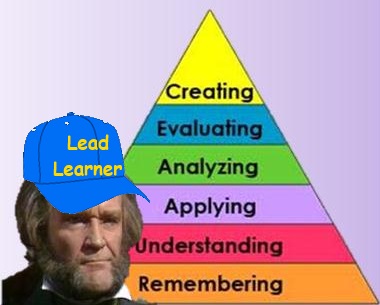
Why Mr Gradgrind, Thou Art Updated!

Why, Mr, Gradgrind, thou art updated!

“NOW, what I want is, Skills. Teach these boys and girls nothing but Skills. Skills alone are wanted in life. Plant nothing else, and root out everything else.” Mr Gradgrind paused for a moment.

“And when I say ‘teach’ what I really mean is ‘facilitate’. This is the principle on which I bring up my own children, and this is the principle on which I bring up these children. Stick to Skills, sir!’ The scene was a plain vault of a school-room, decorated only with the multicoloured pyramid of Bloom’s Taxonomy on the far wall which the speaker’s square forefinger emphasized silently by pointing, in the approved “talk-less” neo-Gradgrindian manner.

“In this life, we want nothing but Higher Level Thinking, sir; nothing but Analysis, Evaluation and Creativity!” The speaker and the second grown person present both swept with their eyes the knots of little vessels then and there arranged in groupwork PowerTalk Circles (TM), ready to have imperial gallons of Conceptual Understanding facilitated into them until they were full to the brim, or at least until their personalised learning objectives could be self-actualized and triple cross-checked by peer assessment.

“Girl number twenty,” said Mr. Gradgrind, squarely pointing with his square forefinger, “as a starter, please go to the flipchart and analyse and evaluate what the concept of ‘horse’ means in the 21st Century within the context of productive economic citizenship. Please make full use of all the colours available to delineate your thought-clusters. You have two minutes.” Sissy Jupe blushed nervously but gamely walked over to the flipchart stand. Mr Gradgrind started a countdown timer on the interactive whiteboard.

The pips sounded and Sissy stepped away from the flipchart. She had drawn a picture of a horse. It was actually quite a good picture although it was wearing a hat and smiling in a decidedly unhorselike way. She had written “Dobbin is a quadruped” in very neat handwriting at the bottom.

Mr Gradgrind refrained from commenting with some difficulty. “Suggestions?”

A hand went up. “She should use the word ‘because’ in every sentence to encourage higher level thinking skills?”

“Yes, but . . .” conceded Mr Gradgrind , walking over the flipchart and putting a big red circle around the word quadruped. “More suggestions? Yes, Bitzer?”

“The sentence containing the word quadruped is a statement of a merely factual nature, sir,” said Bitzer, pulling a sour face as the word ‘factual’ left his mouth.

“Precisely!” roared Gradgrind . He turned towards the class. “And why should we bother to remember things when–”

“–we can look it up on Google!” chorused the class. Poor Sissy Jupe looked crestfallen.

“Bitzer, show us how its done.” The whey-faced lad tapped away on his iPad.

“Sir, horses are not quadrupeds! It says here on Wikipedia that they’ve got five legs.”

“One cannot always trust Wikipedia, boy!”

“The article was updated not seven and a half minutes ago by a contributor called Professor LOLZ, sir!”

Gradgrind gave Sissy Jupe a significant look. “Analysis, Evaluation and Creativity — that’s how its done! Consider: (1) the article is recent and up-to-date; (2) it’s written by an academic; and (3) Lolz sounds a bit German and they are a jolly efficient nation with an education system that is higher in the PISA rankings than ours! QED. Well done there, Bitzer!”

Sissy Jupe looked puzzled.”But . . . horsies have four legs, don’t they?”

Gradgrind warmed to one of his favourite themes: “In the fuddy-duddy old twentieth century, perhaps horsies did have four legs. But in the twenty-first century, are you going to rely on what your brain tells you or what the internet says? Shift happens. There’s going to be a lot of Chinese and Indian people about, some of them quite clever. Big numbers. Lots of new words and job titles with the word digital in them. Twenty-first century skills, sort of thing. Shift happens..”

Gradgrind became uncomfortably aware that his precis wasn’t having the same impact as the ‘Shift happens’ Youtube video itself usually did. “Consider, young Sissy,” he said, changing tack, “the skills of 21st century equestrianism are likely to be vastly different from the skills of 20th century equestrianism. If you had learned to ride a twentieth century horse, would you still be able to ride a twenty-first century horse?”

“Erm . . . yes?” offered Sissy, hesitantly.

“Of course not! You see, that’s why we’re not teaching you any stuff that might change in the near- to medium-term future, because that would be silly, wouldn’t it? Instead, we’re teaching you skills that will last a lifetime, like using internet browsers and how to use keyboard shortcuts on proprietary software to cut-and-paste. Because those skills will NEVER become obsolete, you mark my words!”

The second adult in the room, the normal class teacher, stepped forward, shaking his head in admiration. Speechlessly, he removed his mortar board and handed it over to Mr Gradgrind . Mr Gradgrind acknowledged the gesture with a grave and courteous inclination of the head, before throwing that tired old symbol of traditional teaching into the nearest wastebasket.

He drew two baseball caps from his pocket — they both had the words ‘Lead Learner’ embroidered upon them — and both of them reverently donned them. From somewhere, the opening bars of Mr Boombastic blared as they got on with chillin’ wid da kidz.

Sissy Jupe sighed and opened her book and started reading quietly: it had been a close run thing, but just for a minute there it had seemed as if someone was actually going to teach her something…

The Twelve Physics Pracs of Gove (Part Two)

A true-devoted pilgrim is not weary
To measure kingdoms with his feeble steps

–William Shakespeare, The Two Gentlemen of Verona


A picture [of reality]  . . .  is laid against reality like a measure  . . .   Only the end-points of the graduating lines actually touch the object that is to be measured  . . .   These correlations are, as it were, the feelers of the picture’s elements, with which the picture touches reality.

–Ludwig Wittgenstein, Tractatus-Logico-Philosophicus 2.141-2.1515


What they say of disc jockeys is also true of teachers: that someone, somewhere will remember some of your words forever; or, at least, for the duration of their lifetime. The downside is, of course, that you never know which of your words are going to be remembered. The wittily-crafted, near-Wildean aphorism pregnant with socratic wisdom — probably not. The unintentionally hilarious malapropism that makes you sound like a complete plonker — almost certainly.

To this day, I still remember Dr Prys’ sharp and appropriate response to a flippant comment (possibly from the callow 6th form me) about whether the scientific constants listed in the data book were truly trustworthy: “Look,” he said, “people have dedicated their whole lives to measuring just one of these numbers to one extra decimal place!” True devoted pilgrims indeed, mapping out the Universe step by tiny step, measurement by measurement.

I have written before on what I consider to be the huge importance of practical work in Physics education. Without hands-on experience of the hard work involved in the process of precise measurement, I do not believe that students can fully appreciate the magnificent achievement of the scientific enterprise: in essence, measurement is how scientific theories “touch” reality.

I am encouraged that parts of this view seem to be shared by the writers of the Subject Content guidance. (All hail our Govean apparatchik overlords!)

Of course, this has to be balanced with the acknowledgement that (as I understand it at least) teacher-assessed practical work will no longer count towards a student’s final exam grade. Many are concerned that this is actually a downgrading of the importance of practicals in Science and thus a backward step.

Sadly, they may turn out to be right: “We have to have this equipment for the practical/controlled assessment!” will no longer be a password for unlocking extra funding from recalcitrant SLTs (and from the exam budget too — double win!)

And, undoubtedly, some “teach-to-the-test” schools will quietly mothball their lab equipment (except for the showy stuff — like the telescope that no-one knows how to use — that they bring out for prospective pupil tours).

That would be sad, and although the DfE have, to be fair, nailed their pro-practical colours to the mast, we all know that the dreaded Law of Unintended Consequences may have the last laugh.

I would say it all depends on how the new A levels are actually put together. I will be attending some “launch events” in the near future. I will blog on whether I think we can expect an Apollo 11 or an Apollo 13 at that time.

In the meantime, I will be setting practicals galore as usual, as I’m old-fashioned enough to think that they give a lovely baroque feel to a scheme of work…

Look at me, I design coastlines, I got an award for Norway. Where’s the sense in that? None that I’ve been able to make out. I’ve been doing fiords all my life, for a fleeting moment they become fashionable and I get a major award. In this replacement Earth we’re building they’ve given me Africa to do, and of course, I’m doing it will all fjords again, because I happen to like them. And I’m old fashioned enough to think that they give a lovely baroque feel to a continent. And they tell me it’s not equatorial enough…
–Slartibartfast, from The Hitch-Hikers Guide to the Galaxy by Douglas Adams

image

The Twelve Physics Pracs of Gove (Part One)

It’s not often that a DfE publication makes me feel like Kent Brockman, the newsreader from The Simpsons.

I’d like to remind them that as a trusted TV personality, I can be helpful in rounding up others to toil in their underground sugar caves.
Kent Brockman: “I, for one, welcome our new insect overlords.”

This feeling stems from reading the “Use of apparatus and techniques – physics” section from the DfE’s April 2014 Subject Content for AS and A level Biology, Chemistry, Physics and Psychology publication (p.23).

I had the rather novel feeling that it’s actually a sound list: and I, for one, welcome this intervention from our Govean-apparatchik overlords.

Why do I welcome this? Well, I feel that all too often we lose sight of the fact that, at its heart, Physics is, and must remain, a practical subject, the foundation of so much of the modern world.

Miroslav Holub’s poem “A Brief Reflection on Accuracy” paints a haunting and disturbing picture of what could be described as an entirely postmodernist, deconstructed and relativist (rather than relativistic) universe:

A certain soldier

    had to fire a cannon at six o’clock sharp every evening.

    Being a soldier he did so. When his accuracy was

    investigated he explained:

I go by

    the absolutely accurate chronometer in the window

    of the clockmaker down in the city.

   [ . . . ]

Oh, said the clockmaker,

    this is one of the most accurate instruments ever. Just imagine,

    for many years now a cannon has been fired at six o’clock sharp.

    And every day I look at this chronometer

    and always it shows exactly six.

[ . . . ]

So much for accuracy.
And fish move in the water, and from the skies
comes a rushing of wings while

Chronometers tick and cannons boom.

Without the grounding supplied by the art and science of measurement, I believe that we would all inhabit a castle-in-the-air universe as outlined above by Holub (whose experiences as an immunological research scientist are said to have influenced much of his poetry).


Is Holub’s nightmarish scenario even a remote possibility? Would we ever be in a world where “chronometers tick and cannons boom” but no-one actually checks the actual time by, say, looking out of the window to see if it’s daylight or not?

As with most nightmares, it’s probably closer than you think: “The sleep of reason brings forth monsters” as Goya suggested, and the steps that produce the monsters are often small, seemingly-harmless compromises of apparently little consequence.

One of my Y13 students, who has been attending a number of interviews for Physics courses, reports that some university departments have told him that “We spend a lot of the first year teaching students how to write formal laboratory reports as we find many of them have not learned how to do this during their A level courses.

Whaaa-aat? I nearly fell off my lab stool when Sam* told me this. In my opinion, that is unconscionable. “Oh, yeah,” Sam went on, “some of the students there said things like ‘Oh, our A level course content makes it unsuitable for practical teaching’.”


Opinions like that, if they genuinely reflect the views of the schoolteachers involved, are steps on the road to bringing forth monsters. Of course, it may not seem like a big deal to either the students or the teachers who are probably following what they see as a reasonable path of little resistance. But it is a big deal, it really is.

“And what did you say, Sam?” I asked.

“I said that we do a formal write up with a full analysis of experimental uncertainties every lesson.”

“Do we, Sam? Every lesson? Really?”
“Yeah, well,” said Sam with a smile, “I lied about that, didn’t I?”

“Exaggerated, Sam. I think you mean exaggerated.”

“Whatever you say, sir,” said Sam.

More on the 12 pracs of Gove in a later post..

* not his real name

The Metaphor of Progress

Whatever anybody says, time is most definitely not money.

Time is space.

Let me explain: the language we use to describe and reason about time uses space and (more exactly) movement as a metaphor.

We may picture ourselves journeying through time, where we are physically moving toward the future; perhaps like a passenger on board a train: “We’ll soon reach the end of the month”, or “It’ll be a long time before I reach retirement age.”

train 1

Alternatively, we may picture ourselves as standing still and time moving past us; perhaps like a person standing on a platform watching a train go by: “Christmas will soon be here”, or “The examination season will soon be upon us.”

Original image from http://pippagoldenberg.wordpress.com/2011/05/23/special-relativity/

Why do we make these analogies? It is not just to co-opt words but to co-opt their inferential machinery. Some deductions that apply to motion and space also apply nicely to possession, circumstances and time. That allows the deductive machinery for space to be borrowed for reasoning about other subjects. […] The mind couches abstract concepts in concrete terms.

— Steven Pinker, How The Mind Works, p.353 [emphasis mine]

I don’t want to suggest that time is only a metaphor, but rather that our ordinary, everyday ways of thinking about time are, in the main, part of the time-is-space bundle of metaphors.

And this, of course, is fine. We live our lives relying almost exclusively on inference, induction and guesswork (rather than logical analysis, deduction and rational consideration) and — usually — it’s great! These short-cuts and rules of thumb often lead us to the correct answers more quickly than other pathways. But not always.

Sometimes our machinery of inference gets things wrong. For example, who could have predicted the strange composite entity known as spacetime that is used in relativistic physics and the many counter-intuitive (but experimentally verified) predictions that stem from it?

So, if time is space, what is progress?

Pinker (pp.357-8) summarises the work of Lakoff and Johnson which suggests (amongst other things) that “virtue is up“:

He is high-minded.
She is an upstanding citizen.
That was a low trick.

It seems to me that, currently, in the world of education in general, progress buys into both the progress-is-up and progress-is-forward bundle of metaphors.

These test scores are disappointing: we need to move this class forward to show progress.
She has made excellent progress and is working at a higher level.

And my point? That although the word progress sounds real and concrete, it’s actually not. It is just a metaphor.

When we say that students are “making progress” what are we actually saying? Are they gaining higher test scores? Are they copying stuff neatly off the board? Are they writing coherent, original paragraphs in their exercise books? Are they working on a higher textbook page number than last week? Are they able to solve more difficult problems? Do they collaborate with each other to solve problems? Are they more often in brain-state X rather than brain-state Y?

I am not sure. If I say (and I have said it before and will probably continue to say it again, both verbally and in writing): “Student A has made progress. She is working at a higher level than she was last term.” —  is there actually any useful information in that first sentence other than the implication than I like what Student A has done?

Again let me reiterate that I, myself, am not sure about this. But since the idea of progress is central to much of appraisal and performance management in education, I would like to feel we are not building on sand. Is there a way of nailing this idea of progress, other than “I knows it when I sees it”? (For some reason, I hear this said in a Yorkshire accent.)

When inspectors ask to see evidence of students making progress in a lesson, are they actually only asking to see “some stuff that I like”?

Let me emphasise that I am not averse to metaphor, especially professionally useful metaphors, but I am not sure if progress is one of those.

My propositions serve as elucidations in the following way: anyone who understands me eventually recognizes them as nonsensical, when he has used them — as steps — to climb up beyond them. (He must, so to speak, throw away the ladder after he has climbed up it.) He  must transcend these propositions, and then he will see the world aright.

— Ludwig Wittgenstein, Tractatus Logico-Philosophicus, 6.54

Is it time to throw away the simple ladder idea of progress? Just asking…

The only way is up, baby
For you and me, baby
The only way is up
For you and me

— Yazz and the Plastic Population

The Physicist’s Eulogy

“You want a physicist to speak at your funeral. You want the physicist to talk to your grieving family about the Principle of Conservation of Energy, so that they will understand that your energy has not died. You want the physicist to remind your sobbing mother about the First Law of Thermodynamics: that no energy gets created in the universe, and none is destroyed. You want your mother to know that all your energy, every vibration, every joule of heat, every wave of every particle that was her beloved child remains with her in this universe. You want the physicist to tell your weeping father that amid the energies of the cosmos, you gave as good as you got.

“And at one point you’d hope that the physicist would step down from the pulpit and walk to your broken-hearted spouse there in the pew and tell him that all the photons that ever bounced off your face, all the particles whose paths were interrupted by your smile, by the touch of your hair — those hundreds of trillions of particles — have raced off like children, their ways forever changed by you. And as your spouse rocks in the arms of a loving family, may the physicist let him know that the photons that bounced from you and that were gathered in the particle detectors that are his eyes, that those photons have created within his brain constellations of electromagnetically charged neurons whose energy will go on forever.

“And the physicist will remind the congregation of how much of all our energy is given off as heat. There may be a few fanning themselves with their programs as she says it. And she will tell them that the warmth that flowed through you in life is still here, still part of all that we are, even as we who mourn continue the heat of our own lives.

“And you’ll want the physicist to explain to those who loved you that they need not have faith; indeed, they should not have faith. Let them know that they can measure, that scientists have measured precisely the conservation of energy and found it accurate, verifiable and consistent across space and time. You can hope that your family will examine the evidence and satisfy themselves that the science is sound and that they will be comforted to know that your energy is still around.

“Because, according to both the First and Second Laws of Thermodynamics, not one bit of you is gone: you’re just less orderly.”

Original author unknown. Quoted by ‘WelshmanEC2’ in The Guardian http://www.theguardian.com/commentisfree/2014/feb/14/below-the-line-people-angry-science-astronomy-enthusiast [accessed 14/2/14].  NB: some minor stylistic amendments made in the version presented here.

Update: the original author is Aaron Freeman who performed it on NPR Radio in 2005. Original transcript here. Audio of performance (with added slideshow) here.

George Eliot and the Internet

George Eliot (penname of Mary Anne Evans, 1819-1880): did she predict the rise of the Internet?

As I wandered around a small shopping mall today, I observed a large number of people interacting intently with their smartphones. Nothing ground breaking there, you might say, but it called to mind a passage I’d read in George Eliot’s Essays (which is a treasure trove of exquisite writing of which I was completely unaware until a few days ago):

In fact, the evident tendency of things to contract personal communication within the narrowest limits makes us tremble lest some further development of the electric telegraph should reduce us to a society of mutes, or to a sort of insects communicating by ingenious antenna of our own invention.

George Eliot, “Woman in France: Madame de Sable”, The Essays of George Eliot

The internet is a further development of the electric telegraph. Mobile phone technology can certainly be likened to “ingenious antenna of our own invention”. Perhaps we will grow more insect-like as we incorporate the technology more and more into our physical structure. I suspect that “Google Glass” is only the beginning of the process.

File:Google Glass Explorer Edition.jpeg
Google Glass is a wearable computer with an optical head-mounted display (OHMD) that is being developed by Google in the Project Glass research and development project. (Wikipedia).

But is this and similar technology in the process of reducing us to a society of mutes?

Yes and no. In my experience, digital communication can certainly help to spark conversation of the old-fashioned, face-to-face kind.

However, as my wife has frequently observed–acerbically, but with love, as only she can(!)–I am all too ready to crawl into my digital man-cave of an evening. I can’t help but be aware that I am also one of those people who often prefers to email or text rather than make an actual person-to-person phone call. And how does being a blog-writer fit into this pattern? Pass over those electronic antenna of our own invention, Alice.

I don’t think that I’m a particularly unsociable person, but it makes me think. Selective verbal mutism: is this the wave of the future?

T. S. Eliot predicted in The Hollow Men that

This is the way the world ends
Not with a bang but a whimper.

I don’t think he was quite as prescient as the other Eliot. Perhaps it should read:

This is the way the world ends
Not with a bang but a Tweet.

And a Merry Christmas to one and all!

A Slice of Humble PISA: Back to Basics For Us All…?

Over a period of two or three years the scholarship boys were crammed with learning as cynically as a goose is crammed for Christmas. And with what learning!  . . . At St Cyprian’s the whole process was frankly a preparation for a sort of confidence trick. Your job was to learn exactly those things that would give an examiner the impression that you knew more than you did know, and as far as possible to avoid burdening your brain with anything else.

— George Orwell,  Such, Such Were The Joys [emphasis added]

Perhaps enough ink and bile have been spilled and projected over the recent PISA ranking that you may feel that no more needs to be said. Perhaps you are correct. However, this post is only tangentially addressed towards this.

In this post, I want to mention a nagging worry that has been growing in my mind for a number of years concerning science education in the UK. The feeling I have is that we are not getting the fundamental basics of science education correct.

At times, I feel that we are inflicting a St Cyprian-style (so memorably described by George Orwell in the quote above) of science education on the majority of students. Now, I am not approaching this from the angle of “things-were-so-much-better-in-the-old-days-before-all-this-grade-inflation-malarkey”. Rather, I am going to lay out some items of concern that I have.

Item the first: I was recently reminded of an old (1984) textbook called A First Physics Course by R. B. Arnold. I remember I had a class set of these in my very first classroom. It was written as a guide for Y7-9 students and was crammed full of neat experiments. For example, the section on magnetism showed how to magnetise a needle to make a compass (not as easy as you might think — how can you make sure the north seeking pole is at the pointy end?) and then a bunch of other enjoyable experiments (well, I enjoyed them anyway).

Compare this with a more recent textbook: say, the recent Collins KS3 scheme. The material covered is similar in many ways, and the design and full-colour illustrations are attractive — however, the emphasis on hands-on practical experience is entirely gone. Instead, the students are expected to extract information from diagrams, video clips and text rather than getting a chance to experience the phenomena for themselves. (I am not suggesting that the Collins scheme is a particularly bad example, by the way, rather I am using it as a typical example of modern educational publishing.)

I cannot help but feel that without the vital hands-on experience of actually using real magnets in a variety of situations (not just the 2-like-poles-repel practical suggested in the modern textbook) then students are merely getting a St Cyprian-style cramming session rather than a true learning experience. I cannot help but feel that many of the textbooks and — dread words! — revision guides that we use nowadays cater for a wide but superficial acquaintance with scientific knowledge: “learn exactly those things that would give the examiner the impression that you knew more than you did know.

Item the second: look up the word density in the Collins scheme, or most other KS3 schemes for that matter and you get . . . zilch, zero, nada, nothing. This is sad, because I think the concept of density is an excellent example of how we can process physical measurements to get a surprisingly useful quantity.

The class measures the mass of 100 cubic centimetres of water and then divide the mass by the volume to find the density, the mass per cubic centimetre. Big deal. What can they do with that? The answer — everything. Can we weigh the world’s oceans? Sure, if we know the volume: mass = density x volume. Can we estimate the mass of a human head (preferably without removing it from its owner)? Sure: find the mass of a human being (easy) and the volume (tricky but not impossible), calculate the average density of a human being, then measure the volume of  the head  (again tricky but can be done with a bucket of water, a towel and a show-off volunteer) and use the mass = density x volume equation.

Students get concrete, real world experience of mathematical manipulation of a quantity that can be felt (compare the weight of 1 cubic centimetre of lead with 1 cubic centimetre of wood)  and yet is essentially an abstract quantity: a window on a wider world, so to speak. Who could ask for anything more?

Item the third: someone, somewhere who really, truly should know better thinks that the art of precise measurement is trivial. To the best of my knowledge, there is no KS3 or KS4 course that currently gives this noble but neglected skill its due acknowledgement. I despair of A-level students who cannot use a metre rule to produce simple readings of length of sufficient precision without intensive coaching. (“Avoid parallax error, read to the nearest millimetre, not the nearest cm” and so on). It’s also quite a laugh watching students use measuring cylinders too — although if you want a real belly laugh try asking them to adjust a simple laboratory stand and clamp: generally speaking, students will tighten and loosen the screws at random.

Digital natives? Perhaps. Mechanical idiots? Definitely.

I suspect that at the root of it is the British class system: the thinkers are generally regarded as superior to the do-ers, and all too often practical skills are classified as ‘merely’ mechanical and menial, and not worthy of the attention of a true professional.

Sadly, the truth is that opinions such as this  will produce dilettantes rather than rounded, competent professionals. And even more sadly, I believe that the dilettantes have taken over the asylum…

To learn a mystic formula for answering questions is very bad. The book has some others: “gravity makes it fall;” “the soles of your shoes wear out because of friction.” Shoe leather wears out because it rubs against the sidewalk and the little notches and bumps on the sidewalk grab pieces and pull them off. To simply say it is because of friction, is sad, because it’s not science.

— Richard Feynman, The Pleasure of Finding Things Out (1990), p.180

Through Other Eyes

To see a World in a Grain of Sand
And a Heaven in a Wild Flower,
Hold Infinity in the palm of your hand
And Eternity in an hour.

–William Blake, Auguries of Innocence

Yet another whiny email from a Year 12 student. He requests a special selection of past paper questions on a particular topic. My answer? “Go to the flipping website that I have so laboriously set up for your benefit which has resources galore of that particular ilk and more, as well as digital bells and whistles, you clod!”

I did express the above sentiments somewhat more diplomatically in the email. And, to be honest, I was glad to get even that whiny missive: I feel we might be on the verge of that tipping point where the Year 12s stop being passive GCSE Spongebobs and become a little more independent, a little more grown up, a little more like proper 6th form students. Maybe. Just maybe. It might be a sign. I loved it when I heard him say to the other students in the class that “there’s a lot of good stuff on the website.”

Now I know that the student concerned had seen the website previously. He had even complimented me on it. But he obviously hadn’t seen it properly. And, strangely enough, it started me thinking about how we do not always see the world as others see it.

To my mind, one the finest descriptions and “thought experiments” on this topic comes from a short story by the incomparable R. A. Lafferty:

“It may be that I am the only one who sees the sky black at night and the stars white,” he said to himself, “and everyone else sees the sky white and the stars shining black. And I say the sky is black, and they say the sky is black; but when they say black they mean white.”
— R. A. Lafferty, Through Other Eyes, “Nine Hundred Grandmothers and other stories”

Do we genuinely ever see the world as others see it? The truth is — ultimately at least — we don’t rightly know.

Charles Cogsworth, the scientist in R. A. Lafferty’s short story, invents a machine called the Cerebral Scanner which literally allows its user to see out through other people’s eyes, and to truly see the world as others see it.

Charles makes the mistake of using the Scanner to look out through the eyes of his girlfriend, Valery. He is horrified: “she hears sounds that I thought nobody could ever hear. Do you know what worms sound like inside the earth? They’re devilish, and she would writhe and eat dirt with them.”

Valery also uses the Cerebral Scanner to look out through the eyes of Charles, and is equally disturbed. She confronts the hapless Charles:

“You can look at a hill and your heart doesn’t even skip a beat. You don’t even tingle when you walk over a field.”

“You see grass like clumps of snakes.”

“That’s better than not even seeing it alive.”

“You see rocks like big spiders.”

“That’s better than just seeing them like rocks. I love snakes and spiders. You can watch a bird fly by and not even hear the stuff gurgling in its stomach. How can you be so dead? And I always liked you so much. But I didn’t know you were dead like that.”

“How can one love snakes and spiders?”

“How can one not love anything? It’s even hard not to love you, even if you don’t have any blood in you. By the way, what gave you the idea that blood was that dumb colour? Don’t you even know that blood is red?

“ I see it red.”

“You don’t see it red. You just call it red. That silly colour isn’t red. What I call red is red.”

And he knew that she was right.

–R. A. Lafferty, Through Other Eyes

The phrase that has stayed with me over all the years since I first read this story as a callow youth is Valery’s description of what is, to her, Charles’ unforgivable deadness to the wonders of the world: “You can watch a bird fly by and not even hear the stuff gurgling in its stomach.

That is the experience of Physics that I want to communicate to my students. I want them to look at the universe and hear the stuff gurgling in its stomach. I want them to be able to experience their understanding, not just on an intellectual level, but also on a visceral level. This, to my mind, is what makes studying Physics fun.

Do I always succeed? Absolutely not. Do I sometimes succeed? Maybe, sometimes.

Do I have fun in classroom? A significant part of the time, yes. This is why I wanted to become a teacher. This is why I have stayed a teacher. And what about the other rubbish that is constantly being foisted on us?

Well, just for now, I think I’ll let it all go hang. I’ll worry about that on Monday.

National Curriculum Levels: worth keeping?

There is a tide in the affairs of men, or so opined Brutus in Julius Caesar.

Likewise, there is something like a tide in the edu-blogosphere, or at least a prevailing wind. And the prevailing wind right now seems to blowing against the idea of National Curriculum levels (try Joe, Daisy or Keven for their wiser, more coherent thoughts on this issue.)

But here’s the thing: I’ve always quite liked the idea of levels.

There. I’ve said it. Now I feel like Captain Rum in Blackadder:

Aaaaaar! All them other scurvy-bloggers be sayin’ be rid of NC levels! But I says…

Edmund: Look, there’s no need to panic. Someone in the crew will know how to steer this thing.

Rum: The crew, milord?

Edmund: Yes, the crew.

Rum: What crew?

Edmund: I was under the impression that it was common maritime practice for a ship to have a crew.

Rum: Opinion is divided on the subject.

Edmund: Oh, really?

Rum: Yahs. All the other captains say it is; I say it isn’t.

Blackadder II, Episode 3: Potato

Now this is not to say that some schools did some mighty strange things with levels and sub-levels. Like insisting that Key Stage 3 students should progress by two sub-levels per year. And woe betide any teacher that did not achieve this minimal standard of progression, or — horror of horrors! — reported that a student had made negative progress. How dare one cause even the minutest blip on our glorious straight lines on our graphs (drawn in Excel! with colour coding!) of student progression!

And so, for a quiet life, some rascally teachers may have looked at last year’s level, added two sub-levels to it, and entered that.

And, lo, it came to pass that everybody was happy: “Yea, we have numbers, and numbers are scientific. Gosh, some of us even use numbers and letters, which is beyond scientific: I mean, it’s more like advanced cognitive calculus of your learning soul, right? And Ofsted want to see progress over time. Which is shown by our graphs. In Excel. With colour coding. A glorious and undeviating straight line. For every single student. God, we are so good, aren’t we? Outstanding, even.”

That said, I am still in favour of keeping a form of assessment level. No, not the hyperformal “Oh-they’ve-got-to-sit-both-SATS-papers-in-order-to-get-a-reliable-level-and-sublevel” type of level.

What I have got in mind is an approach that was introduced to me many, many moons ago. It was called the CONTROL WORD approach to levels (ring any bells for anyone else yet?)

Level 3: DESCRIBES cause and effect using everyday language (e.g. “The wind blew the door shut”)

Level 4: Uses scientific TERMINOLOGY (e.g. “A force is a push or a pull.”)

Level 5: EXPLAINS cause and effect using scientific terminology (e.g. “The boat slowed because of the drag force of the water.”)

Level 6: Explain cause and effect using an ABSTRACT concept (e.g. “The bulb became dimmer because the resistance of the circuit increased.”)

Level 7: Uses a scientific MODEL to explain a phenomenon (e.g. “The wire has resistance because the freely moving electrons collide with the atoms of the wire and lose energy.”)

Level 8: Links PHENOMENA using a sophisticated model [or models] (e.g. “The atoms vibrate with greater amplitude at higher temperatures. This means that the freely moving electrons will collide more frequently with them. Thus the resistance of the wire increases with temperature.”)

The sublevels were allocated as follows:

(c) can do this with coaching or with highly structured prompts

(b) can usually do this with some prompting or coaching

(a) can do this relied on to do this independently

I’ve always secretly applied this assessment schema when asked for NC levels, and my rule-of-thumb-pulled-out-of-thin-air level has usually been at least comparable with “two-sodding-SATS-papers-to-bloody-well-mark-just-to-generate-one-number-and-one-stupid-letter approach”, or the T.S.S.P.T.B.W.M.J.T.G.O.N.A.O.S.L Approach, as an educational consultant might call it.

Anyhow, now my secret is out. Please feel free to pile on and criticise.

I shall sign off with what I think is an appropriate quotation from Wittgenstein:

My propositions are elucidatory in this way: he who understands me finally recognizes them as senseless, when he has climbed out through them, on them, over them. (He must so to speak throw away the ladder, after he has climbed up on it.)

He must surmount these propositions; then he sees the world rightly.

Tractatus Logico-Philosophicus, 6.54