It may seem incredible to us, but over a millennium before the invention of the telescope, some of our resourceful ancestors had not only measured the radius of the Earth, but also the distance from the Earth to the Moon, and even the distance from the Earth to the Sun.
However, the ancients still held fast to the idea that the Earth was the centre of the universe. This is often presented unfairly as a failure of intelligence or nerve on their part. However, they believed they had good evidence to support the idea. One of the more convincing arguments advanced in favour of geocentrism was the absence of stellar parallax. Surely, if the Earth described a vast circle around the Sun in one year, then we would observe some shift in the positions of the fixed stars? Just as we would observe the nearer trees shift against the background of the distant hills as we walked through the landscape. The absence of stellar parallax could only be explained by (a) the fixity of the Earth; or (b) the fixed stars were absurdly distant so stellar parallax was too small to be observed.
Robert Hooke’s attempt to measure stellar parallax
In 1674, Robert Hooke (1635-1703) attempted to measure stellar parallax and put an end to one of the more powerful arguments of the anti-Copernicans. He built a zenith telescope (that is to say, a telescope that only points vertically upwards) that extended through the roof of his house in order to observe Gamma Draconis, a star that can be seen directly overhead in London. He recorded a total of four observations and calculated its annual parallax as 30 seconds of arc, that is 30/3600ths of one degree. His contemporaries remained unconvinced, mostly because he had only made four observations.
Modern astronomers have measured the distance of Gamma Draconis to be 153.4 light years, giving it an annual parallax of 0.02 seconds of arc: Robert Hooke’s measurement was 1500 times the actual value, so it would appear that, although his methodology was sound, his instrumentation was not up to the task.
And so it would remain until the 1830s when telescope technology had improved to the point where stellar parallaxes could be accurately measured.
However, Scottish mathematician and astronomer James Gregory (1638-1675) had suggested and acted on an intriguing alternative in 1668.
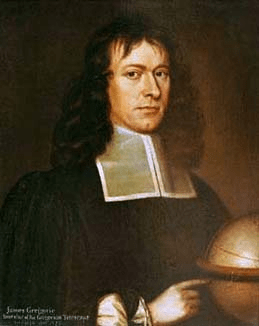
Before discussing Gregory’s method, we will look at Christiaan Huygens (1629-1695) later, more famous but — as I shall argue — less accurate method for measuring the distance to Sirius.
Christiaan Huygens’ calculation of the distance to Sirius (1698)
Many astronomers had suggested that we could estimate the distance to the stars if:
- we assume that the Sun is a typical star so that other stars have a similar size and luminosity;
- we compare the brightness of the Sun to a given star; and
- we use the inverse square law to calculate how much further away the star is than the Sun given their relative brightnesses.
The problem was: how can we reliably compare the brightness of the Sun and a given star?
Huygens tried to do this by observing the Sun through a small hole and making the hole smaller until it appeared to match his memory of the brightness of Sirius as observed previously.

This is obviously a highly subjective method since Huygens was relying not only on his memory, but also on the memory of an observation made under very different observing conditions. Huygens did take steps to make the observing conditions as similar as possible: for example, he viewed both the Sun and Sirius through a long 4 metre tube to eliminate light from other sources. (Please be aware, that observing the Sun directly, even through a small aperture, is extremely dangerous!)
The difficulty was compounded by the fact that Huygens lacked the technology to make the hole in the brass plate small enough to mimic the appearance of Sirius; he improvised by adding a small microscope(!) lens to scatter the light but this, of course, added another layer of complication. Nonetheless, he was able to estimate the distance to Sirius as being 27664 times the Earth-Sun distance or 0.44 light-years. This is indeed in the right ball park. The modern distance is given as 8.6 light-years which is much further than Huygens’ measurement, partly because Sirius isn’t a star similar to the Sun: Sirius is actually 25.4 times brighter than our local star so is even more distant than Huygens supposed.
James Gregory’s method for calculating the distance to Sirius (1668)
Gregory suggested using a planet as an intermediary in comparing the brightness of the Sun to Sirius.

In 1668, in his ‘Geometriae pars universalis’, James Gregory set out a method for solving the challenging technical problem of actually determining the ratio of the apparent brightness of the Sun as compared with that of a bright star such as Sirius. He proposed using a planet as an intermediary between the Sun and Sirius. We are to observe the planet at a time when its brightness exactly equals that of Sirius, so that the problem then reduces to one of comparing the brightness of the Sun with that of the planet. But the planet’s brightness depends upon the light it receives from the Sun (and therefore upon the brightness of the Sun), and upon quantities such as the size and reflectivity of the planet and distances within the solar system (quantities which we suppose to be accurately known). A simple calculation then yields the required value. Gregory himself obtained [a value of] 83,190 [times the Earth-Sun distance], but he tells us that with more accurate information on the solar system the figure would be greater still
Hoskin (1977)
Gregory’s method is not so subjective as Huygens’ because we would be viewing Jupiter and Sirius under very similar observing conditions and also would not have to rely on our memory of our perception of Sirius’ brightness. His value of 83190 times the Earth-Sun distance equates to 1.32 light-years. However, had he known that Sirius was 25.4 times brighter than the Sun, he would have increased the calculated distance by a factor equal to the square root of 25.4 which would give a value of 6.6 light-years — not bad, considering the modern value is 8.6 light-years!
Also, bear in mind that Gregory had to assume that Jupiter reflected 100% of the sunlight that fell on it since he had no information about Jupiter’s albedo (the proportion of light reflected by Jupiter’s surface) and had only quite sketchy estimates of Jupiter’s diameter. As Gregory correctly surmised, his figure was a lower boundary estimate for the distance of Sirius, which was likely to increase as more information came to light.
Newton and Gregory’s Method
Sir Isaac Newton (1624-1727) possessed a copy of Gregory’s book (Hoskin 1977: 222) and gave a detailed description of the method in The System of The World which, however, was only published in 1728 after Newton’s death.
In consequence, James Gregory’s brilliant proposal of 1668, which so quickly led Newton to a correct understanding of the distances to the nearest stars, was effectively in limbo until the second quarter of the eighteenth century. In its stead, students of astronomy were introduced to the method of Christiaan Huygens, which was based on the same assumptions but used a much inferior technique for comparing the brightness of the Sun and a star.
Hoskin 1977
The brain is wider than the sky,
Emily Dickinson, ‘The Brain’
For, put them side by side,
The one the other will include
With ease, and you beside.
Reference
Hoskin, M. (1977). The English Background to the Cosmology of Wright and Herschel. In: Yourgrau, W., Breck, A.D. (eds) Cosmology, History, and Theology. Springer, Boston, MA.

 e=mc2andallthat