[Being a satire partly inspired by university campus “safe space” policies and this.]
The Roman Inquisition recently posted this message on their Facebook page:
The Roman Inquisition Society stands in solidarity with the Geocentric Society. We support them in condemning the actions of the Astronomy Society in extending an invitation to Professor Galileo Galilei to speak on campus, and agree that hosting known geocentrophobes at our university creates a climate of hatred.
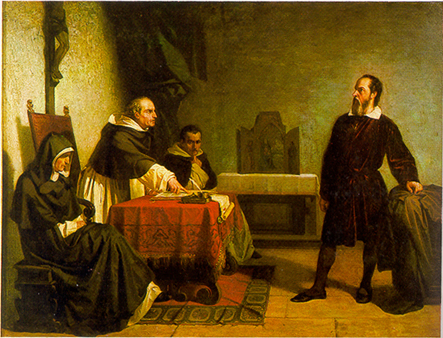
Galileo Facing The Roman Inquisition by Cristiano Banti
A spokesman for the Roman Inquisition Society told us that the publication of Galileo Galilei’s new book Dialogue On The Two Chief World Systems showed that Professor Galilei, was “nothing but a reactionary Heliocentrist of the worst stripe”. Frontispiece of Dialogue On The Two Chief World Systems
The spokesman went on to say that an event where Professor Galilei would be able to speak “uninterrupted and unopposed, possibly for several whole minutes, on the supposed ‘reality’ of the Earth’s motion around the Sun” would be in direct contravention of stated Student Union policy which does not grant a platform for speech which could be interpreted as being “disruptive to social and community harmony”.
He closed by saying that: “Whilst we in the geocentrist community have always welcomed debate and challenge, it must be within the context of a positive conceptual framework, such as that put forward by that nice Professor Harry Stottle. After all, freedom of speech is all well and good, but don’t we geocentrists deserve our safe space too?”
Members of the Astronomy Society said that they had invited both the Roman Inquisition Society and the Geocentric Society to observe the moons of Jupiter through a telescope, but representatives of both societies had declined by sticking their fingers in their ears and shouting “La-la-la! Not listening! La-la-la!”
It’s taken me a while to realise this, but “Growth Mindset” is essentially the repackaging of that perennial teacher favourite: “Must Try Harder”.
Suppose that the difference in “people who talk up innate ability” and “people who talk up hard work” maps onto a bigger distinction. Some people really want to succeed at a task; other people just care about about clocking in, going through the motions, and saying “I did what I could”.
Put the first group in front of an authoritative-looking scientist, tell them to solve a problem, and make sure they can’t. They’re going to view this as a major humiliation – they were supposed to get a result, and couldn’t. They’ll get very anxious, and of course anxiety impedes performance.
Put the second group in front of an authoritative-looking scientist, and they’ll notice that if they write some stuff that looks vaguely relevant for a few minutes until the scientist calls time, then whatever, they can say they tried and no one can bother them about it. They do exactly this, then demand an ‘A’ for effort. At no point do they experience any anxiety, so their performance isn’t impeded.
Put both groups on their own in private, and neither feels any humiliation, and they both do about equally well.
Now put them in real life. The success-oriented group will investigate how to study most effectively; the busywork-oriented group will try to figure out how many hours of studying they have to put in before other people won’t blame them if they fail, then put in exactly that amount. You’ll find the success-oriented group doing a bit better in school, even though they fail miserably in Dweck-style experiments.
[ . . . ]
So basically, you take the most vulnerable people, set them tasks you know they’ll fail at, then lecture them about how they only failed because of insufficient effort.
Imagine a boot stamping on a human face forever, saying “YOUR PROBLEM IS THAT YOU’RE JUST NOT TRYING NOT TO BE STAMPED ON HARD ENOUGH”.
Recent research shows that children do better in classes where teachers ensure that the region around their cubital ginglymus has a organic epidermal integument attached. Watch this space for more on the Organic Epidermal Integument Elbow Set, next week.
MAN IN GLASSES (for it is he):Good evening, viewers. Tonight, we are going to examine the impact of the government’s controversial new education policies ‘on the ground’, so to speak, at one of the first schools in the country to undergo forced academisation in the latest tranche of institutions deemed to be ‘failing’ or ‘coasting’ by Government ministers.
WHILE M.I.G. SPEAKS, BACKGROUND SHOTS OF A TYPICAL COMPREHENSIVE SCHOOL BUILT IN THE 1970s APPEAR ON THE SCREEN.
WOMAN: Well, of course, the first we knew about the forced academisation was when the new management team from the SKARO Academy Chain arrived in their shiny new suits.
The new senior leadership team from the SKARO Academy chain arrive…
M.I.G.: And would you say that they’ve succeeded in driving up standards?
WOMAN: A little. The kids are a lot less scruffy since the Headteacher started exterminating anyone who had their top button undone. Or who didn’t know their target grades. Or didn’t make the expected level of progress. Or looked at SLT a bit funny. Mind you, they treated the staff in exactly the same way.
M.I.G: What? You mean that they held staff to the same exceptionally high standards as the children?
WOMAN: No, they exterminated them. Some of the older staff just couldn’t adjust to pushed around on castors with a sink plunger and an egg-whisk under their armpits whilst shouting “YOU WILL MAKE PROGRESS! OR! YOU! WILL! BE! EXTERMINATED!” in a loud, grating voice. But that’s part of the academy chain’s “corporate style” and one of the “non-negotiables”, as the Headteacher likes to call them. But the younger staff seem to be adapting well to new regime, especially those who entered on the SKARO Directand EXTERMINATE First! routes. Actually, some of them seem to enjoy it . . .
THE CAMERA ZOOMS IN ON A SMALL Y7 CHILD STANDING ALONE IN THE PLAYGROUND. HE IS STANDING STIFFLY TO ATTENTION. EVERY FEW SECONDS, HE REFLEXIVELY AND REPETITIVELY CHECKS WHETHER HIS TOP BUTTON IS DONE UP. HIS EYES SWIVEL NERVOUSLY FROM SIDE TO SIDE. TUMBLEWEED BLOWS AROUND HIS FEET.
M.I.G.: Have the new leadership team exterminated many of the students?
WOMAN: A fair few. But as Mr Davros, the CEO of SKARO Academy, said in the newsletter, that we shouldn’t think of it as a form of ruthless mass murder, but rather as a “proactive measure to help ease the national pressure on school places”.
M.I.G.: I understand there was some unpleasantness involving a surprise Ofsted inspection?
WOMAN: Not really. I mean, the lead inspector was a bit suspicious when he found that the majority of the SLT were descended from an extraterrestrial race of humanoids know as the ‘Kaleds’. He said that sounded, well, a bit ‘un-British’ if you catch my drift.
M.I.G.: And what the leadership team do?
WOMAN: Well, two little doors opened up in the dome on top of Mr Davros’ head and two little union jack flags popped out and he started chanting “BRITSH VALUES! BRITSH VALUES! YOU MUST HAVE BRITISH VALUES!” before leading everyone in a rousing rendition of ‘Land of Hope and Glory’.
British values! British values! You must have British values!
M.I.G.: And what happened then?
WOMAN: Oh, they exterminated the Ofsted Lead Inspector.
M.I.G.: Really?
WOMAN: Yeah. He undid his top button while they were singing.
M.I.G.: And how did the staff react to this?
WOMAN:To the Lead Inspector being reduced to a small pile of smoking ashes by an extraterrestrial death ray? Stunned, I think. Followed by some quiet smiles and handshakes and someone saying “I didn’t know we could do that…” Mind you, some of the inspection team didn’t look too displeased either…
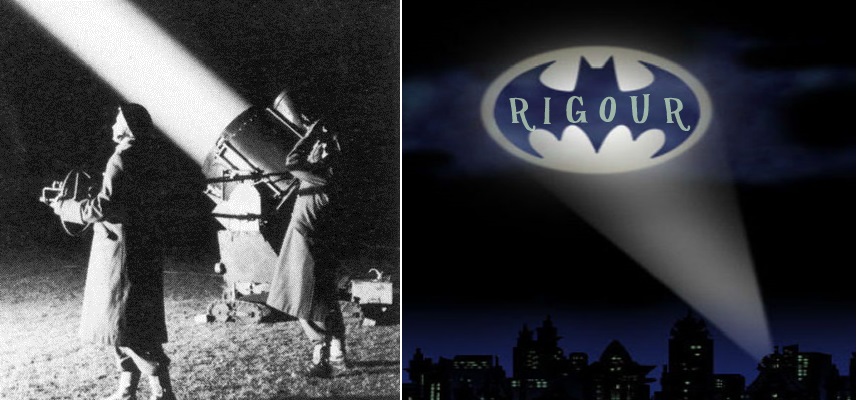
A crack team of DfE boffins test the proposed new system for the management and oversight of the United Kingdom’s increasingly fissiparous school system.
Rigour, n.
1. The quality of being extremely thorough and careful.
2. severity or strictness.
3. (when pluralized) harsh and demanding conditions
In education (as in other walks of life) the word rigour is usually meant in sense (1) when applied to one’s own thinking or the thinking of one’s friends or allies: “I am being rigorous. However, you, sir, are merely pedantic.”
These days, sense (2) seems to require the insertion of a prefix, as in “The moderation of our controlled assessments was over-rigorous.”
Rigour is therefore a good thing, right?
However, in my opinion it seems to be used more and more as a talisman rather than as a genuine description.
Mr Gove told the Commons: “The new specifications are more challenging, more ambitious and more rigorous. That means more extended writing in subjects like English and history, more testing of advanced problem-solving skills in mathematics and science.”
I am not sure if Michael Gove* is using the word in sense (1) or sense (2) here. If he meant it in sense (2) then it is a rhetorical flourish to emphasise the idea that GCSEs will be more challenging. If he meant it in sense (1) then the promise of “extended writing [and] more testing” doesn’t tell me how the new exams will be more thorough and careful. This is not saying that the examination system does not need to be more thorough and careful, merely that “extended writing [and] more testing” won’t necessarily make it so.
Let me emphasise that I am not opposed to rigour. I like rigour and being rigorous, at least in sense (1). I would perhaps favour the words consistent and fair rather than use rigour in sense (2) in an educational context, but that’s a personal preference.
In short, I wish people would be more rigorous in their use of the word rigorous. You shouldn’t just use it because you think it sounds good. A is rigorous while B is not should mean more than I like A and dislike B.
And as a final thought, I strongly suspect that many of the people who are most keen to bemoan the lack of rigour in education would have to step out of the kitchen when push came to shove, as in this little vignette:
[I listened] to magazine columnist Fred Barnes . . . whine on and on about the sorry state of American education, blaming the teachers and their evil union for why students are doing so poorly. “These kids don’t even know what The Iliad and The Odyssey are!” he bellowed, as the other panellists nodded in admiration at Fred’s noble lament.
The next morning I called Fred Barnes at his Washington office. “Fred,” I said, “tell me what The Iliad and The Odyssey are.”
He started hemming and hawing. “Well, they’re … uh … you know … uh … okay, fine, you got me—I don’t know what they’re about. Happy now?”
No, not really. You’re one of the top TV pundits in America, seen every week on your own show and plenty of others. You gladly hawk your “wisdom” to hundreds of thousands of unsuspecting citizens, gleefully scorning others for their ignorance.
— Michael Moore, Stupid White Men (2001), p.58
* His successor Nicky Morgan look set to continue Gove’s use of the term.
Postscript: For the those (including myself) who are classically undereducated: The Iliad is an ancient Greek epic poem by Homer about the Trojan War. The Odyssey is another epic poem by Homer recounting the ten-year journey home from the Trojan War made by Odysseus, the king of Ithaca.
There are robust systems in place for the safe recruitment of staff, which assess their suitability to work with young people.
–OFSTED report (selected randomly), Oct 2013. p.6
In [a number of the] schools visited where science achievement had recently improved [there had been a] robust review by senior leaders, leading to a reduction in weaker teaching
OFSTED, Maintaining Curiosity in Science, November 2013. p.26 [emphasis added]
“Robust” is an increasingly common word in educational circles these days.
They say a picture is worth a thousand words. As a physicist, I would argue that a nice graph is worth at least five thousand.
It certainly seems that the setting up of Ofsted has significantly increased the usage of the word “robust”. In fact, the phrase “to infinity and beyond!” springs to mind when we view the precipitous increase after 1984. Now, it might be argued that this is merely conincidental: after all, correlation is not proof of causation.
This is true. But just for the record, an advanced Google search for the word “robust” on just the Ofsted website alone gets 87300 hits. (A similar search of the Ofgem website returns just 5790 results). When Google release a more up-to-date dataset, it will be interesting to see if the usage of “robust” will have increased or decreased during Sir Michael Wilshaw’s tenure. I know what possibility I’ll be putting my money on.
Robustadj.
When used in an educational context:
1. [of systems or processes] able to withstand or overcome adverse conditions
2. [of SLT or other interventions] uncompromising and forceful
What it actually means in practice:
Robustadj.
A system or process that is explained at tedious length in the staff handbook and that has least one desultory paper trail so that we can pretend that this thing happens as a matter of course: (A custom more honoured in speech than in observance, you might say.)
A meeting during which SLT got (a) shouty; or (b) offered “support” that turned out to be profoundly unsupportive; or (c) both
.
As a final thought, UK education seems to be in the hands of people who like to use the word “robust” a lot. H’mmm, I feel a song coming on . . .
# If there’s something weird
# and it don’t look good
# Who ya gonna call?
# ROBUSTers!!!
“NOW, what I want is, Skills. Teach these boys and girls nothing but Skills. Skills alone are wanted in life. Plant nothing else, and root out everything else.” Mr Gradgrind paused for a moment.
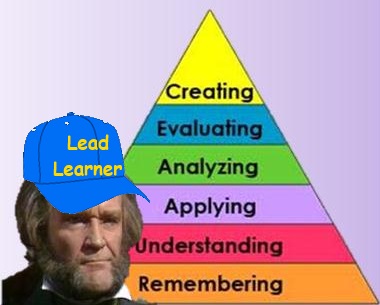
“And when I say ‘teach’ what I really mean is ‘facilitate’. This is the principle on which I bring up my own children, and this is the principle on which I bring up these children. Stick to Skills, sir!’ The scene was a plain vault of a school-room, decorated only with the multicoloured pyramid of Bloom’s Taxonomy on the far wall which the speaker’s square forefinger emphasized silently by pointing, in the approved “talk-less” neo-Gradgrindian manner.
“In this life, we want nothing but Higher Level Thinking, sir; nothing but Analysis, Evaluation and Creativity!” The speaker and the second grown person present both swept with their eyes the knots of little vessels then and there arranged in groupwork PowerTalk Circles (TM), ready to have imperial gallons of Conceptual Understanding facilitated into them until they were full to the brim, or at least until their personalised learning objectives could be self-actualized and triple cross-checked by peer assessment.
“Girl number twenty,” said Mr. Gradgrind, squarely pointing with his square forefinger, “as a starter, please go to the flipchart and analyse and evaluate what the concept of ‘horse’ means in the 21st Century within the context of productive economic citizenship. Please make full use of all the colours available to delineate your thought-clusters. You have two minutes.” Sissy Jupe blushed nervously but gamely walked over to the flipchart stand. Mr Gradgrind started a countdown timer on the interactive whiteboard.
The pips sounded and Sissy stepped away from the flipchart. She had drawn a picture of a horse. It was actually quite a good picture although it was wearing a hat and smiling in a decidedly unhorselike way. She had written “Dobbin is a quadruped” in very neat handwriting at the bottom.
Mr Gradgrind refrained from commenting with some difficulty. “Suggestions?”
A hand went up. “She should use the word ‘because’ in every sentence to encourage higher level thinking skills?”
“Yes, but . . .” conceded Mr Gradgrind , walking over the flipchart and putting a big red circle around the word quadruped. “More suggestions? Yes, Bitzer?”
“The sentence containing the word quadruped is a statement of a merely factual nature, sir,” said Bitzer, pulling a sour face as the word ‘factual’ left his mouth.
“Precisely!” roared Gradgrind . He turned towards the class. “And why should we bother to remember things when–”
“–we can look it up on Google!” chorused the class. Poor Sissy Jupe looked crestfallen.
“Bitzer, show us how its done.” The whey-faced lad tapped away on his iPad.
“Sir, horses are not quadrupeds! It says here on Wikipedia that they’ve got five legs.”
“One cannot always trust Wikipedia, boy!”
“The article was updated not seven and a half minutes ago by a contributor called Professor LOLZ, sir!”
Gradgrind gave Sissy Jupe a significant look. “Analysis, Evaluation and Creativity — that’s how its done! Consider: (1) the article is recent and up-to-date; (2) it’s written by an academic; and (3) Lolz sounds a bit German and they are a jolly efficient nation with an education system that is higher in the PISA rankings than ours! QED. Well done there, Bitzer!”
Sissy Jupe looked puzzled.”But . . . horsies have four legs, don’t they?”
Gradgrind warmed to one of his favourite themes: “In the fuddy-duddy old twentieth century, perhaps horsies did have four legs. But in the twenty-first century, are you going to rely on what your brain tells you or what the internet says? Shift happens. There’s going to be a lot of Chinese and Indian people about, some of them quite clever. Big numbers. Lots of new words and job titles with the word digital in them. Twenty-first century skills, sort of thing. Shift happens..”
Gradgrind became uncomfortably aware that his precis wasn’t having the same impact as the ‘Shift happens’ Youtube video itself usually did. “Consider, young Sissy,” he said, changing tack, “the skills of 21st century equestrianism are likely to be vastly different from the skills of 20th century equestrianism. If you had learned to ride a twentieth century horse, would you still be able to ride a twenty-first century horse?”
“Erm . . . yes?” offered Sissy, hesitantly.
“Of course not! You see, that’s why we’re not teaching you any stuff that might change in the near- to medium-term future, because that would be silly, wouldn’t it? Instead, we’re teaching you skills that will last a lifetime, like using internet browsers and how to use keyboard shortcuts on proprietary software to cut-and-paste. Because those skills will NEVER become obsolete, you mark my words!”
The second adult in the room, the normal class teacher, stepped forward, shaking his head in admiration. Speechlessly, he removed his mortar board and handed it over to Mr Gradgrind . Mr Gradgrind acknowledged the gesture with a grave and courteous inclination of the head, before throwing that tired old symbol of traditional teaching into the nearest wastebasket.
He drew two baseball caps from his pocket — they both had the words ‘Lead Learner’ embroidered upon them — and both of them reverently donned them. From somewhere, the opening bars of Mr Boombastic blared as they got on with chillin’ wid da kidz.
Sissy Jupe sighed and opened her book and started reading quietly: it had been a close run thing, but just for a minute there it had seemed as if someone was actually going to teach her something…
As part of our reforms to the national curriculum , the current system of ‘levels’ used to report children’s attainment and progress will be removed. It will not be replaced.
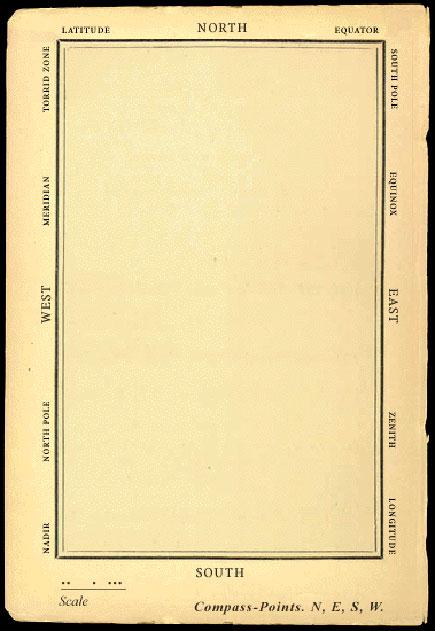
He had bought a large map representing the sea,
Without the least vestige of land:
And the crew were much pleased when they found it to be
A map they could all understand.
“What’s the good of Mercator’s North Poles and Equators,
Tropics, Zones, and Meridian Lines?”
So the Bellman would cry: and the crew would reply
“They are merely conventional signs!
“Other maps are such shapes, with their islands and capes!
But we’ve got our brave Captain to thank:
(So the crew would protest) “that he’s bought us the best–
A perfect and absolute blank!”
May they stumble, stage by stage
On an endless pilgrimage,
Dawn and dusk, mile after mile,
At each and every step, a stile;
At each and every step withal
May they catch their feet and fall
— Robert Graves, Traveller’s Curse After Misdirection (from the Welsh)
There is something fundamentally wrong with a system where individuals are expected to invest more time and energy in proving that they’ve done a thing than in actually doing the thing itself.
It seems to me that in the world of education (in the UK, at least) we have stepped through into that looking glass world already. And it’s getting worse.
Case in point: my school’s new salary policy. Gone is the system of automatic salary progression (subject to satisfactory performance management, of course). Instead, any teacher seeking to progress on the salary scale will need to submit — oh joy of joys! — a portfolio of evidence. And this is evidence required in addition to the evidence required for the performance management process. One system is not enough! We need two complex, mutually independent systems to check that everyone is doing the job that they are being paid to do.
In a way, it’s quite endearing: this is our leadership team admitting that if a person happened not to be doing their job properly, then it is more than likely that no-one on the management team would have noticed.
But never mind! An extra layer of inflexible, unresponsive bureaucracy will undoubtedly do the job, as it has done in numerous other instances.
I can’t help but be reminded (yet again) of Woody Allen’s Dictator who required that all citizens change their underwear every half hour. And that they wear their underwear on the outside. Why? “So we can check.”
The dreaded words weekly minuted line management meeting cannot be far behind. The idea of this is that I get to spend an hour meeting with my line manager and then another hour meeting with the people that I line-manage and then we’ll all email each other to confirm the issues, actions and timelines discussed in the meeting. And type up the minutes so that our line manager can submit them to his or her line manager. The upshot of this is that of course nobody has the time to actually take the actions agreed on in the meeting. As the old joke has it: a meeting is a process whereby you spend hours in order to produce minutes.
And will the line manager of our line manager read the minutes submitted? I doubt it. Nobody possibly could, even assuming they wanted to.
This is the latest iteration of an ancient human idea:
[W]hen any uncertainty disrupted the smooth flow of life . . . men turned to the supernatural . . . The ordinary person found many willing to allay his concerns [including] professional magicians ready to supply incantations for any need . . . Superstition in general guided life . . . Charms were commonly used against all manner of ills.
Robert Knapp, Invisible Romans (The Romans That History Forgot) p.13
I conjure you, daemon, whoever you may be, to torture and kill, from this hour, this day, this moment, the horses of the Green and the White teams; kill and smash the charioteers Clarus, Felix, Primulus, Romanus; do not leave a breath of them.
— spell written on a lead tablet by an ancient Roman, quoted by Knapp p.13
To develop independent learning within a whole school context and challenge staff and student underperformance at a systemic as well as individual level
— Recent performance management target
Computing includes the concept of ROM — Read Only Memory; that is to say, memory that is designed so that its contents cannot be deleted or overwritten.
In my opinion, what passes for best practice in the world of education today includes the concept of WOD — Write Only Documents; that is to say documents that are designed so they are never to be read after they have been written.
Quite frankly, we are building giant pyramids and Doric-columned temples of propositions that are destined to be forever unread: mighty, cloud-piercing ziggurats of unread words.
For all the good that they do, these words might just as well be scratched on a pottery shard or a scrap of lead and thrown in a magic well as, once upon a time, the Romans used to do.
May they stumble, meeting by pointless meeting
Upon an endless paperchase,
Dawn and dusk, email after email,
Each one more urgent than the last;
Each one demanding data,
Available to the sender
Who finds it easier to press “send”
Than look it up themselves.
…
And may the bone that breaks within
Not be, for variation’s sake
Now rib, now thigh, now arm, now shin,
But always, without fail, THE NECK.
(With apologies to Robert Graves for the first 8 lines)
George Eliot (penname of Mary Anne Evans, 1819-1880): did she predict the rise of the Internet?
As I wandered around a small shopping mall today, I observed a large number of people interacting intently with their smartphones. Nothing ground breaking there, you might say, but it called to mind a passage I’d read in George Eliot’s Essays (which is a treasure trove of exquisite writing of which I was completely unaware until a few days ago):
In fact, the evident tendency of things to contract personal communication within the narrowest limits makes us tremble lest some further development of the electric telegraph should reduce us to a society of mutes, or to a sort of insects communicating by ingenious antenna of our own invention.
George Eliot, “Woman in France: Madame de Sable”, The Essays of George Eliot
The internet is a further development of the electric telegraph. Mobile phone technology can certainly be likened to “ingenious antenna of our own invention”. Perhaps we will grow more insect-like as we incorporate the technology more and more into our physical structure. I suspect that “Google Glass” is only the beginning of the process.
Google Glass is a wearable computer with an optical head-mounted display (OHMD) that is being developed by Google in the Project Glass research and development project. (Wikipedia).
But is this and similar technology in the process of reducing us to a society of mutes?
Yes and no. In my experience, digital communication can certainly help to spark conversation of the old-fashioned, face-to-face kind.
However, as my wife has frequently observed–acerbically, but with love, as only she can(!)–I am all too ready to crawl into my digital man-cave of an evening. I can’t help but be aware that I am also one of those people who often prefers to email or text rather than make an actual person-to-person phone call. And how does being a blog-writer fit into this pattern? Pass over those electronic antenna of our own invention, Alice.
I don’t think that I’m a particularly unsociable person, but it makes me think. Selective verbal mutism: is this the wave of the future?
T. S. Eliot predicted in The Hollow Men that
This is the way the world ends
Not with a bang but a whimper.
I don’t think he was quite as prescient as the other Eliot. Perhaps it should read:
This is the way the world ends
Not with a bang but a Tweet.
Generally speaking, it takes two years to become a qualified teacher, by whichever route you choose (PGCE + QTS, Teach First or Schools Direct). Opinions vary as to how long it will take you to become a good teacher, although it is generally agreed that this is not an automatic process. (‘Good’ according to whom is a question I will leave to one side for this post.)
From my own experience, I would venture to make the risky generalisation that good teachers are not born, they are not made (in the sense of being manufactured on an assembly line); rather, good teachers are grown.
I entered the profession some 20+ years ago via the near-universal (at the time) PGCE route. To be honest, I wasn’t driven by any sense of vocation aside from a hazy idea that another year of uni would be kind of nice (ooh – and a bursary too, thank you so much). As I recall, the course had two school placements: a short one (of two weeks) and a long one (of — wait for it — six weeks).
The rest of the time was passed pleasantly on campus, sometimes attending lectures on educational theory and philosophy, and other times having useful (and sometimes not-so-useful) small class tutorials on the stuff of actual Physics teaching. I regret to say that I was often more focused on drama society productions and going to the pub than on my studies and placements.
Nevertheless, I passed. I don’t know how, but I passed. And I managed (again, God knows how) to get my first job. It was as a Physics teacher at a small rural comprehensive. I won’t say in which part of the UK, except that there were so many Mr Jones’s that we had to be distinguished by referencing our teaching subject. I was “Mr Jones Physics”.
And I was rubbish. I couldn’t control a class to save my life, my planning was abysmal (when I actually did any), and I spent most of each lesson shouting at students (well, at least all that drama society stuff was put to some use after all) in increasingly desperate attempts to get them to copy stuff off the blackboard (one of those old style ones where the writing surface was a looped belt that you used chalk to write on). Without a doubt, the present-day me would have fired the then-me without a second thought.
Surprisingly, I still made it through my probationary year (the prehistoric version of QTS), although with my ears ringing with a stern admonition to mark my students’ books more often.
What saved me? An inspirational Head of Science who — wonder of wonders — saw some teaching potential in me. He unselfishly gave me the lion’s share of A-level Physics teaching. Gradually, in the relative calm of an A-level class, I learned how to communicate my knowledge of Physics to students in a useful way. I learned how to talk with rather than at or down to students. I learned how to control a class using the maxim “It’s not the severity of a sanction that matters, it’s the certainty.” And, sometime near the beginning of my second year of teaching I remember a lesson with a Y10 group when I had the shocking thought “Hey, I’m enjoying this!” I became confident enough to write and develop my own teaching resources. I started getting positive feedback from students. I learned techniques and strategies to help students across the ability range. And . . . well, I was hooked.
So: fast-forward to today. Am I a good teacher? Hell, yes, I think so. A-level Physics take-up at my school has never been so healthy. Results are above the school average and improving. Ex-students occasionally write to me saying how much they enjoyed learning in my classes. A student gets up at the end of the final lesson before the exams to shake my hand and say “Thanks for being a great Physics teacher!” A young woman says that she persevered to the end of A2 Physics simply because “It’s so rare to a teacher who is so passionate about his subject.” (PS — I’m not making any of this stuff up, honest; blowing my own trumpet does not come easily to me, but I think I need this to give some perspective on what follows. Plus I need to counter some of the steady drip-drip-drip of SLT negativity.)
The point is: it wasn’t the PGCE or QTS* process per se that made me into a good teacher. It was time, good guidance and inspiring examples from colleagues and friends and — most importantly of all — learning that I, myself, wanted to do this well and putting the hours into thinking about teaching, planning lessons, developing teaching sequences and ways of communicating concepts and — perhaps most importantly of all — learning about how important it is to know about children’s possible misconceptions in order to effectively teach (thank you, Rosalind Driver and her colleagues for this research).
So if PGCE and QTS-equivalent did not, by my own admission, turn me into a good teacher, should they be dispensed with?
Absolutely not. I believe that QTS is the “Goons’ Cambridge tie” (see below) of the teaching profession. It is the minimum standard. It is the line drawn in the sand: to be a teacher you have to do this and this and this*. And to an extent, anybody who wants it can get it (assuming they do the necessary work, of course). It is the necessary first step.
So far, I have not heard an argument that convinces me that QTS is a major obstacle to outside experts entering the classroom. As far as I can tell, all such arguments are obfuscatory justifications for cost cutting by way of employing temporary or transient staff.
Teaching looks easy but is actually much harder than it looks. Unless a person is willing to “buy the tie”, so to speak, I do not think they will develop the classroom expertise that students need and (usually) respond so warmly to.
Receptionist:
Do take a seat with the other applicants.
Greenslade:
Thank you. I sat down next to a man wearing a brass deerstalker, white cricket boots, and a shredded cardboard wig.
Eccles:
Ha-llo!
[…]
Greenslade:
Don’t tell me you’re applying for the post of announcer?
Eccles:
Oh, yeah! And I’ll get it too, you’ll see! I’m wearing a Cambridge tie!
Greenslade:
You? You were at Cambridge?
Eccles:
Yeah!
Greenslade:
What were you doing there?
Eccles:
Buying a tie.
The Goon Show, “The Greenslade Story”
* Ridiculously oversimplified, I know. My apologies to all those who have had to assemble multiple ringbinders of evidence for the QTS standards.








 e=mc2andallthat