Why do we make these analogies? It is not just to co-opt words but to co-opt their inferential machinery. Some deductions that apply to motion and space also apply nicely to possession, circumstances and time. That allows the deductive machinery for space to be borrowed for reasoning about other subjects. […] The mind couches abstract concepts in concrete terms.
— Steven Pinker, How The Mind Works, p.353 [emphasis added]
I am, I must confess, a great believer in the power of analogy.
Although an analogy is, in the end, only an analogy and must not be confused with the thing itself, it can be helpful.
As Steven Pinker notes above, the great thing about concrete analogies and models of abstract concepts is that they allow us to co-opt the inferential machinery of well-understood, concrete concepts and apply them to abstract phenomena: for example, we often treat time as if it were space (“We’re moving into spring”, “Christmas will soon be here”, and so on).
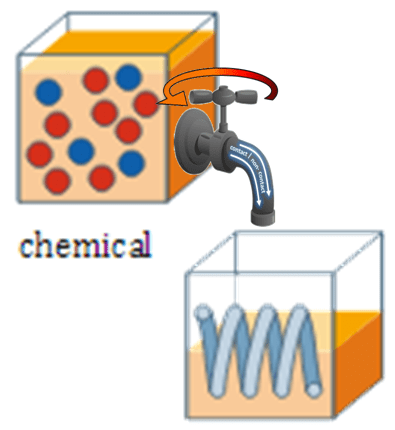
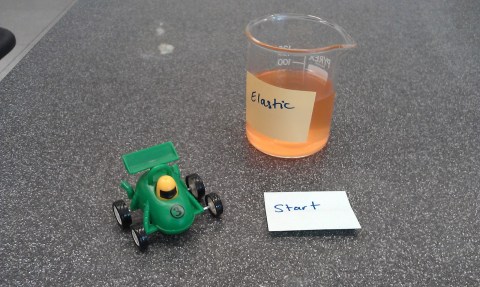
To that end, I propose introducing the energy stores and pathways of the IoP model to KS3 and GCSE students as tanks and taps.
Energy Stores = tanks
Energy Pathways = taps
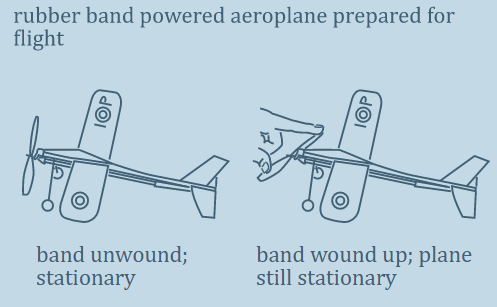
Consider the winding up of an elastic band.
This could be introduced to students as follows:
One advantage I think this has over one of my previous efforts is that I am not inventing new objects with arbitrary properties; rather, I am using familiar objects in the hope of co-opting their inferential machinery.
Suggestions, comments and criticisms are always welcome.
My propositions are elucidatory in this way: he who understands me finally recognises them as senseless, when he has climbed out through them, on them, over them. (He must so to speak throw away the ladder, after he has climbed up on it.)
He must surmount these propositions; then he sees the world rightly.
— Ludwig Wittgenstein, Tractatus Logico-Philosophicus (1922), 6.54
[I]t is ambition enough to be employed as an under-labourer in clearing the ground a little, and removing some of the rubbish that lies in the way to knowledge;- which certainly had been very much more advanced in the world, if the endeavours of ingenious and industrious men had not been much cumbered with the learned but frivolous use of uncouth, affected, or unintelligible terms, introduced into the sciences
John Locke, An Essay Concerning Human Understanding (1690)
OK, so I was wrong.
In a previous blog, I suggested a possible “diagrammatic” way of teaching energy at GCSE which I thought was in line with the new IoP approach. Thanks to a number of frank (but always cordial!) discussions with a number of people — and after a fair bit of denial on my part — I have reluctantly reached the conclusion that I was barking up the wrong diagrammatic tree.
The problem, I think, is that unconsciously I was too caught up in the old ways of thinking about energy. I saw implementing the new IoP approach as being primarily about merely transferring (if you’ll pardon the pun) the vocabulary. “Kinetic store” instead of “kinetic energy”? Check. “Gravity store” instead of “gravitational potential energy”? Check. “Radiation-pathway-thingy” instead of “light energy”? Check.
Let’s look at the common example of a light bulb and I will try to explain.
Using the old school energy transfer paradigm, we might draw the following:
In spite of its comforting familiarity, however, there are problems with this: in what way does it advance our scientific understanding beyond the bare statement “electricity supplied to the bulb produces light and heat”. Does adding the word “energy” make it more scientific?
For example, when we are considering “light energy”, are we talking about the energy radiated as visible light or the total energy emitted as electromagnetic waves? It is unclear. When we are considering “heat energy” are we talking about the energy emitted as infrared rays or the increase in the internal energy of the bulb and its immediate surroundings? Again, it is unclear. In the end, explanations of this stripe are all-too-similar to that of Moliere’s doctors in The Imaginary Invalid, who explained that the sleep-inducing properties of opium were due to its “dormative virtues”; that is to say, sleep was induced by its sleep-inducing properties.
The problem with the energy transfer paradigm is that it draws a veil over the natural world, but it is a veil that obscures rather than simplifies.
The IoP, after much debate, collectively rolled up its sleeves and decided that it was time to take out the trash. In other words, they wanted to remove the encumbrance of terms that had, over time, essentially become unintelligible.
The new IoP model distinguishes between stores and pathways. For example, an object lifted above ground level is a gravity store because the energy is potentially available to do work. Pathways, on the other hand, are a means of transferring energy rather than storing energy. For example, the light emitted by a bulb is not available to do work in the same sense as the energy of a lifted weight. It is, within the limits of the room containing the bulb, a transient phenomenon. Many photons will be absorbed by the surfaces within the room; a small proportion of photons will escape through the window and embark on a journey to Proxima Centauri or beyond, perhaps.
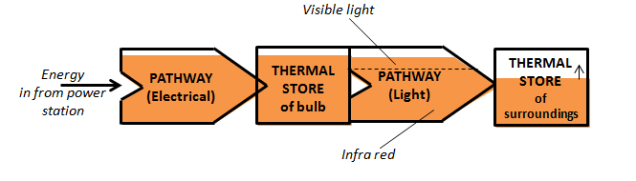
Now let’s look at my well-meaning diagrammatic version of the energy transfers associated with a light bulb:
The stores are “leak-proof buckets” holding the “orange liquid” that represents energy. The pathways are “leaky containers” that enable energy to be transferred from one store to another. I have to admit, I was quite taken with the idea.
The first criticism that gave me pause for thought was the question: why mention the thermal store of the bulb? Surely that’s a transient phenomenon that does not add to our understanding of the situation. Switch off the electric current and how long would the thermal store be significant? Wouldn’t it be better to limit the discussion to two snapshots at the beginning (electrical pathway in) and end (radiative pathway out)?
The second question was: what does the orange liquid in the pathways represent? In my mind, I thought that the level might represent the rate of transfer of energy. Perhaps a high power transfer could be represented by a nearly full pathway, a low power transfer by a lower level.
But this led to what I thought was the most devastating criticism: why invent objects and assign clever (but essentially arbitrary) rules about the way they interact when you could be talking about real Physics instead?
Is there any extra information in the phrase “light energy” as opposed to simply the word “light”?
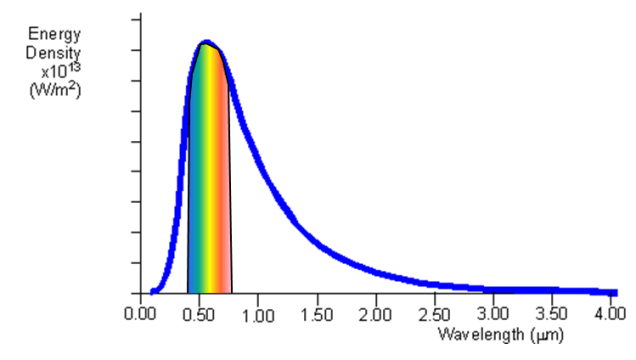
Efficiency of a bulb: find the total energy emitted as visible light and divide by the total energy emitted as light of all wavelengths.
And that’s when I realised that I wasn’t helping to take out the trash; in fact, I was leaving the rubbish in place and merely spray painting it orange.
Now don’t get me wrong, I think there’s still a long road ahead of us before we become as comfortable with the IoP Energy newspeak as we were with the old paradigm. As a first step, I suggest all those interested should read and contribute to Alex Weatherall’s excellent Google doc summary to be found here. But I honestly believe that it’s a journey worth taking.
Opium facit dormire.
A quoi respondeo,
Quia est in eo
Vertus dormitiva
Individuals aren’t naturally paid-up members of the human race, except biologically. They need to be bounced around by the Brownian motion of society, which is a mechanism by which human beings constantly remind one another that they are…well…human beings.
— Terry Pratchett, Men At Arms
Happiness is . . . not having an office.
I had a job once where I had an office. It was a quite a nice office. And I had it all to myself. It was a quiet, pleasant little space with a small kitchen nearby. It even had natural daylight through a large window Perfect, you might think.
But I grew to hate that office. You see, I think that teachers — more than anyone, perhaps — need, occasionally, to be “bounced around by the Brownian motion of society”.
What is Brownian motion? Well, it was first observed by botanist Robert Brown in 1827, who noted that, under a microscope, pollen grains in water seemed to “jiggle” randomly. Brown at first assumed that this motion was due to the “life force” of the pollen grains; however, he dispensed with this idea when he saw particles of stone dust (reportedly taken from the Great Pyramid to make sure they were completely and utterly devoid of life) perform the same drunken, wiggly waltz that came to be known as Brownian motion.
And there the matter rested, for a while. And then in 1905, a young patents clerk, working in his spare time at a kitchen table in a very modest apartment in Geneva, suddenly discovered the explanation — and more, much more.
The patents clerk’s name was, of course, Albert Einstein. His explanation rested on the insight that the visible pollen or dust particles were being buffeted by invisible water particles. His mathematical analysis was not only the first verifiable evidence of the actual physical existence of atoms, but also established their size. Understanding the movement and nature of the unobservable by minute and careful scrutiny of the observable…
Looking back at the job with its own office, I think I missed the simple daily dose of teacherly Brownian motion that you get by simply stepping into a staff room. Are you a little too-full-of-yourself-by-half? Some friendly ego-puncturing banter is usually on tap. At your wit’s end with a difficult student or class? A sympathetic shared eye-roll can work wonders. Plus there might even a few good ideas thrown in for good measure.
A good school staff room is not always synonymous with a “good” school, but a good staff room can make even a “bad” school bearable — enjoyable, even! — and the lack of one can make even an “outstanding” school feel like a souless and joyless treadmill.
If you are being interviewed by more than one school, choose the one that has the beat-up, well-used furniture in the staff room, replete with dirty coffee mugs and tottering piles of unmarked marking whose lower layers are being spontaneously formed into sedimentary rock by the crushing pressure from above.
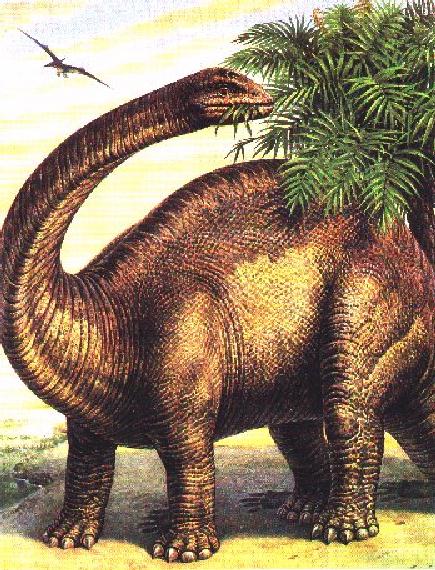
Sadly, I feel that that this type of staff room is a vanishing phenomenon. I suppose that I am like a dinosaur complaining that bromeliads these days don’t taste as nice as the bromeliads they had in the old days.
Teachers today just aren’t rubbing elbows as much as they used too. H’mmm. Maybe that’s why we don’t have to wear elbow patches any more…
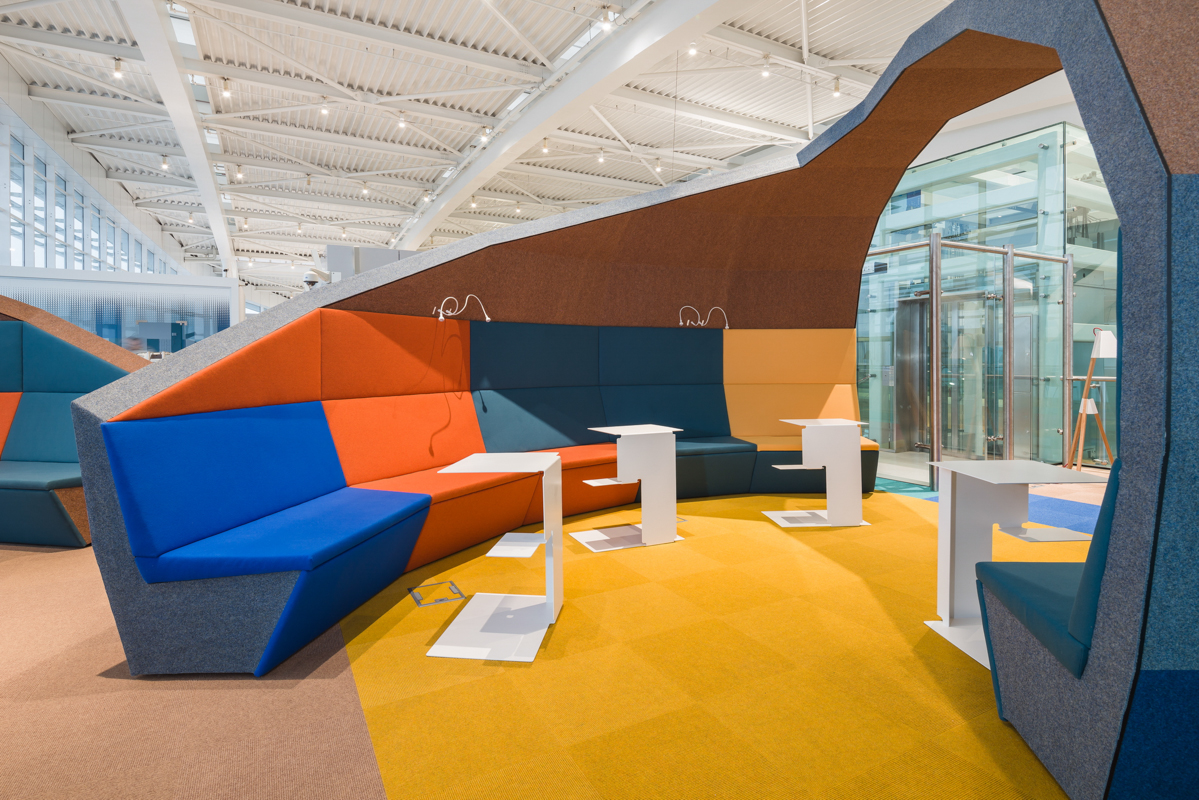
But that does not detract from this universal truth that should, I feel, be more universally acknowledged: if a staff room is suspiciously neat and clean and looks like an airport lounge…RUN AWAY!
Uniformity of practice seldom continues long without good reason.
So opined the estimable Dr Johnson in 1775. In other words, if a thing is done in a certain way, and continues to be done in that same way for a number of years by many different people, then it is a pretty safe bet that there is a good reason for doing the thing that way. And this is true even when that reason is not immediately apparent.
For the choice of this situation there must have been some general reason, which the change of manners has left in obscurity.
— Samuel Johnson, A Journey To The Western Islands of Scotland (1775).
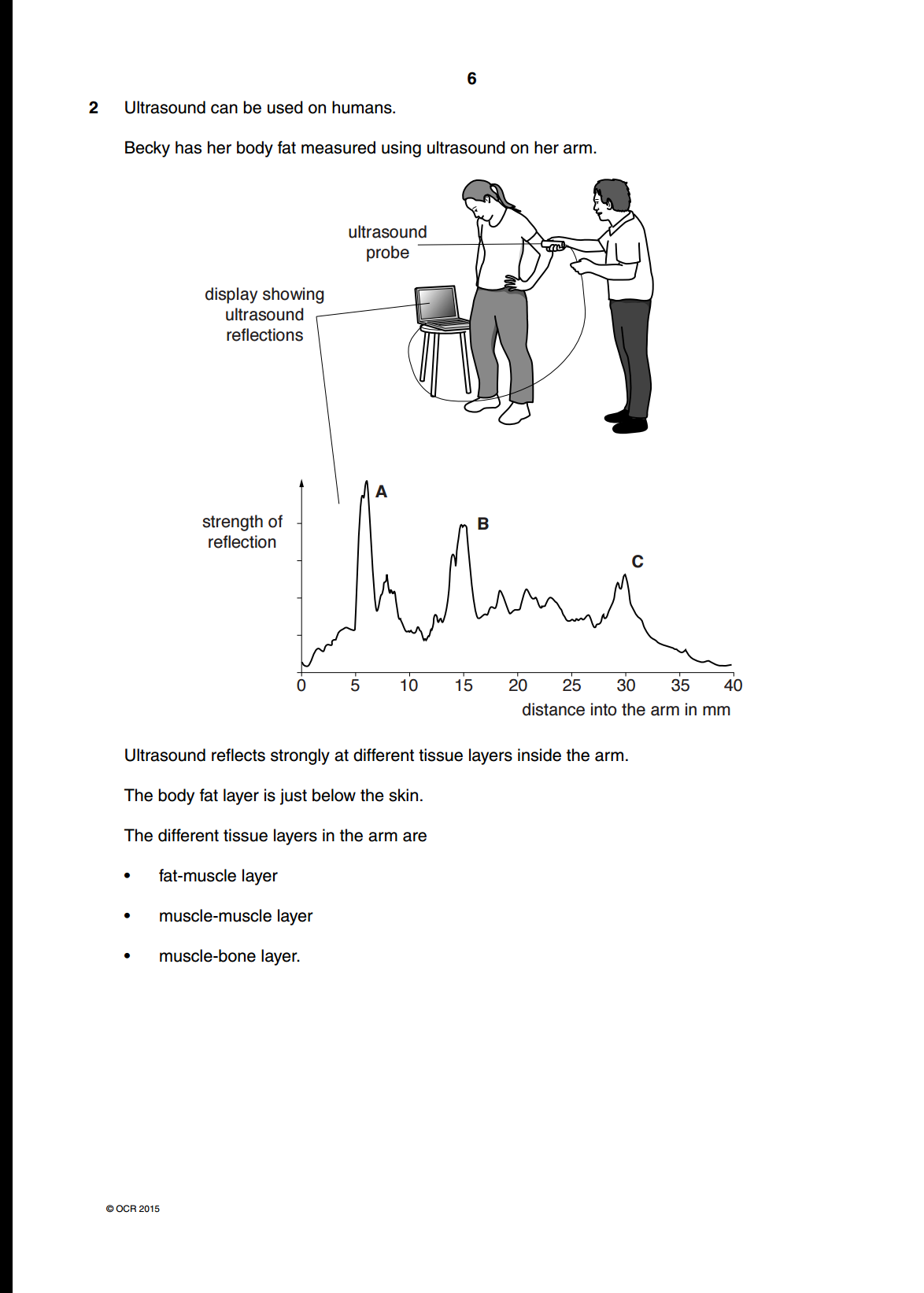
Consider the following examples of “uniformity of practice”:
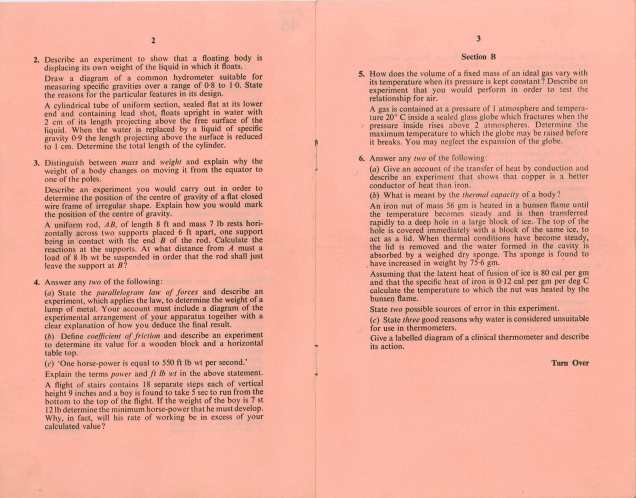
They are fairly bog-standard GCSE examination questions from the last two years from three different exam boards. But compare and contrast with an O-level Physics paper from 1966:
The “uniformity of practice” that leaps out at me is that the more modern papers, as a rule, have many more illustrations than the older paper. Partly, of course, this is to do with technology. It would have been (presumably) vastly more expensive to include illustrations in the 1966 paper.
Even if we assume that the difficulty level of the questions in the modern and older papers are equivalent (and therein lies a really complex argument which I’m not going to get into), there is a vast difference in the norms of presentation. For example, the modern papers seems to eschew large blocks of dense, descriptive text; this extends to presenting the contextual information in the ultrasound question as a labelled diagram.
Now I’m not saying that this is automatically a good or a bad thing, but there does seem to be a notable “uniformity of practice” in the modern papers.
Now what could the “general reason” for this choice?
Rather than leave the “change of manners” responsible for the choice “in obscurity”, I will hazard a guess: the examiners know or suspect that many of their candidates will struggle with reading technical prose at GCSE level, and wish to provide visual cues in order for students to play “guess the context” games.
Now I’m not assigning blame or opprobrium on to the examiners here. If I was asked to design an exam paper for a wide range of abilities I might very well come up with a similar format myself.
But does it matter? Are we testing Physics or reading comprehension here?
My point would be that there can be an elegance and beauty in even the most arid scientific prose. At its best, scientific prose communicates complex ideas simply, accurately and concisely. It may seem sparse and dry at first glance, but that is only because it is designed to be efficient — irrelevancies have been ruthlessly excised. Specialised technical terms are used liberally, of course, but this is only because they serve to simplify rather than complicate the means of expression.
Sometimes, “everyday language” serves to make communication less direct by reason of vagueness, ambivalence or circumlocution. You might care to read (say) one of Ernest Rutherford’s papers to see what I mean by good scientific prose.
The O-level paper provides, I think, a “beginner’s guide” to the world of scientific, technical prose. Whereas a modern question on falling objects might tack on the sentence “You may ignore the effects of air resistance” as an afterthought or caveat, the O-level paper uses the more concise phrase “a body falling freely” which includes that very concept.
To sum up, my concern is that in seeking to make things easier, we have actually ended up making things harder, and robbing students of an opportunity to experience clear, concise scientific communication.
Sir. It must be considered, that a man who only does what every one of the society to which he belongs would do, is not a dishonest man. In the republick of Sparta, it was agreed, that stealing was not dishonourable, if not discovered.
— Samuel Johnson
At a recent event, the speaker asked us to consider a hypothetical conundrum: what if one GCSE Triple Science student was strong in (say) Chemistry and Biology, but significantly weaker in GCSE Physics?
What course of action would you recommend? Extra support in Physics, was the consensus reply.
Actually, said the speaker, the smart “Progress 8 Maximisation Strategy” would be to:
Tell the student to focus her efforts entirely on Biology and Chemistry and completely ignore Physics. . .
. . . but keep her entered for GCSE Physics anyway, and make sure that she goes into the exam hall and writes her name on the Physics papers, even if she does nothing else.
That way, she has ostensibly followed a full and balanced curriculum. She has, after all, been entered for all three Science subjects. And, since Progress 8 counts only the two highest Science grades (or so I’m told), the student’s contribution to the school’s league table position would be also be secure.
H’mm. Dishonest? No. In the school’s best interests? Definitely. In the student’s best interests? Erm . . . on balance, no.
Sadly, as the character Joseph Sisko (ably played by Brock Peters) once observed on Star Trek: Deep Space Nine: “There isn’t a test that’s been created that a smart man can’t find his way around!” And that includes Progress 8 . . .
Sir, I do not call a gamester a dishonest man; but I call him an unsocial man, an unprofitable man. Gaming is a mode of transferring property without producing any intermediate good.
Few who watched the TV series Boys From The Blackstuff back in 1982 could forget Bernard Hill’s affecting portrayal of Jimmy “Yosser” Hughes’ mental breakdown, as a man whose job was an integral part of his self-image struggled to come to terms with being laid off. Yosser walked the streets of Liverpool, desperately looking for a job — any job! — and plaintively asking anyone who would listen: “Gizza job. I can do that!” (“Give us [me] a job” as Wikipedia helpfully translated for non-Scousers.)
What brought this to mind was an advert for a science teaching job that I stumbled across recently which stated “No long written statement will be required”(!)
Those famous lines of W. B. Yeats occurred to me:
Things fall apart; the centre cannot hold;
Mere anarchy is loosed upon the world
And for why? Well, the application process for any teaching job has always tended towards the recondite, rococo, recherché and — dare I say it? — the ridiculous.
First, there was the dreaded application form, which was anywhere between four and six pages long. Always the same information required, but always in an annoyingly different format, seemingly designed with fiendish cunning to prevent cutting and pasting from any previous application form.
Second, there was the hell of writing the personal statement: write several hundred words on . . . you. Just you. “Tell us what makes you so fabulous and great. Focus on the outcomes of the many initiatives that you have recently spearheaded, both within your department and in a broader whole school context.” This type of writing does not come easily for us introverted sciencey types, I can tell you.
The fact that many schools are now openly willing to reduce the number of “application hoops” that candidates have to jump through is, to my mind, very telling. It indicates how deeply the recruitment and retention crisis is biting.
It now seems to be schools who are scouring the country, plaintively crying “Gizza teacher!” Strange times indeed.
This has stayed with me from my PGCE course at Swansea University, many years ago. It was said by Frank Banks, the course tutor, in response to the question “What’s the simplest way to describe energy?”
And as pithy descriptions of energy go, it’s not half-bad. A small stone, dropped from the top of a skyscraper: lots of energy before it hits the ground — it could kill you. A grand piano, dropped from six feet above your head: lots of energy — it could kill you. Licking your fingers and touching the bare live and neutral wires in a socket: the conduction electrons in your body suddenly acquire a lot of energy — and yes, they could kill you. (With alternating current, of course, the electrons that will kill you are already inside your body — freaky!)
This attention-grabbing definition of energy seems to lead naturally to a more formal definition of “Energy is the capacity to do work“. This still leaves the problem of defining work, of course, but as R. A. Lafferty once said, that’s another and much more unpleasant story.
As I mentioned in an earlier post, I have been writing the Energy scheme of work for GCSE Science. As part of that brief, I wrote a short summary for my science colleagues of the IoP’s new approach to energy. I present it below without much amendment (or even a proper spellcheck) in the hope that someone, somewhere, at some time — may find it useful 🙂
The problem with teaching energy
One reason for the difficulty in deciding what to say about energy at school level is that the scientific idea of energy is very abstract. It is, for example, impossible to say in simple language what energy is, or means. Another problem is that the word ‘energy’ has entered everyday discourse, with a meaning that is related to, but very different from, the scientific one. [ . . .]
This ‘forms of energy’ approach has, however, been the subject of much debate. One criticism is that pupils just learn a set of labels, which adds little to their understanding. For example, one current textbook uses the example of a battery powered golf buggy. It asks pupils to think of this in the following terms:
Chemical energy in the battery is transformed into electrical energy which is carried by the wires to the motor. The motor then transforms this into kinetic energy as the buggy moves.
This, however, adds nothing to the following explanation, which does not use energy ideas:
The battery supplies an electric current which makes the motor turn. This then makes the buggy move.
A good general rule when explaining anything is that you should use the smallest number of ideas needed to provide an explanation, and not introduce any that are unnecessary
The new approach to the teaching of energy developed by the Institute of Physics (IoP) suggests that we limit our consideration of energy to situations where we might want to do calculations (at KS4, KS5 or beyond).
We should talk of energy being stored and shifted. The emphasis should be on the start and end of the process with minimal attention being given to any intermediate stages.
Consider the following examples:
lifting an object. Chemical potential energy store is emptied, and gravitational potential energy store is filled (note that we are not interested in intermediate motion as it doesn’t affect the final energy store).
rolling an object down a slope to the bottom. Gravitational potential energy store is emptied and thermal energy stores (of slope, of pen) increased.
Boiling water in kettle. Chemical store (from coal/gas power station) is emptied. Thermal store of water increased, thermal store of air increased, thermal store of kettle increased.
The new approach has been adopted by all UK exam boards for their new specs and is used in the AQA approved textbooks.
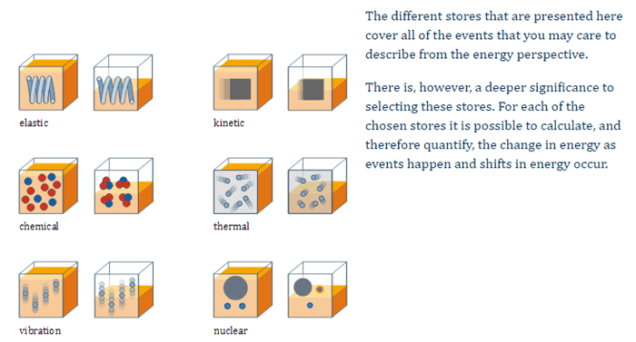
The following energy stores are considered: kinetic energy store, gravitational potential energy store, elastic potential energy store, thermal energy store, chemical potential energy store, nuclear energy store, vibrational energy store, electromagnetic energy store (note: the last is limited to situations involving static electric charges and static magnetic poles in magnetic fields).[NB Items in bold are those required for GCSE Combined Science.]
One major difference is that electric current and light are no longer considered as forms of energy. Rather, these are now regarded as means of transferring energy.
I suggest these energy icons should be called enojis (by analogy with emojis).
Probably the biggest adjustment for most teachers will be to avoid referring to light and sound as forms of energy and to treat them as pathways for transferring energy instead.
The physical environment provides continuous and usually unambiguous feedback to the learner who is trying to learn physical operations, but does not respond to the learning attempts for cognitive operations.
Engelmann, Siegfried; Carnine, Douglas. Theory of Instruction: Principles and Applications (Kindle Locations 1319-1320). NIFDI Press. Kindle Edition.
Into The Dustbin Of Pedagogy?
Helen Rogerson asks: “Should we bin [science] practicals?” and then answers emphatically: “No. We should get better at them.”
I wholeheartedly concur with her last statement, but must confess that I find it hard to articulate why I feel practical science is such a vital component of science education.
The research base in favour of practical science is not as clear cut as one would wish, as Helen points out in her blog.
[T]his then raises the question of “what about the kids who are never going to see a pipette dropper again once they’ve left school?” I don’t have a great answer to that. Even though all knowledge is valuable, it comes with an opportunity cost. The time I spend inculcating knowledge of pipette droppers is time I am not spending consolidating knowledge of the conservation of matter or evolution or any other “Big Idea.” [ . . . ] But if you’ve thought about those things, and you and your department conclude that we do need to teach students how to use a balance or clamp stand or Bunsen burner, then there is no other way to do it – bring out the practical! Not because anyone told you to, but because it is the right thing for your students.
Broadly positive, yes. But am I alone in wishing for a firmer foundation on which to base the plaintive mewling of every single science department in the country, as they argue for a major (or growing) share of ever-shrinking resources?
The Wrong Rabbit Hole
I think a more substantive case can indeed be made, but it may depend on the recognition that we, as a community of science teachers and education professionals, have gone down the wrong rabbit hole.
By that, I think that we have all drunk too deep of the “formal investigation” well, especially at KS3 and earlier. All too often, the hands-on practical aspect plays second- or even third- or fourth-fiddle to the abstract formalism of manipulating variables and the vacuous “evaluation” of data sets too small for sound statistical processing.
So, Which Is The Right Rabbit Hole?
The key to doing science practicals “better” is, I think, to see them as opportunities for students to get clear and unambiguous feedback about cognitive operations from the physical environment.
To build adequate communications, we design operations or routines that do what the physical operations do. The test of a routine’s adequacy is this: Can any observed outcome be totally explained in terms of the overt behaviours the learner produces? If the answer is “Yes,” the cognitive routine is designed so that adequate feedback is possible. To design the routine in this way, however, we must convert thinking into doing.
Engelmann, Siegfried; Carnine, Douglas. Theory of Instruction: Principles and Applications(Kindle Locations 1349-1352). NIFDI Press. Kindle Edition.
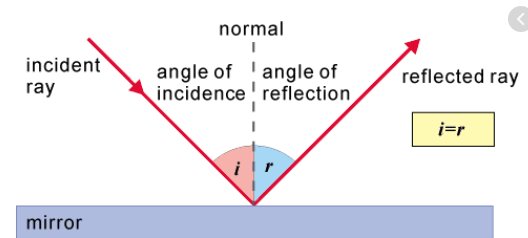
Angle of Incidence = Angle of Reflection: Take One
It’s a deceptively simple piece of science knowledge, isn’t it? Surely it’s more or less self-evident to most people…
How would you teach this? Many teachers (including me) would default to the following sequence as if on autopilot:
Challenge students to identify the angle of incidence as the independent variable and the angle of reflection as the dependent variable.
Explain what the “normal line” is and how all angles must be measured with reference to it.
Get out the rayboxes and protractors. Students carry out the practical and record their results in a table.
Students draw a graph of their results.
All agree that the straight line graph produced provides definitive evidence that the angle of reflection always equals the angle of incidence, within the limits of experimental error.
I’m sure that practising science teachers will agree that Stage 5 is hopelessly optimistic at both KS3 and KS4 (and even at KS5, I’m sorry to say!). There will be groups who (a) cannot read a protractor; (b) have used the normal line as a reference for measuring one angle but the surface of the mirror as a reference for the other; and (c) every possible variation of the above.
The point, however, is that this procedure has not allowed clear and unambiguous feedback on a cognitive operation ( i = r) from the physical environment. In fact, in our attempt to be rigorous using the “formal-investigation-paradigm” we have diluted the feedback from the physical environment. I think that some of our current practice dilutes real-world feedback down to homeopathic levels.
Sadly, I believe that some students will be more rather than less confused after carrying out this practical.
Angle of Incidence = Angle of Reflection: Take Two
How might Engelmann handle this?
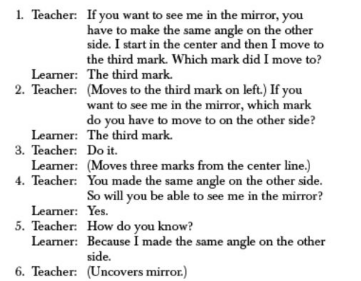
He suggests placing a small mirror on the wall and drawing a chalk circle on the ground as shown:
Theory of Instruction (Kindle Location 8686)
Initially, the mirror is covered. The challenge is to figure out where to stand in order to see the reflection of an object.
Note that the verification comes after the learner has carried out the steps. This point is important. The verification is a contingency, so that the verification functions in the same way that a successful outcome functions when the learner is engaged in a physical operation, such as throwing a ball at a target. Unless the routine places emphasis on the steps that lead to the verification, the routine will be weak. [ . . . ]
If the routine is designed so the learner must take certain steps and figure out the answer before receiving verification of the answer, the routine works like a physical operation. The outcome depends on the successful performance of certain steps.
Engelmann, Siegfried; Carnine, Douglas. Theory of Instruction: Principles and Applications (Kindle Locations 8699-8709). NIFDI Press. Kindle Edition.
Do I want to abandon all science investigations? Of course not: they have their place, especially for older students at GCSE and A-level.
But I would suggest that designing practical activities in such a way that more of them use the physical environment to provide clear and unambiguous feedback on cognitive ideas is a useful maxim for science teachers.
Of course, it is easier to say than to do. But it is something I intend to work on. I hope that some of my science teaching colleagues might be persuaded to do likewise.
A ten-million year program in which your planet Earth and its people formed the matrix of an organic computer. I gather that the mice did arrange for you humans to conduct some primitively staged experiments on them just to check how much you’d really learned, to give you the odd prod in the right direction, you know the sort of thing: suddenly running down the maze the wrong way; eating the wrong bit of cheese; or suddenly dropping dead of myxomatosis.
Douglas Adams, The Hitch-Hiker’s Guide To The Galaxy, Fit the Fourth
The fact narrated must correspond to something in me to be credible or intelligible. We as we read must become Greeks, Romans, Turks, priest and king, martyr and executioner, must fasten these images to some reality in our secret experience, or we shall learn nothing rightly.
–Ralph Waldo Emerson, “History”
The autumn term is always the longest term: that long drag from the wan sunlight of September to the bleak darkness of December. This is the term that tests both the mettle and the soul of a teacher. At the end of it, many of us have cause to echo the gloom of Francisco’s lines from Hamlet — “’tis bitter cold, and I am sick at heart.”
But even when it seems like it’s all over, it’s still not over.
The heavy hand of collective-responsibility roulette has tapped me on the shoulder. It’s my turn to write the scheme of work and resources for the next term. I am to write the energy module for the new GCSE Science course. And it must be done, dusted and finished over the Christmas break. The Christmas break.
And the surprising and unexpected truth is . . . I actually think I’m going to like doing it! Yes, really.
Strange to say, I have always enjoyed writing schemes of work. To my mind, it’s a bit like fantasy teaching instead of fantasy football. I move lesson objectives and resources hither and thither where others shift premier league strikers and goalkeepers.
Some aspects of the Science curriculum are abtruse and hard to communicate. Undoubtedly, some of the things we narrate do not always correspond closely enough to something which is already in students to be either credible or intelligible to them. The images and concepts must be fastened to some reality in their “secret experience” for them to learn rightly.
And what can we do to help them? Simply this: make sure that students get as much hands-on practical work as possible. Of course, it goes without saying (I hope!) that it should go hand-in-glove with coherent and thorough explanations of the theoretical underpinnings of scientific understanding.
One without the other is not enough.
Physics: it’s remarkably similar to Maths. But there’s a point to Physics
Let us hope that our students (in the words of R. A. Lafferty) never see a bird fly by without hearing the stuff gurgling in its stomach.
But it must be remembered, that life consists not of a series of illustrious actions, or elegant enjoyments; the greater part of our time passes in compliance with necessities, in the performance of daily duties, in the removal of small inconveniences, in the procurement of petty pleasures; and we are well or ill at ease, as the main stream of life glides on smoothly, or is ruffled by small obstacles and frequent interruption.
–Samuel Johnson, A Journey To The Western Isles (1775)
Another day, another drachma. (Teachers aren’t paid enough for it to be counted in dollars.) And a new school!
Yes, notwithstanding the fact that I am generally a supine and procrastinating creature of habit, I finally decided to take a plunge and move school. For a number of reasons, the grass looked decidedly greener elsewhere. And although it’s more a cheeky little sidestep than a promotion, so far I would say that it still “feels” right.
So I am now deep into the business of establishing myself in a brand new school. It makes you realise how much we all depend on the unwritten and unspoken rules and expectations that are grist to the mill of every workplace. But these seem writ especially (but invisibly) large in schools, or so it seems to me.
So my working life now is emphatically not a series of illustrious actions, or elegant enjoyments. Rather, it is the bread and butter of teaching: turn up; do thou thy daily duties; attempt to remove or smooth over the inconveniences of life; work to establish relationships; and procure a few petty pleasures for yourself, your colleagues, and your students.
My new school has some excellent policies and procedures. And, of course, some batshit crazy ones too. Some of them make you think that the MAT it belongs to has never read the “Ofsted Mythbusters” page. On the plus side, the Science department has developed a system that makes triple marking almost work.
I have made some other changes too. Although I’ve been working long hours, I have not installed my school email on my phone or my tablet: when I am at home I intend to be at home, without the insatiable monster of work email rearing its ugly, insistent head and colonising my every waking thought — and, sometimes, even my dreams.
And so the main stream of life glides smoothly onwards. So far, at least. Long may it continue.













 e=mc2andallthat