A Letter from Talleyrand: ‘Some Thoughts on Education and Political Priorities’ by Dominic Cummings, aged 39¾

Michael Gove and Dominic Cummings
If Michael Gove can be likened to Napoleon, would that make Dominic Cummings his Talleyrand? (after Charles Maurice de Talleyrand-Périgord 1754-1838, Napoleon’s éminence grise.)

The Duke of Wellington once remarked that the battle plans of Napoleon were made of marble, whereas his own were made of little bits of string. Napoleon’s plans were brilliant and effective, as majestic as a triumphal arch. However, they all shared one fatal flaw: if one little bit went wrong then the whole edifice came crashing down. Wellington said that his own battle plans were different: if one string broke, he would merely knot two other strings together and the plan would continue on.

The pdf what Cummings wrote*  has the feel of man attempting to build a Napoleonic battle plan in order to sort out, once and for all, all the tiresome disagreements about educational policy.

And there’s no denying the man has been busy: he has read a lot. An awful lot. From a very wide range of authors. And it’s quite an interesting and eclectic read.

But it also gives the impression of being no more than an energetic exercise in quote mining, and not a dispassionate investigation of the issues. In other words, I strongly suspect that Cummings read so widely in order to find extracts to support his pre-existing views, rather than thoughts or insights to help form or challenge them.

Reading this document, I was put in mind, more than once, of the fictional doctor, Andrey Yefimitch:

“You know, of course,” the doctor went on quietly and deliberately, “that everything in this world is insignificant and uninteresting except the higher spiritual manifestations of the human mind … Consequently the intellect is the only possible source of enjoyment.”

— Anton Chekov, Ward 6

Cummings laments that “less than one percent are well educated in the basics of how the ‘unreasonable effectiveness of mathematics’ provides the language of nature and a foundation for our scientific civilisation.” That, though true, is not necessarily a reason for lambasting our current education system as “mediocre at best”. For me, this seems a curious priority.

Sir Isaac Newton was roundly criticised by his contemporaries for lacking a solid theoretical foundation for the infinitesimal calculus: Bishop Berkeley accused him of trafficking in “the ghosts of vanished quantities”. A couple of centuries later, the rigorous** notion of a limit laid that criticism to rest. Now of course it is generally better to understand more rather than less, but would learning about the foundational difficulties of the calculus be the most pressing priority of a 18th Century student of Physics? I would argue no, not necessarily.

For my part, I have thought long and hard about the “unreasonable effectiveness of mathematics in the natural sciences” (in Eugene Wigner’s phrase). I have discussed it with students. I think it’s a fascinating issue, and I adore far-ranging, off-spec discussions of this ilk. But is it an educational priority? Not in my opinion.

Other parts of the pdf seem just plain odd to me:

It would be interesting to collect information on elite intelligence and special forces training programmes (why are some better than others at decisions under pressure and surviving disaster?). E.g. Post-9/11, US special forces (acknowledged and covert) have greatly altered … How does what is regarded as ‘core training’ for such teams vary and how is it changing?

— Cummings, p.98

Interesting, sure. These special forces teams are (I presume) made up of already highly-motivated and highly-capable individuals. Cummings overarching priority always seems to be towards the individuals on far right of the “bell curve” (another Cummings hot topic: see pp.13, 20, 67, 224 and others). He genuinely seems to recoil in fastidious horror at the very concept of being “mediocre”.

This essay is aimed mainly at ~15-25 year-olds and those interested in more ambitious education and training for them. Not only are most of them forced into mediocre education but they are also then forced into dysfunctional institutions where many face awful choices: either conform to the patterns set by middle-aged mediocrities (don’t pursue excellence, don’t challenge bosses’ errors, and so on) or soon be despised and unemployed.

–Cummings p.4

Compare with Dr Yefimitch:

Life is a vexatious trap; when a thinking man reaches maturity and attains to full conciousness he cannot help feeling that he is in a trap from which there is no escape.

— Anton Chekov, Ward 6

Apparently, Mr Cummings plans to leave the DoE and take up the headship of a Free School. Although I have serious reservations about the Free School programme, I welcome this as an encouraging example of a politician putting his money where his mouth is. And I wish him well. I genuinely do.

However, from my own experience I have to say that I do not think his abstract philosophy will be as reliable a guide for navigating the choppy waters of a headteacher’s life as he believes it will be.

I have quoted from Chekov’s Ward 6 already. This masterful short story is the best description I have ever come across of the result of a collision between a man with an abstract philosophy and real life. In a discussion with a lunatic, Dr Yefimitch proposes that: “There is no real difference between a warm, snug study and this [cold, freezing] ward … A man’s peace and contentment do not lie outside a man, but in himself.” However, disaster strikes and he is committed to the asylum:

Andrey Yefimitch was even now convinced that there was no difference between his landlady’s house and Ward No. 6, that everything in the world was nonsense and the vanity of vanities. And yet his hands were trembling, his feet were cold, and he was filled with dread…

Now, I am not suggesting that our Dom will end up in an insane asylum, or even cold, hungry and alone. What I suggesting is that since one Free School head of what might be described as “the-how-hard-can-it-be?” tendency has, sadly, already bitten the dust, Mr Cummings may find that running a school (or just being a plain old teacher for that matter) requires far more than is dreamt of in his philosophy.

Unless, that is, he learns to make his plans out of string rather than out of marble…

______________________________________________________

* This joke ©Morecambe and Wise c.1972, as are most of the rest of my jokes
** Now where have I heard that word before?

I Will Have At Thee With Mine Index Finger! Or, Two Thumbs Good

Not for the first time, I did a double take during a lesson today. Out of the corner of my eye, I thought one student was texting. During an AS Physics lesson? Shameful! This behaviour cannot and must not be tolerated!

Screenshot 2023-04-08 11.05.35

But she wasn’t texting at all. She was actually using her scientific calculator to solve projectile problems exactly as I’d asked her to do — but using her thumbs to press the keys rather than her fingers. And she was holding the calculator in exactly the way she would hold a smartphone when texting.

Possibly this seems unremarkable to you. I guess it depends on your generation. It seems remarkable to me. Let me explain why.

Similar to my first calculator, but ours had even more keys.

I still remember the first scientific calculator that entered my parents’ house. It was a hulking unwieldy thing with a primitive red LED display that completely drained a 9V battery after barely an hour of use; it also had what seemed like a button for each and every function (e.g. a separate button for both sine and inverse sine), since the SHIFT key had yet to be invented. It was still hailed as a liberator, since it freed me from the tedium of looking up values in printed, mark you, printed log and sine tables.

The calculator was placed flat on the table, or held in my left hand, and the keys pressed using my right index finger. It’s the way I still use a calculator today.

Not so the young folks of today. They have been raised from birth using a variety of teeny tiny little keyboards. I don’t know if it was a lone, unsung genius who figured out that holding a touch screen keypad firmly in both hands and operating the keys using two thumbs was preferable to the I-shall-stab-at-thee-with-mine-index-finger method, or whether it hailed from the mind of Steve Jobs or his minions, but the technique has conquered the world.

Even I use it with my phone these days, although at such a slow, cack-handed pace that it makes any teenagers in the vicinity wince with frustration.

And why do I think that this is worth commenting on? Because this is an example of a real live copper-bottomed twenty-first century skill. It is an efficient, effective way of interacting with mobile electronic technology

You know the “Shift Happens“* brigade, those folks who say that the current education system is not teaching the skills necessary for the world of tomorrow?

Well, taught or not, it seems that some of the “skills of tomorrow” are developing apace. And I think that it is a skill that could not have been anticipated by any futurologist. It developed to meet a need to input data quickly and accurately on a mobile device.

But you know what has not changed for the student I mentioned above? The mathematical knowledge required to press the number and function keys in the correct sequence. I may not have taught my students the “two thumbs” input technique, but at least I taught them the mathematical foundations required to use a calculator to solve Physics problems. The other stuff they were able to teach themselves. (Good thing too, because I don’t think I could.)

I feel that examples like this quite take the wind out of the sails of those who claim that traditional teaching is too “old hat” to be taken seriously: it’s the traditional skills that provide the footing for the new skills. I think that we ignore that truth at our peril.

Screenshot 2023-04-08 11.07.48

The fact is that human beings have adapted successfully to many novel changes in the past. The likelihood is that we will continue to do so, albeit in ways that may well be surprising and unexpected. But the point is, we generally build on or adapt things which have worked in the past. Evolution rather than revolution if you will.

I think that too many people have claimed oracular powers to see into the future and thus justify the revolutionary changes they wish to make to the education system. Frequently these appeals sound plausible and have emotional power, with phrases like flexibility and creativity and breaking the factory model, but as Tom Bennett points out in Chapter 9 of his excellent Teacher Proof, these buzzwords are about as deep and thoughtful as they go. Pragmatic Education also also does a good job of taking down one of these oracles in a recent post.

There is no royal road to educational nirvana, no quick revolutionary fix to make people learn without effort and hard work.

Do you want me to walk otherwise than with my feet, and to talk otherwise than with my mouth?
— Voltaire, Philosophical Dictionary

I think that, as Voltaire suggests, we will continue to walk with our feet and talk with our mouths for a long whiles yet. But we may well be typing more with our thumbs…

*The Youtube video that has launched a thousand CPDs

Weasel Words in Education Part 2: Work Smarter, Not Harder

Work Smarter, Not Harder!

This is an increasingly common phrase in the education world.

It means, basically, work harder! [FX: WHIP CRACK]

It is often associated, strangely enough, with very poorly thought-out initiatives. Some cosmic karmic balance demands that a lack of cognitive effort by the management is balanced by an excess of cognition by the hapless underlings affected.

Rumour has it that this is especially prevalent in schools that have added the word “Academy” to their letterheads and logos, but scholars disagree if this is a case of causation or mere correlation.

Weasel Words in Education Part 1: Intervention

Intervention (n. and v.)

– as in “What interventions have you put in place?” or “We’ll have to intervention this!” or (even more common) “You’ll have to intervention this!”

Meaning: doing stuff of doubtful or unclear efficacy mainly for the sake of being seen to do some stuff.

Some words sound better than others. For example, “I kicked some butt at work today!” sounds better than “I wrote a stiffly-worded email to query an invoice.”

So with the word intervention. “I staged an intervention to address underachievement in the Year 10 target group” does sound more dynamic, proactive and energetic than “I got a bunch of Year 10s to stay behind after school and nagged them for a bit.”

This is a word beloved of SLTs* and similar riffraff. Essentially, it is a long-winded way of “Do something!”. The unspoken subtext that should be tacked on to the end is “…so that I don’t have to.”

Most interventions happen outside of the normal school day. After school interventions are a perennial favourite. Never mind that most researchers (correctly, in my opinion) identify such activities as “High Effort, Low Impact.”

When the test scores are down and the going gets tough, the tough get . . . some unenthusiastic kids together in a room and read some powerpoint slides at them. Or, get them to do some card sort activities, where cutting out and laminating the cards takes up to seventeen times longer than the bloody card sort activity itself takes to do. Or, nag them. Yes, nag them with as much energy, sincerity and passion as you can summon at the end of a full teaching day when you are knackered and bursting to go the loo.

This is the way to the educational promised land, my friends. To a better place that is overflowing with the milk of EBaccs and the honey of Ofsted-approval, and yet which remains free of the evil spectre of grade inflation!

Let us all put interventions in place now! Interventions today! Interventions tomorrow! Targeted interventions for all!

After all, its not as if the kids were actually taught this stuff in lessons during the normal school day, is it? I mean, it stands to reason, doesn’t it? It’s not their fault that they weren’t listening/trying/paying attention, is it? Otherwise, they wouldn’t need all these sodding ‘interventions’ all the time…

*Senior Leadership Team

Coe, Wilshaw and Ofsted

[T]he community suffers nothing very terrible if its cobblers are bad and become degenerate and pretentious; but if the Guardians of the laws and state, who alone have the opportunity to bring it good government and prosperity, become a mere sham, then clearly it is completely ruined.

— Plato. The Republic 421a (Penguin Classics) (Kindle Locations 2815-2817). Penguin Books Ltd. Kindle Edition.

I am not sure if I agree with Plato about cobblers and the community. As Benjamin Franklin once pointed out: “For want of a shoe…the kingdom was lost.”

However, I think his statement about the Guardians of the state stands. Equally so with the state-appointed guardians of education: Ofsted.

I think Professor Coe (http://www.bbc.co.uk/news/education-24079951) has done the education world a huge service by pointing out that the Ofsted king has no clothes. However, perhaps in the manner of scrupulous academics everywhere, Professor Coe might prefer a more nuanced “the king probably doesn’t have any clothes”.

Coe pointed out that there is no — repeat, no — valid research supporting the “Ofsted model” of classroom observation being either: (a) a reliable tool for assessing teaching quality or effectiveness when cross-referenced with other measures such as student learning gains; or (b) the observation-feedback process leading to an improvement in teaching quality. (See  http://www.youtube.com/watch?v=_-UyGwYHhGY for the section of his talk on classroom observations and http://t.co/AqY7Xqzknw for a link to his slides.)

I don’t know about anyone else but I am staggered by this. As a working teacher who is just about maintaining a precarious foothold on the treacherous scree of middle management, I always thought my seniors and betters had reams of evidence supporting the stuff they were asking us to do. And if they didn’t, well probably their seniors and betters did.

To hear a respected academic say that classroom observation might be “the next Brain Gym” was shocking.

And the Ofsted response? “Tosh and nonsense,” said Sir Michael Wilshaw.  “I don’t know of any headteacher who doesn’t believe that classroom observation isn’t anything other than a help. The fact that we are an inspectorate and we do make judgements has made a huge amount of difference.” According to the TES (13/9/13 p.8):

He said that new figures released this week, showing a 9 percentage point rise in the proportion of schools judged to be good or outstanding, proved that the watchdog’s tougher inspection regime had “galvanised the system”

This is, to my mind, a textbook example of the logical fallacy known as petito principii or “circular reasoning”. The form of this particular logical fallacy is as follows:

Logical Form:

     Claim X assumes X is true.

     Claim X is therefore, true.

Bennett, Bo (2012-02-21). Logically Fallacious: The Ultimate Collection of Over 300 Logical Fallacies (p. 82). eBookIt.com. Kindle Edition.

Let’s see what Wilshaw said again.

  • The inspectorate’s judgements make a huge amount of [presumably positive] difference.
  • Ofsted judgements show that more schools (9 percentage points!) are good or outstanding.

…therefore Ofsted judgements make a huge amount of positive difference.

Now please note that this does not necessarily mean that the conclusion (that Ofsted helps schools improve) is false, but merely that the argument put forward by the Chief Inspector to support that conclusion is fallacious. And it hopefully goes without saying that a fallacious argument is by definition invalid and must be dropped immediately.

The character Chief Brody in the film Jaws once remarked that they needed “a bigger boat”. The Chief Inspector needs a better argument. And in view of the large amount of taxpayers’ money going to support Ofsted, that new argument should be supplied sooner rather than later. As Professor Coe remarked (somewhat plaintively) in his excellent talk: “Just one would be nice.”

H’mm. More rigour, anyone?

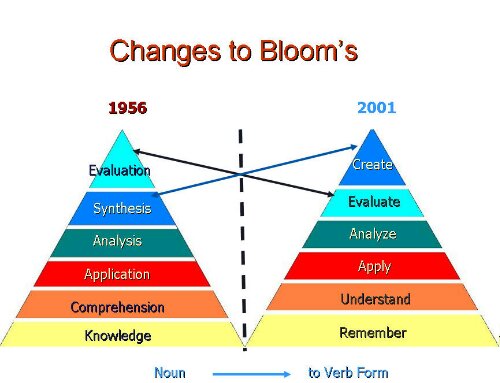
Bloom Schloom; or, some research what I have auto-didactically done

“Use Bloom’s taxonomy here for a quick win with Ofsted!!!!”
— AHT giving lesson observation preparation advice, sometime in 2013. [Note: the multiple exclamation points are to give the reader some indication of the evangelical zeal with which this advice was imparted.]


 “I can’t remember the last time I met a teacher who knew if Bloom’s taxonomy was ever criticised”   — Tom Bennett, Teacher Proof, Kindle Locations 191-192. Taylor and Francis. Kindle Edition 2013

wpid-img8.jpg

I must confess, at the outset, that Bloom’s taxonomy has never sat right with me: for example, is it always the case that creating is always more cognitively demanding than (say) applying? So, creating a story about how the dog ate my homework is more cognitively demanding than applying Einstein’s time dilation equation?

I thought I was alone in my scepticism until I came across Tom Bennett’s comment (quoted above). However, even our very own Ben Goldacre-style enfant terrible of the educational research world doesn’t put the boot in to Bloom’s flipping taxonomy any further, although he does do a good job on knocking down de Bono’s coloured hats (as well as several other pieces of educational “wisdom” that he reveals to be not so wise  — read the book!)

And so I present my Bennett-ian take on Bloom’s taxonomy, the fruit of at least one afternoon of casual internet research — I’m sorry I’ll rephrase that, Ernie Wise-style, as “the research what I have auto-didactically done”. (And please note that I do not mean to imply in any way shape or form that Tom Bennett’s research for his book was as slapdash and cursory as mine…)

A taxonomy is, in its essence, nothing more or less than a system of sorting or classifying. To my mind, Bloom’s taxonomy has more of the feel of a folk taxonomy than a scientific taxonomy. For example, the folk classification of the large plants in a garden as trees, shrubs or flowers would be more than adequate for the average layperson. However, a botanist or gardener would probably require a more rigorous classification system using actual detailed scientific observations of the characteristics of the plants, rather than a handwaving “it’s a bit bushy” or “it looks tree-y”.

At first glance, it might seem obvious that creating is more cognitively demanding than (say) applying. But is it? How do we know? It seems to me that in order to accept this as a fact we need a sound model of how the human mind actually works. Is it always the case that creating always trumps applying? From my (admittedly limited) understanding of neuroscience, it seems to me that creating involves many brain processes and that these are currently poorly understood. The same can be said of the brain processes involved in applying. As a consequence, to place the two in any sort of cognitive hierarchy is, at best, premature.

The danger is that Bloom’s taxonomy is prejudicial in the sense that it assigns relative value to certain nebulously-defined types of thinking. As psychologist Robert J. Sternberg says, such theories “often do not have the clarity in epistemological status” that is required of a scientific taxonomy. So what we are left with is a folk taxonomy common among educational practitioners.

But how common? As Brenda Sugrue notes, even fans of Bloom’s taxonomy do not always agree on the level of a given learning objective: “it might be classified into either of the two lowest levels [ . . . ] or into any of the four highest levels [ . . . ] by different designers.” Sugrue argues that Bloom’s taxonomy:

was developed before we understood the cognitive processes involved in learning and performance. The categories or “levels” of Bloom’s taxonomy … are not supported by any research on learning. The only distinction that is supported by research is the distinction between declarative/conceptual knowledge … and procedural knowledge (which enables application or task performance).

It might seem, therefore, that possibly Bloom’s taxonomy is not even a folk taxonomy within the educational community, but rather it is simply a taxonomy of personal preference with regard to educational objectives.

David Morrison-Love makes the point that “the contribution made by Bloom’s Taxonomy cannot be underestimated, as a communication system derived from classifying different types of exam questions”; but goes on to say that  he does “not view the elements in Bloom’s Taxonomy as successive levels, but simply a collection of equally important intellectual processes I wish to promote and develop in learners; the challenge of which I control.”

Many of the authors cited propose alternative systems to replace Bloom’s taxonomy. At the moment, I am not sure whether any of these are worth considering.

However, the point of this blog post is to warn you that if that ubiquitous multicoloured triangle is flashed without a caveat on to a training screen near you, it could be an indication that the presenter has not done his or her homework, and that his or her assurances that what they say is based on  what ” research shows” may not be as rock solid as they might appear.

REFERENCES

O for a draught of vintage! (Or: Bring back POAE!)

O for a draught of vintage! that hath been

Cool’d a long age in the deep-delvèd earth

— John Keats, Ode to a Nightingale

The Northfarthing barley was so fine that the beer of 1420 was long remembered and became a byword. Indeed a generation later one might hear an old gaffer in an inn, after a good pint of well-earned ale, put down his mug with a sigh: “Ah! that was proper fourteen-twenty, that was!”

— J. R. R Tolkein, The Grey Havens, from The Lord of the Rings

I don’t know about anybody else, but I could do with a draught of the vintage good stuff right about now. I am that old gaffer in the pub muttering: “They should being back POAE, they really should.”

In all probability, only Science teachers of a certain generation (translation: old farts like me) will recognise the acronym P.O.A.E.

For the youthful pups who now seem to comprise the majority of the UK’s teaching workforce, it stands for “Planning, Evaluation, Observing and Evaluating”, the “strands” (dread word!) by which we used to mark practical skills in the good old days of yore, when the world was yet young.

And truth be told, they weren’t all that good. It is only in comparison with more modern iterations that they achieve their near-mythic ‘fourteen-twenty’ status.

One of the jobs I have been studiously avoiding over the summer holidays is to mark a portfolio of Y10 students’ controlled assessment practical work. I am dreading it. The reason is, I have to use the worst mark scheme every developed in the entire history of humankind. Or before. Or, applying a rigorous Bayesian statistical analysis of relevant probabilities, since.

Accuse me of hysterical hyperbole if you will, but take my word for it: this mark scheme is a turkey that out-turkeys all the Christmas lunches served over the past two millennia.

Let me explain. What is the purpose of marking students coursework or controlled assessment? Wearing our summative, assessment-of-learning hats for a moment, the essence of marking in this context is to generate a number that indicates a student’s relative performance. Ideally, another professional marking the same student’s work would generate a similar number.

Using the old-style POAE scheme, I would have to assess a student’s work against 25 hierarchical criteria which would give a “best fit” number out of a maximum of 30 marks. (Boy, this sure is a fun post, isn’t it?) From memory, moderators would tolerate a disagreement of plus or minus 3 marks before adjustment.

Using the modern, rubbish mark scheme, I have to assess a student’s work against, by my count, 67 hierarchical criteria which give a “best fit” number out of a maximum of 64 marks. This takes a while, as I challenge anyone to memorise or internalise the mark scheme.

And the end result: is a mark out of 64 ‘better’ than a mark out of 30? Does it allow a finer discrimination between the performance of students?

In theory: perhaps. In practice: no. It is just another example of assessment-itis:-itis” being the most appropriate suffix in this case as the entire system of assessment is, indeed, inflamed. More is, in fact, less.

As an example, under the old POAE-scheme, the P for Planning strand (dread word!) had 7 criteria and a maximum 8 marks. Using the new mark scheme, I mark the same set of skills which are now labelled as S for Strategy (“Mategy, Categy, Sategy”) and include two individual sub-strands (even more dread words!) with a total of 21 marking criteria and a maximum 16 marks. And . . . it doesn’t tell the student or the teacher anything that the older scheme did not.

It is, in my opinion, a badly-designed exercise in futility which provides no useful guidance or feedback for either student or teacher. Let it be sent forthwith to whatever corner of limbo that clapped-out assessment formats go to die. A curse upon it, and . . .

Sings to the tune of “My Bonnie Lies Over the Ocean”:

Bring back, bring back, O bring back my P-O-A-E, A-E!

Bring back, O bring back my P-O-A-E to me!

The Power of Instruction

“But the power of instruction is seldom of much efficacy, except in those happy dispositions where it is almost superfluous.”
Edward Gibbon, The Decline and Fall of the Roman Empire, Volume 1, p.147.

And so, the A-level Physics results were announced. And . . . they weren’t too bad. Actually, I thought the A2 ones were pretty good. I was pleased. The AS ones were more mixed, but still they were “not too shabby” as Lenny from The Simpsons might say.

Like many other teachers, I spent the previous, fateful Wednesday night sleepless with worry. Mainly selfish worry in my case, I am sorry to confess. Would the results be such that I would be drawn slowly over hot coals by SLT? Thankfully, in the morning, some quick calculations on the back of an envelope helped me to dispel that worry, at least.

The Physics results stacked up well against Biology and Chemistry, and were comfortably above the school average. This is how our current “data driven culture” has affected the behaviour of a typical teacher on the ground. It sometimes seems that we worry more about our percentages than our pupils.

But this post isn’t about that. It’s about a thought that occurs whenever I am complimented on “my” examination results. How much of my students’ success (or failure, for that matter) is actually down to me?

I have helped. Of that I have no doubt. There is a small share of exam glory that belongs to us — we few, we happy few that dare to tread that strange, dazzlingly-lit space in front of the interactive whiteboard.

But I believe that it is a lesser share than is commonly supposed. I know that the public, many parents, most students — and perhaps even the majority of teachers — actually accept this myth of “it’s mainly down to the teacher” as an article of faith. And I think they’re wrong.

Let me suggest an analogy to explain what I mean: “You can lead a horse to water but you cannot make it drink.” I believe that teachers are in a similar situation: you can lead students to knowledge but you cannot make them learn.

Does that mean that I’m a passive, inactive take-it-or-leave-it teacher? Hell, no! I bloody well am not! I am busy jumping up and down pointing out that the water in this here waterhole is ever so nice and cool and clear and I will happily serve it in a golden goblet with a paper umbrella and a cherry on top while singing the hallelujah chorus if only the skittish ponies in my care would just . . . drink. A little bit, please? On some days I’d even settle for a sip. On others, I might even be satisfied it they so much as glanced in the direction of the water.

But the point is: the ultimate decision to learn or not to learn is theirs, not mine. Oh, I can come up with all sorts of ingenious activities to keep them occupied and busy, but busy does not equate to learning. In fact, it is my considered opinion based upon both my experience as an A-level student (many, many moons ago) and as a teacher that, particularily at A-level, the most important learning often takes place outside the classroom.

What we do in the classroom is encourage, signpost and help students overcome the occasional obstacle or misunderstanding. For the most part, the magic of genuine learning happens out of our sight.

A while back, an ex-student sent me an email which I still read now and then when I am dispirited or discouraged. The student wrote: “Life at university has been great, but you can’t imagine the number of times that I’ve wished that learning in life was as easy as learning in your classes back then.”

I am touched and honoured that the student felt that way, but feel I must acknowledge that the student’s own efforts did the lion’s share of the heavy lifting. This student — amongst many others that I have had the privilege of teaching — had that “happy disposition” that meant (in my opinion) that my instruction was “almost superfluous”.

Almost superfluous. But not, by any means, completely superfluous. Just “almost.” And that makes me smile.

This was the feeling that made the opening quote from Edward Gibbon resonate with me. But I find some wise words from Machiavelli also carry weight: “God is not willing to do everything, and take away that share of glory that belongs to us.”

A small share of our students’ glory is a teacher’s portion, and for many of us, it’s actually the best part of the job.

The Woman Who Is Kicking the Hornets’ Nest

So, I’m reading  Seven Myths about Education.  Just like most of the rest of the teaching blogosphere, I suspect. And just like most of the rest of the teaching blogosphere, I have an opinion about it. Several, as a matter of fact. And since I am now about halfway through, I thought I’d share my thrupence’ worth.

To begin with, is Ms Christodoulou more like the boy who cried that the king had no clothes or the boy who cried wolf?

For my money, she is more the former than the latter. I think the estimable Ms Christodolou is calling time on some pretty dodgy ideas.

Some ideas are as ubiquitous and seemingly essential as air, but as Joseph Joubert correctly opined: “A thought is a thing as real as a cannonball”.  And in some circumstances, the wrong idea can be more dangerous than a large round metal ball travelling at close to the speed of sound.

Now teaching-wise, I have to confess that I have been around the block a few times. I am the definitive “old fart in the staffroom”. Like many old farts, I could bring myself to believe that oftentimes it is not what Ofsted actually said that was the main problem, but what all-too-many people thought that Ofsted said: some half-remembered, half-digested soundbite from some godforsaken half-decade-old CPD.

Christodoulou marshals some convincing evidence that often it is the actual demands of Ofsted that create the problem. It seems that Ofsted genuinely do not like didactic teaching, and we’re not just imagining it. Christodoulou presents some damning examples of the current vogue of trashing “teacher talk” from inspection reports. Whether Wilshaw will be able to rein in the “talk-less-teaching” rottweilers on his staff is open to debate. Large organisations can have a momentum as stubborn as supertanker and carry on going in the same direction for mile after mile, whatever the frantic signals from the wheelhouse say.

One of the passages that resonated most strongly with me was this:

For example, in a project that involved pupils writing any type of extended writing … I would provide them with a helpsheet summarising what they should put in each paragraph. […] Rather than breaking down the individual components required to write good reports and teaching those, I was asking students to write a report and then giving them a few cheats or hints about how to do it. It is rather like teaching pupils a few cheats or hints that would help them play a certain song on the piano, while neglecting to teach them the scales and musical notation.
— Location 1727, Kindle edition

Been there, done that, smugly uploaded the worksheet on to the TES Resources website…

She quotes psychologist Dan Willingham: “the most general and useful idea that cognitive psychology can offer teachers [is to] review each lesson plan in terms of what the student is likely to think about.”

Christodoulou argues that teaching (say) Romeo and Juliet by getting the students to make fingerpuppets of the main characters is counterproductive because the students spend more time thinking about making fingerpuppets rather than Romeo and Juliet. “That is not to say that … puppetmaking [is] unimportant. The problem is that this lesson . . . was supposed to be about Romeo and Juliet. If the aim of the lesson was … how to make a puppet, it would have been a good lesson. Not only do these types of lesson fail in their ultimate aims, but because they are so time-consuming, they also have a very significant opportunity cost.”

I agree with Christodoulou that direct instruction is often the most effective form of teaching. Now don’t get me wrong, I am not proposing that teachers spend the whole of the lesson talking at their charges. What I am saying is that students’ thinking should be channelled to engage as directly with the concepts being taught as possible. And at the heart of good teaching is clear, succinct, unhurried teacher talk.

The fingerpuppet stuff I have done, but only to pass observations. Sadly, honesty is not the best policy these days.

A while back, Arnold Schwarzenegger was The Terminator: robot on the inside, human on the outside.

Call me the The Didactor: steely-eyed, garrulous, “I’ve-got-a-banda-and-I’m-not-afraid-to-use-it” old-school (hah!) schoolteacher on the inside; cuddly, Ofsted-friendly, near-mute “lesson-facillitator” on the outside (readers of a certain generation are invited to think of a cross between Fingerbobs and Marcel Marceau).

Sigh, I wish. I got a 3 (“Requires improvement”) in my last lesson observation.

The secret of success is sincerity. Once you can fake that you’ve got it made.

— Jean Giraudoux

More sincere faking is required on my part, I feel.