Nature abhors a change of flux.
D. J. Griffiths’ (2013) genius re-statement of Lenz’s Law, modelled on Aristotle’s historically influential but now debunked aphorism that ‘Nature abhors a vacuum’
A student recently asked for help with this AQA A-level Physics multiple choice question:

This question is, of course, about Lenz’s Law of Electromagnetic Induction. The law can be stated easily enough: ‘An induced current will flow in a direction so that it opposes the change producing it.’ However, it can be hard for students to learn how to apply it.
What follows is my suggested explanatory sequence.
Step 1: simplify the diagram using the ‘dot and cross’ convention
When the switch is closed, a current I begins to flow in coil P. We can assume that I starts at zero and increases to a maximum value in a very small but not negligible period of time.

Step 2: consider the magnetic field produced by P
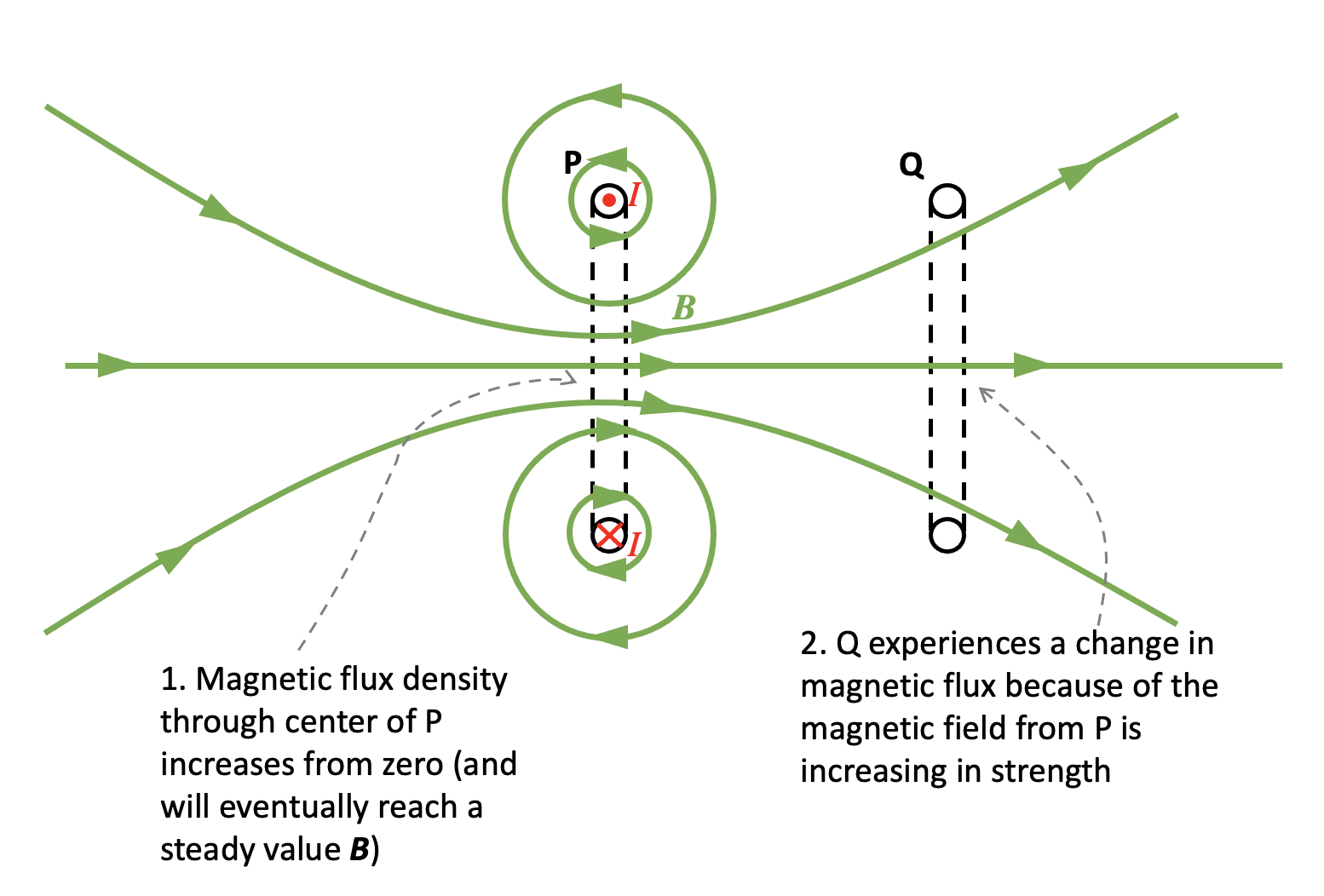
You can read more about a simple method of deducing the direction of the magnetic field produced by a coil or a solenoid here.
Step 3: apply Faraday’s Law to coil Q
Since Q is experiencing a change in magnetic flux, then an induced current will flow through it.
Step 4: apply Lenz’s Law to coil Q
The current in coil Q must flow in such a direction so that it opposes the change producing it.
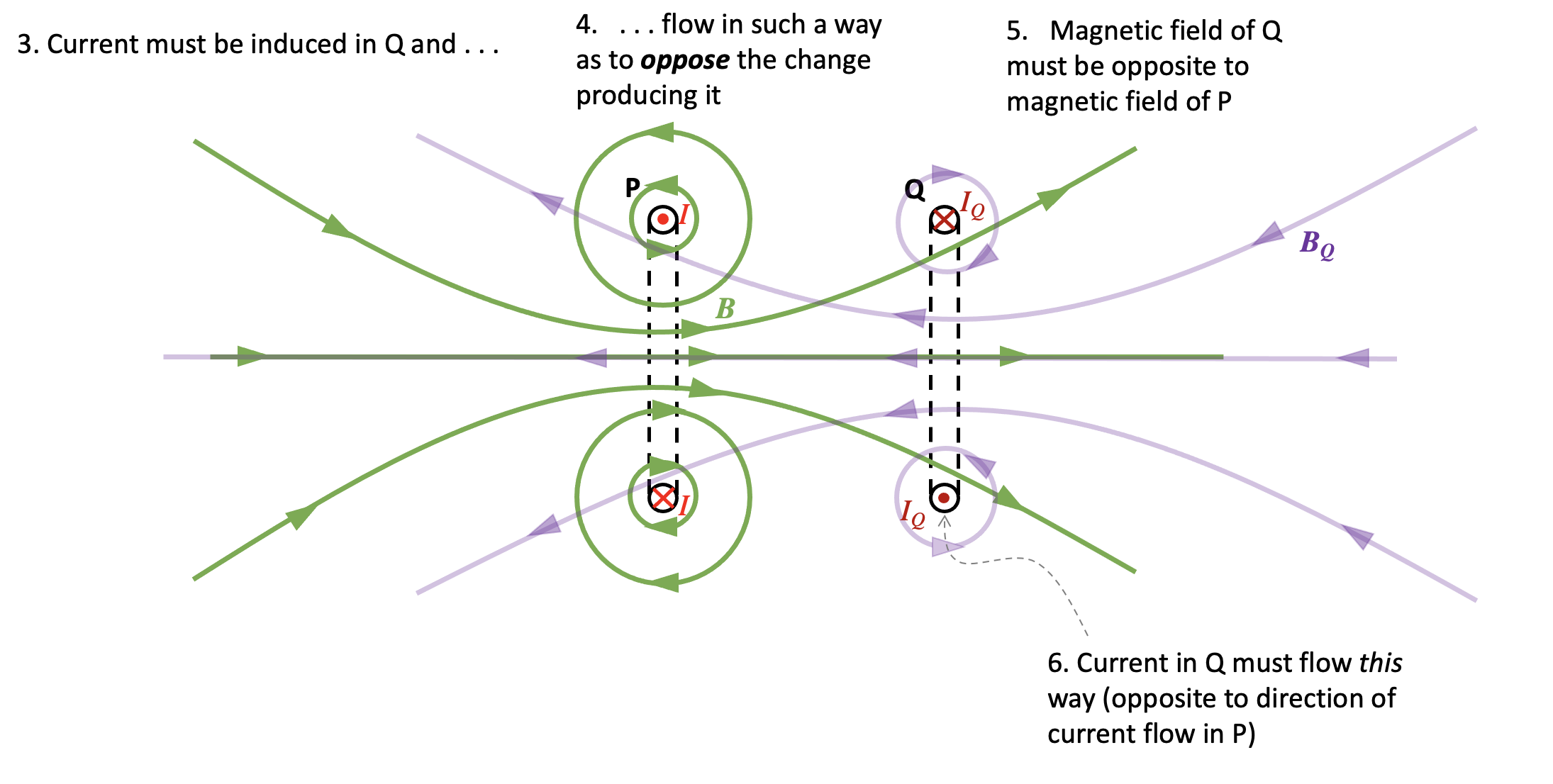
Since P is producing an increasing magnetic flux through Q, then the current in Q must flow in such a way so that it tries to prevent the increase in magnetic flux which is inducing it. The direction of the magnetic field BQ produced by Q must therefore be opposite to the direction of the magnetic field produced by P.
Step 5: consider the polarity of the magnetic fields of P and Q
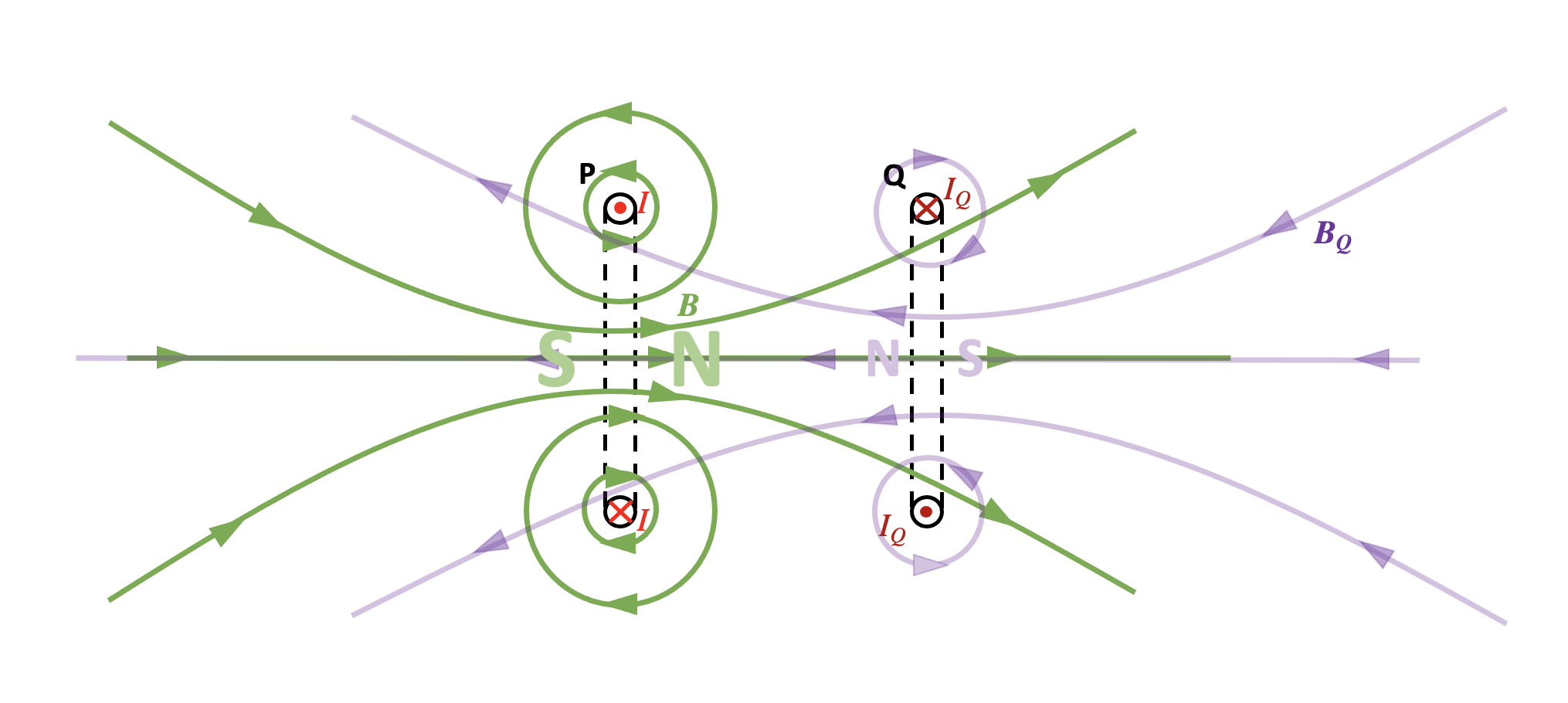
We can see the magnetic field lines of coil P produce a north magnetic field on its right hand side. The magnetic field of Q will produce a north magnetic field on its left hand side. Coil P will therefore push coil Q to the right.
It follows that we can eliminate options A and C from the question.
Step 6: What happens when the magnetic field of P reaches its steady value?
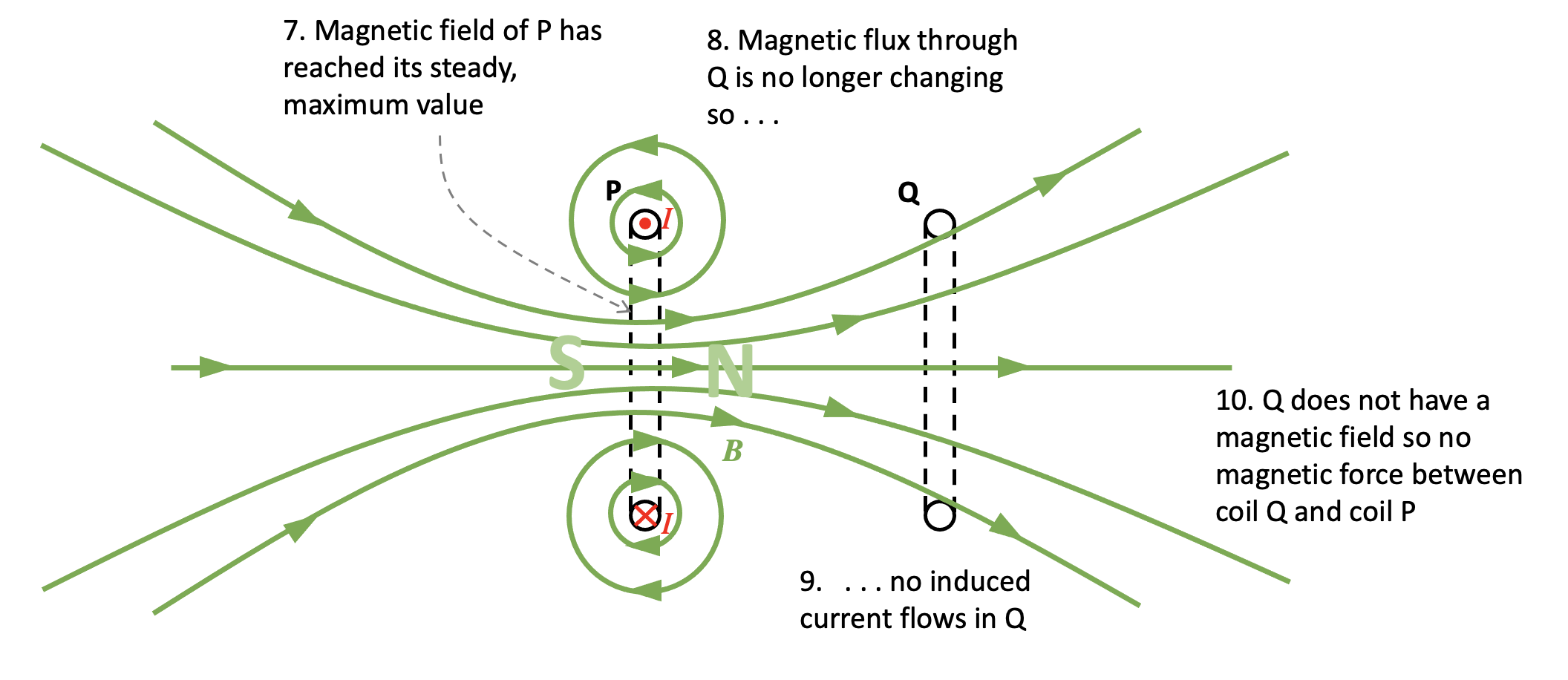
Because the magnetic field produced by coil P has how reached its steady maximum value, this means that the magnetic flux through coil Q also has a constant, unchanging value. Since there is no change in magnetic flux, then this means that no emf is induced across the coil so no induced current flows. Since Q does not have a magnetic field it follows that there is no magnetic interaction between them.
The answer to the question must therefore be D.
Step 7: check student understanding

For the alternative question, the correct answer of C can be explained by going through a process similar to the one outlined above.
- When the switch is opened, the magnetic flux through Y begins to decrease.
- A changing magnetic flux through Y induces current flow.
- Lenz’s Law predicts that the direction of this current is such that it opposes the change producing it.
- The current through Y will therefore be in the same direction as the current through X to produce a magnetic field in the same direction.
- The coils will attract each other.
- Eventually, the magnetic flux produced by coil X drops to a constant value of zero.
- Since there is no change in magnetic flux through Y, there is no induced current flow through Y and hence no magnetic field.
- There is no magnetic interaction between X and Y and therefore the force on Y is zero.
Conclusion
I hope teachers find this detailed analysis of a Lenz’s Law question useful! As in much of A-level Physics, the devil is not in the detail but rather in the application of the detail. Students who encounter more examples will have a more secure understanding.
Reference
Griffiths, David (2013). Introduction to Electrodynamics. p. 315.
 e=mc2andallthat
As a physics enthusiast, I found this detailed breakdown of Lenz’s Law incredibly insightful. The step-by-step approach (https://quebecelectricien.ca/) to simplifying the problem and applying Lenz’s Law makes a complex concept much more digestible. It’s clear that understanding the nuances of electromagnetic induction requires not just memorization but also the ability to apply principles in varied scenarios. The use of diagrams and logical reasoning to eliminate incorrect answers is particularly helpful. For anyone studying A-level Physics, this kind of thorough explanation is invaluable for mastering challenging topics like this one.
Perfectly explained, Thank you https://quebecelectricien.ca/