The Care And Feeding Of Ripple Tanks (Part One)

And so they’re back — ripple tanks, that is. And a Required Practical to boot!

They were a staple of Physics teaching when I started my career, but somehow they fell into an undeserved desuetude. I know many fine teachers and excellent technicians who have never used one in anger, which is a real pity, since they are a great teaching tool.

So I present here my eclectic mix of ripple tanks: what you really need to know.

The Basics: “Look at the shadows, honey, look at the shadows!”

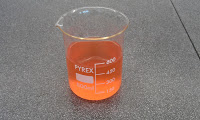
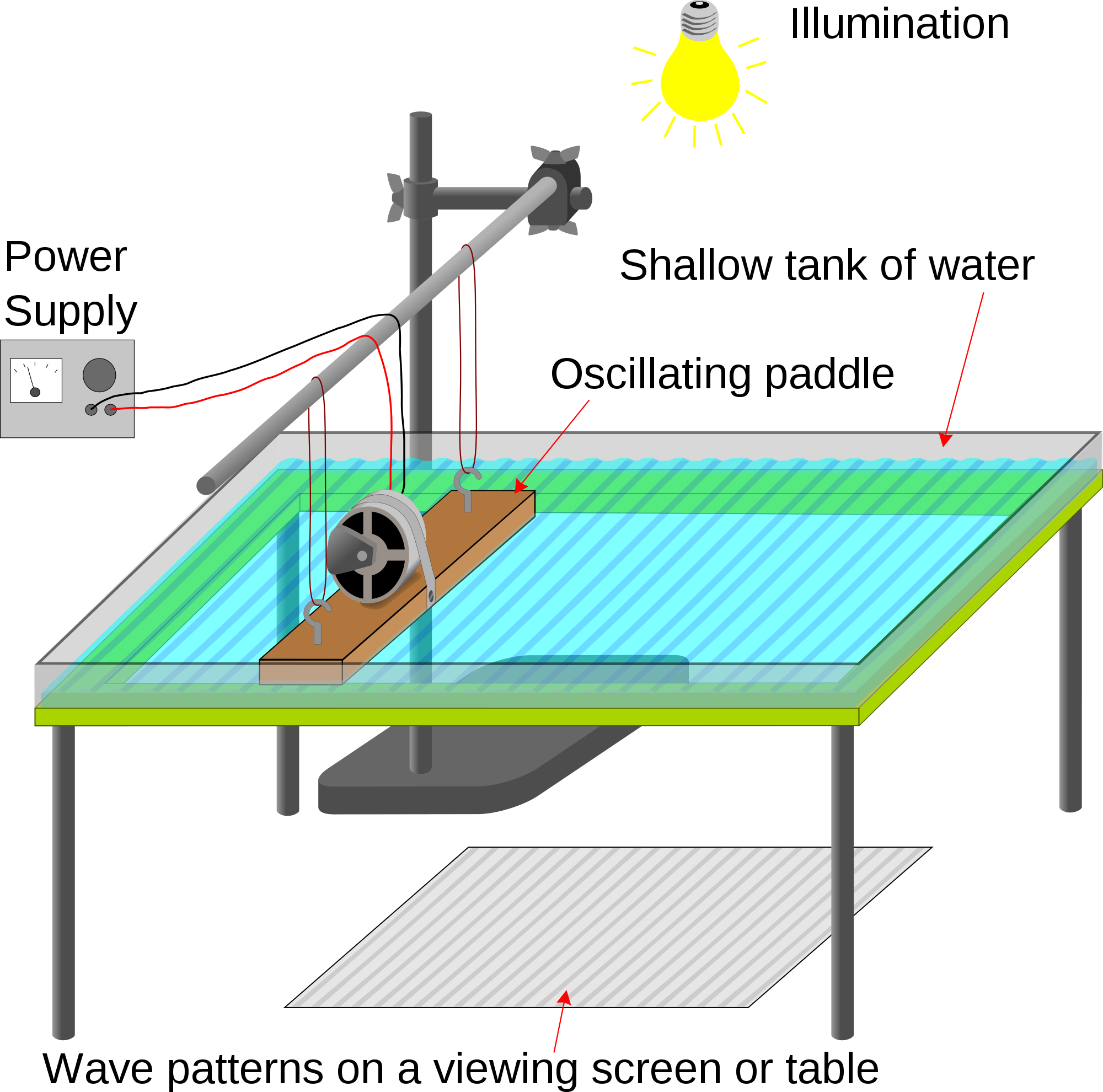
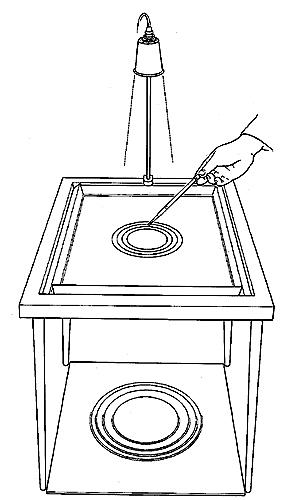
A ripple tank is simply a container with a transparent base. The idea is to put water in the container and make waves or ripples in the water. A light source is positioned above the water so that a screen underneath the transparent tank is illuminated. The crests and troughs act as converging and diverging lenses and produce a pattern of light and dark lines on the screen which enables us to observe wave behaviour more easily.

Remember: look at the pattern of shadows on the floor or bench top, not the ripple tank itself.

If doing this as a demo, sight lines will usually be a bitch for your class. If you have an old fashioned OHP, just put the tank on top of it and project the shadow pattern on to a wall or screen. Alternatively, experiment with positioning the light source underneath the tank and projecting the pattern on to the ceiling.

“Water, Electricity, Children and Darkness: What Could Possibly Go Wrong?”

The ripple tank works best in subdued lighting conditions. Make sure that walkways are free of bags and other trip hazards. If you want students to complete other work during this time, giving them desk lamps (e.g. the ones used by biologists for microscopes) can be useful, and can actually create a nice atmosphere.

Have some towels ready to mop up any water spills.

Most ripple tanks use a low voltage (12V) bulb and vibration generator (0-3 V) to minimise any electrical hazards involved. Be vigilant when plugging in the low voltage supply to the mains and ensure that the mains cable stays dry.

Fill ‘Er Up!

Have a large plastic beaker handy to fill and drain the ripple tank in situ. Don’t try to fill a ripple tank direct from the tap and carry a filled ripple tank through a “live” classroom — unless you want to risk a Mr Bean-type episode. (But you may need to add more water if demonstrating refraction — just enough to cover the plastic or glass sheet used to change the depth.)

In general, less is more. The ripple tank will be more effective with a very shallow 2-3 mm of water rather than a “deep pan” 2-3 cm.

Use the depth of water as a “spirit level” to get the ripple tank horizontal. Adjust the tank so that the depth of water is uniform. (If this seems low tech, remember that it is likely that ancient Egyptians used a similar technique to ensure a level platform for pyramid building!)

It’s also helpful to try and eliminate surface tension by adding a tiny amount of washing up liquid. I dip the end of a thin wire in a small beaker of detergent and mix thoroughly.

And so it begins…

Before switching on the vibration generator etc., I find it helpful to show what a few simple manually-created waves look like using the tank. Using a dropping pipette to create a few random splashes can be eye catching, and then showing how to create circular and straight wavefronts by tapping rhythmically using  the corner of a ruler and then a straight edge.
It’s Not All Relative: Five Things That Einstein Never Said

We have all done it, haven’t we? Each and every one of us has, at some point, appropriated (or misappropriated) a quotation from a great thinker or writer to lend a spurious profundity to our own footling little thoughts.

While it may be well-nigh irresistible to wrap ourselves in the borrowed robes of literary or scientific genius, the temptation is fraught with dangers. To spare both our own blushes and those of our unsuspecting audience, it’s a good idea to check whether the Great Person actually said what they are reputed to have said.

For one reason and another, the life, career and reputation of Albert Einstein makes him an especially tempting target for spurious attributions.

This is my eclectic list of five things that Einstein did NOT say, and yet seem to be quoted and requoted again and again, especially in an educational context.

It is a melancholy truth that these particular memes will most likely be circulating on the internet until the last router rusts away to nothingness. However, on the principle that it better to light a candle than complain about the dark, I present this list (although, given their preternatural persistence, a flamethrower might be more appropriate).

Watch out, any one of them may well be coming to a CPD near you sometime soon…

Nein-stein No. 1

Everyone is a genius. But if you judge a fish by its ability to climb a tree, it will live its whole life believing that it is stupid.

This, according to Quote Investigator [QI 1], was first attributed to Einstein as recently as 2004. The original allegory about animals attending a school and being judged against inflexible criteria, can be traced back to physicist Amos E. Dolbear who published it under a pseudonym in 1898.


Nein-stein No. 2

Everything is energy and that’s all there is to it. Match the frequency of the reality you want and you cannot help but get that reality. It can be no other way. This is not philosophy. This is physics.

Philosophy this gem certainly isn’t. Sadly, it bears no relation to any recognisable form of Physics either. (“Pass the bag labeled ‘New Age Quantum Claptrap’ please, Alice.”)

The original form of this quotation was penned by special effects artist Darryl Anka in 1998 — forty years after Einstein had shuffled off this mortal coil (or, at least, had become significantly less ordered).

Incidentally, Anka never attempted to attribute this thought to Einstein. In fact, he claimed that it had been obtained via “trans-dimensional channelling” from an extraterrestrial entity named “Bashar”. [QI 2]


Nein-stein No. 3

Two things inspire me to awe: the starry heavens and the moral universe within.

A beautiful quote, but Einstein? Naaaah. From Immanuel Kant’s Critique of Practical Reason (1788), actually. Highbrow enough for ya? [Ref 1]


Nein-stein No. 4

The definition of insanity is doing the same thing over and over and expecting different results.

Not Einstein. Not Benjamin Franklin. Not Rita Mae Brown either. The earliest instance tracked down by Wikiquote was from a Narcotics Anonymous publication from 1981.


Nein-stein No. 5

Two things are infinite: the universe and human stupidity. Actually, I’m not sure about the universe.

Einstein may or may not have said this, but the only evidence we have is from the works of therapist Frederick S. Perls, who credited the quote to a “great astronomer” in a book published in 1947. In later works, Perls specifically named Einstein as the originator of the quote which was said during a personal meeting with Perls. However, Perls did present different versions of the statement over the years. [QI 3]

The Renaming of Parts; or, Energy is the New Orange

image

A PC approach to energy?

Neil Atkin recently wrote a fascinating post about the “New” approach for teaching the concept of energy to secondary school students, and provides some interesting commentary and some very useful links: go read!

I first came across the work of Ogborn and Boohan, on which much of the “New Approach” is based, in the 1990s. I remember embracing it enthusiastically. However, I subsequently returned to the more “traditional” kinetic-chemical-heat-potential-light-sound “naming of parts” model, mostly because many of the resources favoured by our students followed the older convention.

And so it has remained for a number of years, so I was all set to give the “New Approach” a proper rubbishing (as might be gleaned from my selection of the Gary Larson cartoon above) as a specious form of PC — physical correctness as opposed to political correctness, perhaps.

But as I read more about the “New Approach”, I gradually came to the conclusion that it is conceptually sound. More importantly, I think it follows one of the basic principles suggested by Engelmann and Carnine:

[I]f we are to understand how to communicate a particular bit of knowledge . . . we must understand the essential features of the particular concept that we are attempting to convey. Only if we understand what it is and how it differs from related concepts can we design a communication that effectively conveys the concept to the learner.
The Theory Of Instruction, location 296

In other words, I think the “New Approach” is a more accurate representation of the physics of energy, and less likely to lead to misconceptions and false inferences.

Energy Is The New Orange

image

Read Dr Dav’s excellent blog post from 2013 for a clear summary of the arguments in favour of the New Approach, as well as Robin Millar’s excellent paper on the topic.

Rise of the Enoji

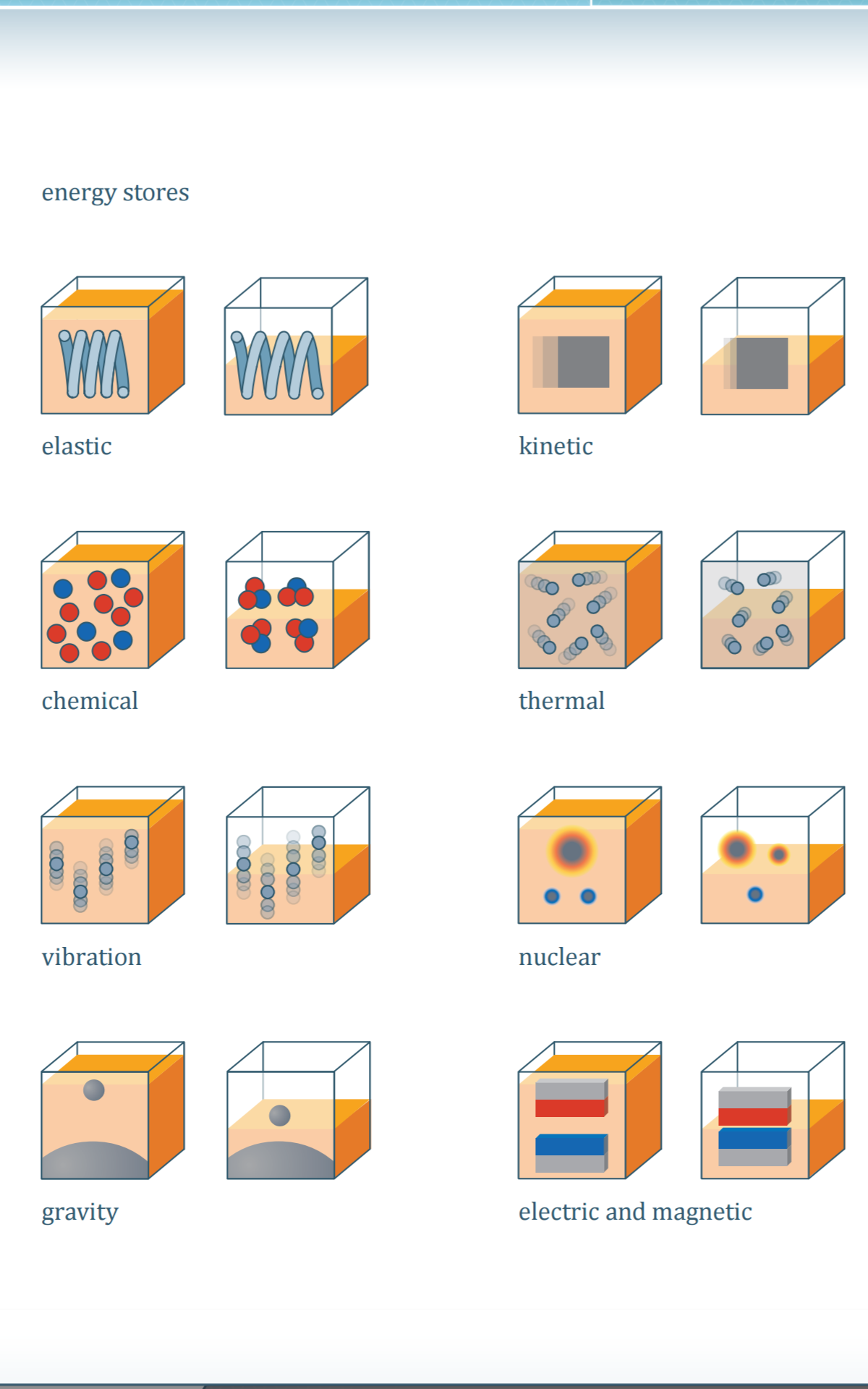
One of the suggestions made in the IOP’s Energy 11-14 is to use ideograms or icons to represent different energy stores.

image

By analogy with the ubiquitous ’emojis’ I suggest that we should call these energy icons Enojis. Who knows, it could just catch on…

They Wouldn’t Let It Lie: The Twelve Physics Pracs of Gove (Part 3)

image

One time a whole lot of the animals made up their minds they would go shares in building a house. There was old Brer Bear and Brer Fox and Brer Wolf and Brer Raccoon and Brer Possum — everyone right down to old Brer Mink. There was a whole crowd of them, and they set to work in building a house in less than no time.

Brer Rabbit was there too, of course, but he said it made his head swim to climb up the scaffold and build like the others, and he said too that he always got sun-stroke if he worked in the sun — but he got a measure, and he stuck a pencil behind his ear, and he went round measuring and marking, measuring and marking. He always looked so busy that all the other creatures said to each other that Brer Rabbit was doing a mighty lot of work.

And folk going along the road said that Brer Rabbit was doing more work than anyone. But really Brer Rabbit wasn’t doing anything much, and he might just as well have been lying by himself in the shade, fast asleep!

Brer Rabbit Gets A House by Enid Blyton

Of all the things that could be dumped overboard during a radical curriculum overhaul, the dreadful, unholy mess known variously as “controlled assessment” or “coursework” or “practical assessment” (but whose names are actually legion) would certainly get my vote.

So, I was actually faintly encouraged by the reformed A-levels insistence that students have to DO twelve “required” practicals, and that all schools have to provide is evidence that their students have DONE those practicals to allow a “practical endorsement” to be ticked on exam certificates. Assessment of students’ practical skills would be in the final examinations.

In my naivety, I thought that a set of properly written laboratory notebooks would be sufficient evidence for the practical endorsement to be awarded. I actually enjoyed explaining the protocols for keeping a lab book to our AS Physics group; for example, the idea that it should be a contemporaneous working document, replete with mistakes and crossings out — proper science in the raw, so to speak, warts and all. And not a suspiciously pristine, antiseptic and bowdlerised “neat” copy. And I thought our students responded gamely to the challenge, even down to worrying whether the pen with erasable ink counted as an ‘indelible pen” or not.

But, goddammit, the latest email from our exam board shows that the JCQ wouldn’t let it lie, they wouldn’t let it lie.

Now, we have to minutely “track” (dread word!) our students’ practical skills, verily even unto recording onto the Holy Spreadsheet if we have indubitable observational evidence of each student reading an Instruction sheet or not.

Oh deary deary me. It calls to mind Wilfred Owen’s memorable lines about being fit to “bear Field-Marshal God’s inspection”.

But it won’t be Field-Marshal God inspecting us. Instead, it will be a vast floppy-eared army of snaggletoothed practical-assessor-Brer Rabbits, hopping all over the land, measuring and marking, marking and measuring…

I give up: this seems to me like defeat, a return to the discredited and unlamented paradigm of controlled assessment. This is defeat, a totally avoidable defeat that has been snatched from the ravening jaws of victory…

The Twelve Physics Prac of Gove Part 1
The Twelve Physics Pracs of Gove Part 2
Bring Back POAE!

PIXL: panacea or poison?

“How the understanding is best conducted to the knowledge of science, by what steps it is to be led forwards in its pursuit, how it is to be cured of its defects, and habituated to new studies, has been the inquiry of many acute and learned men, whose observations I shall not either adopt or censure”.
–Samuel Johnson, The Rambler, April 1750

A colleague described a recent visit to a highly successful science department that has drunk mighty deep of the PIXL well. I shall summarise some of her observations and comments below. My reactions varied from intrigued to puzzled to horrified, but in keeping with the Johnson quote above, I shall endeavour to urge neither adoption nor censure — at least until I have thought about it some more.

Item the first: textbooks are forbidden. Students are taught from in-house PowerPoints and worksheets which are made available online for individual study by students. My colleague reported that she visited several classes in the same year group, and all the teachers were teaching the same topic with the same PowerPoint — and were often on exactly the same slide at the same time! Reportedly, this system was set up because science leaders were not satisfied with the quality of lessons being planned by individual teachers. For myself, I couldn’t help but be reminded of the Gaullist education minister who claimed to know which page of which textbook children throughout France would be studying on that very day . . .

Item the second: science leaders have exhaustively analysed the GCSE exam board specification to produce the materials mentioned above. Every learning point is translated into “student friendly” language and covered in detail. My information is that a typical starter activity might be for students to copy down a summary of important information from a PowerPoint, before practising application using worksheets and past paper questions. These are often peer marked. Since planning and resource making have been centralised, the workload of the classroom teacher appeared to be more manageable than in many schools.

Item the third: students are regularly tested. Test papers are gone over with a fine tooth comb by the science team and areas of weakness identified. These are addressed in large, multiclass study skills sessions led by the head of science in the assembly hall, teaching from the front (brave woman!) using an old fashioned OHP and transparencies! (Sigh! Now that takes me back: I can almost smell the banda machine solvent as we speak.) Students are sat at exam desks for the session, and the hall is supervised by teaching staff and SLT (including the headteacher on the day my colleague visited). This is followed by a “walk and talk” mock (i.e. the answer is modelled by the Head of Science on her trusty OHP), followed by individual exam practice under exam conditions.

And so we come to the question: shall we adopt or censure these observations?

The truth is: I am not sure.

On the one hand, I can see how this might be a rapid and effective way to improve results, especially in a school with an inexperienced science team. And the part of me that actually likes writing schemes of work and resources would relish the challenge of developing such a scheme. And I’m told that percentage science pass rates improved significantly from the low teens to the high eighties . . . over the course of a single year! And you can’t really argue with such success, can you? (Actually, yes you can — see this post on the Halo Effect) Also as Lt. Worf of the starship Enterprise once observed: “If winning isn’t important, why keep score?”

And yet . .

Part of me rebels at such regimentation. Is this an example of the “mcdonaldisation” of education, the continuing process of deskilling the classroom practitioner? I genuinely hate to say this, but given this model maybe Sir Ken Robinson has a point; although this particular iteration seems to owe more to Taylorism rather that the nineteenth century workhouse.

Use another teacher’s PowerPoint? Ugh! I’d rather be forced to use his toothbrush . . .

And, while I grant that many examination questions are indeed fit for purpose and thoughtfully designed to expose misunderstandings and misconceptions, I cannot help the feeling that our examination system has become an overly-powerful tail wagging an emaciated dog.

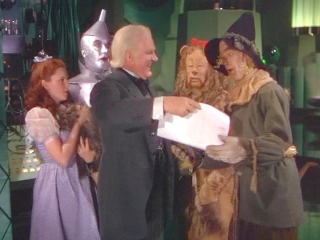
Is learning truly synonymous with exam success? Have we become so enamoured of the assessment of learning rather than learning itself that we, like the Scarecrow in The Wizard of Oz, would not consider ourselves truly learnèd unless we hold a diploma saying that we are?

image
Why, anybody can have a brain. That's a very mediocre commodity . . . great thinkers . . . think deep thoughts and with no more brains than you have. But they have one thing you haven't got: a diploma.

I shall leave the final word to my friend Sam Johnson:

“The great differences that disturb the peace of mankind are not about ends, but means. We have all the same general desires, but how those desires shall be accomplished will for ever be disputed.”
The Idler, December 1758

In Defence Of ‘Inadequate Philosophy’

[B]ecause all my moral and intellectual being is penetrated by an invincible conviction that whatever falls under the dominion of our senses must be in nature and, however exceptional, cannot differ in its essence from all the other effects of the visible and tangible world of which we are a self-conscious part.
— Joseph Conrad, Author’s Note to The Shadow-Line

Anthony Radice writes a provocative blog as The Traditional Teacher: whilst I often agree with much of what he says, sadly our foundational philosophies could not be further apart.

[P]revalent theories are having a disastrous impact on the world of education. Influenced by these theories, there are many nowadays who think that materialism can be justified by statements such as ‘Evidence suggests that ‘conscience’ and ‘consciousness’ and other mental processes are products of human brain activity’.
[22/6/15]

I wrote the quoted words in the comments of the Traditional Teacher’s previous blog post [21/6/15], and I stand by them still. I would describe myself as a methodological naturalist rather than as a materialist. The label “materialist” calls to mind the seventeenth century view that there is only “atoms and the void”. This is indeed a mechanistic philosophy perhaps best described as ontological naturalism: in other words, all that exists is atoms and the void. If we know the initial states of all the particles then it would seem that we then can predict the future state of the universe at any time. This does indeed suggest that the past, present and future are pre-determined.

However, it soon became clear that such a view could not be justified. Perhaps a two-body Newtonian system can be deterministic in the sense that its past, present and future can be calculated provided enough information about its state at one instant is known. However, the lack of an exact solution to the famous Three Body Problem shows that even mechanistic ontological naturalism does not automatically entail determinism.

Since methodological naturalism does not involve a commitment to an ontology but rather to a methodology (perhaps best exemplified by the empirical sciences, but not limited to them), it does not entail a commitment to any form of determinism either.

I believe the foregoing shows that both “flavours” of naturalism do not automatically lead to determinism. Mr Radice, however, is not impressed:

Indeed, we have reached the stage where many do not hold others responsible for their actions, at least in theory. Their materialistic determinism leads them to ‘explain’ actions in psychological or social or (insert favourite flavour of determinism) terms. But this doesn’t explain anything, because it leaves out the person. It removes humanity because it removes conscience and freedom. All humanity is excused because humanity, it turns out, does not exist.

Sadly, I do not follow his reasoning. If materialism does not entail determinism (as I think I have shown above), then it does not rule out conscience or freedom or humanity. In fact, methodological naturalism leads me to conclude that there is substantial evidential warrant for supposing that they do exist. And this in spite of the fact, as Mr Radice points out, that they “are not material objects subject to laboratory experimentation”. True, but irrelevant — so are many of the entities and concepts dealt with by modern science: virtual photons for example. I believe philosopher Robert T. Pennock puts it well:

Many people continue to think of the scientific world view as being exclusively materialist and deterministic, but if science discovers forces and fields and indeterministic causal processes, then these too are to be accepted as part of the naturalistic worldview . . . An important feature of science is that its conclusions are defeasible on the basis of new evidence, so whatever tentative substantive claims the methodological naturalist makes are always open to revision or abandonment on the basis of new, countervailing evidence.
Tower of Babel, pp.90-91

Mr Radice seems to believe that since an individual neuron cannot be conscious, this means that a collection of neurons (a brain, for example) cannot be conscious simply because of the action of neurons:

But this sort of statement doesn’t explain what something is, only how it is manifested in the material realm. It mistakes symptoms for the cause. Understanding is always about finding the cause. What causes the brain activity? A human person with freedom and a conscience.
[22/6/15]

In his philosophy, neural activity is a product of consciousness rather than vice versa. This is a classic case of the Fallacy of Composition: since A is part of B, and A has property X, therefore B has property X. For example, since a single water molecule is not wet, this means that a collection of water molecules cannot be wet, therefore water is not wet. We only experience the property of wetness when water molecules combine on a large scale. Wetness is an emergent property.

Likewise, consciousness is also an emergent property. As Bo Bennett puts it:

[I]t is difficult to imagine a collection of molecules resulting in something like consciousness, because we are focusing on the properties of the parts (molecules) and not the whole system, which incorporates emergence, motion, the use of energy, temperature (vibration), order, and other relational properties.
Logically Fallacious, p.112

Essentially, Mr Radice argues that consciousness is a form of magic with no connection with the empirical universe. Such a viewpoint cannot explain why chemicals such as alcohol and other drugs affect human consciousness, or why brain injuries are demonstrated to cause permanent changes in people’s character.

And one final point:

The Nazis may have been defeated, but their idea that human beings are no more than ‘blood and dirt’ is alive and well, and very fashionable indeed. 
[21/6/15]

Nazi philosophy is not famous for its internal coherence, but the idea that empirical materialism was a major part of their worldview is not borne out by the evidence.

The party as such represents the point of view of a positive Christianity without binding itself to any one particular confession. It fights against the Jewish materialist spirit within and without . . . The leaders of the party undertake to promote the execution of the foregoing points at all costs, if necessary at the sacrifice of their own lives.
The Nazi Party Programme 1920, Article 24

So You Say You Want A Revolution?

You know the power of words. We pass through periods dominated by this or that word — it may be development, or it may be competition, or education, or purity or efficiency or even sanctity. It is the word of the time.

— Joseph Conrad, Chance

A change is stealing over the educational world. I feel it in my water. The time of rigour, standards and excellence is past. The time of creativity, personalised curricula and and exam-factory approaches.

In other words, Sir Ken Robinson’s star is in the ascendant. Or so it would seem, at least from Shadow Education Secretary Tristram Hunt’s review of Sir Ken’s book.

He quotes Sir Ken:

Our school systems are now a matrix of organisational rituals and intellectual habits that do not adequately reflect the great variety of talents of the students who attend them. Because they conflict with these systems, too many students think that they are the problem; that they are not intelligent, or must have difficulties in learning.

H’mm. Based on this extract, this is vintage Sir Ken — and also a textbook case of the informal logical fallacy known as prejudicial language: emotive terms are used to link value and moral goodness to an acceptance of the proposition. It might even be true in certain instances — but as general description of our current schools system . . . in my experience, nah.

Rather worryingly (for me), Tristram Hunt finds this thesis “compelling”. We are, apparently,

currently operating a Fordist model of mass education that is failing to prepare young people for the dramatic socioeconomic demands of the digital age.

‘Fordist’, no less. Sounds bad, doesn’t it? Mass production bad, bespoke craftsmanship good followed by the reassuringly familiar Shift Happens! trope.

To me, this is not redolent of a rabble of rowdy revolutionaries so much as a middle class stitch up. It’s as if the Bolsheviks stormed the Winter Palace in order to get hold of the fish knives and forks. Or, possibly, they stormed IKEA instead. And when I say ‘stormed’ I mean ‘strolled purposefully towards the organic juicer section’.

I suspect that Sir Ken is a Roussean Romantic at heart: his ideal world would be a misty moorland populated by heroic Heathcliff-clones stomping, shouting and being Creative with a capital ‘C’; a world where no-one has to empty the bins, or build or maintain the ‘Fordist’ industrial infrastructure upon which so much romantic posturing depends.

The purpose of education (2); or, forward the Flynn Effect!

Coelum, non animum, mutant.

— Quintus Horatius Flaccus (65 – 8 BCE), Letter XI to Bullatium

Place may be chang’d; but who can change his mind?

Chrismwparsons writes, somewhat provocatively, that the ultimate purpose of education is to “ensure the increasing success of the human species.”

To begin with, I thought that this was perhaps a grandiloquent flourish too far. As a teacher, it is not surprising that I believe that education is genuinely important — but that important?

However, some further thought has led me to believe that Chrismwparsons has, in fact, hit the nail squarely on the head. Education, even in the limited sense of formal schooling, does have a definite and measurable impact on the human condition. That impact is known as the Flynn Effect.

In the 1980s, philosopher James Flynn noticed that the producers of IQ tests periodically adjusted their scoring formulas upwards so that the average IQ score remained fixed at 100. In other words, the tests were being made harder in order to prevent “IQ inflation”. IQ tests have been used in many countries over the last century. In some places, every schoolchild has been tested, as well as adults entering the military or government service. Flynn examined these datasets and his conclusion was startling: IQ scores have been rising over time.

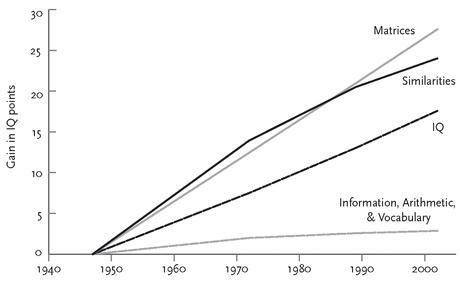
And rising at a non-trivial and fairly constant rate of three IQ points per decade. Steven Pinker comments:

The implications are stunning. An average teenager today, if he or she could time-travel back to 1950, would have had an IQ of 118. If the teenager went back to 1910, he or she would have had an IQ of 130, besting 98 percent of his or her contemporaries.[ . . . ] To state it in an even more jarring way, a typical person of 1910, if time-transported forward to the present, would have a mean IQ of 70, which is at the border of mental retardation.

— Steven Pinker, The Better Angels Of Our Nature p.884

One of the causes of the Flynn Effect is more school. Over the course of the twentieth century and in every country, children spend more time in school. By contrast, in 1900 a quarter of adults in the United States had less than four years of schooling. Flynn suggests that this has led to more people seeing the world through “scientific spectacles”: a number of forms of scientific reasoning have percolated from the schoolhouse into everyday thinking.

And, Flynn suggests, the mindset of science trickled down to everyday discourse in the form of shorthand abstractions. A shorthand abstraction is a hard-won tool of technical analysis that, once grasped, allows people to effortlessly manipulate abstract relationships. Anyone capable of reading this book, even without training in science or philosophy, has probably assimilated hundreds of these abstractions from casual reading, conversation, and exposure to the media, including proportional, percentage, correlation, causation, [ . . . ]  and cost-benefit analysis. Yet each of them—even a concept as second-nature to us as percentage—at one time trickled down from the academy and other highbrow sources and increased in popularity in printed usage over the course of the 20th century. [Pinker p.889]

Graph from Flynn, J. R. 2007. What is intelligence? Cambridge, U.K.: CUP p. 8, cited by Pinker p.886
The Flynn Effect: Rising IQ scores, 1947–2002. Source: Flynn, J. R. 2007. What is intelligence? Cambridge, U.K.: CUP p. 8, cited by Pinker p.885

It is noteworthy, however, that the rising tide of the Flynn Effect does not seem to lift all cognitive boats equally. For example, arithmetical skills have not increased at the same rate as interpretation of complex visual stimuli — it is supposed that since we live in environments which feature increasingly complex visual displays, we are perhaps getting better at extracting information from them.

Arthur C. Clarke once made the mordant observation that we have no evidence that high intelligence contributes towards the long term survival of a species. He suggested that it might turn out to be as useless in the long run as heavy armour was to some species of dinosaur.

He also commented that, in his opinion, humanity was engaged in a race between education and disaster.

I think he was right in both respects. The Flynn Effect suggests we are getting smarter. But are we getting smart enough quickly enough?

Only time will tell.


Educating Arthur

Bookshops are dangerous places: once you pick up a book there’s no telling where you might be swept off to.

image
Sir Arthur C. Clarke 1917-2008

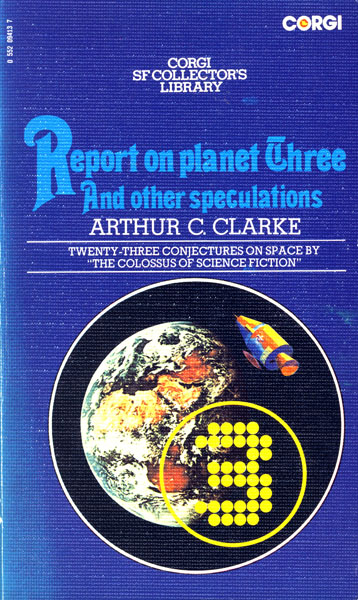
One of the most dangerous books that I have ever picked up was called Report On Planet Three And Other Speculations . I think I may have been eleven or twelve years old when I bought it from the local bookshop-cum-art-supplies-shop-cum-tourist-gift-shop that was my little provincial hometown’s sole purveyor of middlebrow culture. I think paid the princely sum of 30p for it. It was a collection of essays by science and science fiction writer Arthur C. Clarke. I can still see the cheap textured purple cover which bore the legend Corgi SF Collectors Library now, and feel (and smell) the excerably cheap paper on which it was printed.
image

I don’t think a single book has ever widened my mental horizons quite as much before or since.

I was hooked from the moment I started reading the eponymous title essay in which Clarke imagines himself to be a Martian astronomer soberly speculating on the possibility of life on the mysterious ‘Planet Three’, in spite of its ‘unpleasant greenish hue’, and the vast quantities of that toxic gas known as ‘oxygen’ in its crushingly thick atmosphere:

[One of the other results] of the high oxygen concentration is even more catastrophic. It involves a terrifying phenomenon, fortunately known only in the laboratory, which scientists have christened “fire.” . . . During the process, intolerable quantities of heat and light are generated, together with clouds of noxious gases. Those who have witnessed this phenomenon under controlled laboratory conditions describe it as quite awe-inspiring; it is certainly fortunate for us that it can never occur on Mars.

For the eleven year old me, this leap of imagination was heady, intoxicating stuff. I adored looking out through the eyes of a Martian astronomer, even though their conclusions about the possibility of life on Planet Three were somewhat pessimistic:

To sum up, therefore, it appears that out neighbour Earth is a forbidding world of raw, violent energies . . . As for animals . . . if they exist at all, they must be extremely powerful and massively built to resist the high gravity, probably possessing many pairs of legs . . . Their clumsy bodies must be covered with thick layers of protective armour to shield them from the many dangers they must face, such as storms, fire, and the corrosive atmosphere. In view of these facts, the question of intelligent life on Earth must regarded as settled. We must resign ourselves to the idea that we are the only rational beings in the Solar System.

I often hark back to this early inoculation against unimaginative, fuddy duddy, reactionary scientific reductionism, and would like to think that the still, small voice of Arthur C. Clarke sounds a warning in my head whenever I start espousing pompous scientific narrow-mindedness of the same stripe as that fictional Martian astronomer.

When a distinguished but elderly scientist states that something is possible, he is almost certainly right. When he states that something is impossible, he is very probably wrong.
— Clarke’s First Law of Prediction, Profiles of the Future (1962)

PS The title is meant to imply that Arthur was doing the educating, not being educated.

Never Mind The Data, Feel The Noise (or, seek the signal, young Jedi)

Everyone in education loves data.

image
This is the only time it is correct to use the word "Data" in the singular...

Or at least claims to. One sometimes wonders what would happen to the UK education system if a computer virus disabled every Excel spreadsheet overnight — h’mmm, perhaps someone should get in touch with those nice hacker people at Anonymous . . .
image

However, I digress. I wanted to share a recent epiphany that I’d had about data, particularly educational data. Perhaps it’s not much of an epiphany, but I’ve started so I’ll finish.

It came when I was listening to an interview on the evergreen The Jodcast (a podcast produced by the Jodrell Bank Radio Observatory). Dr Alan Duffy was talking about some of the new technologies that need to be invented in order to run the new massive Square Kilometre Array radio telescope (due to begin observing in 2018):

And then we have to deal with some of the data rates . . . essentially we recreate all of the information that exists on the internet today, and we do that every year without fail, it just keeps pouring off the instrument. And what you’re looking for is the proverbial needle in the haystack . . . how do you pick out the signal that you’re interested in from that amount of data?
The Jodcast, October 2014, 18:00 – 21:00 min approximately [emphasis added]

The realisation that hit me was: it isn’t the data that should be centre stage — it’s the signal that’s contained within that data. And that signal can be as hard to find as the proverbial needle in a haystack, even without data volumes that are multiples of the 2014 Internet.

A simple example from the history of science: Edwin Hubble’s famous graph from 1929 that was one of the first pieces of evidence that we exist in an expanding universe. The data are the difficult and painstaking measurements made by Hubble and his colleague Vesto Slipher that are plotted as small circles on the graph.

image

The signal is the line of best fit that makes sense of the data by suggesting a possible relationship between the variables. Now, as you can see, not all the points lie on, or even close, to the line of best fit. This is because of noise — random fluctuations that affect any measurement process. Because Hubble and Slipher were pushing the envelope of available technology at the time, their measurements were unavoidably ‘noisy’, but they were still able to extract a signal, and that signal has been both confirmed and honed over the years.

In my experience, when the dread phrase “let’s look at the data” is uttered in education, the “search for a signal” barely extends beyond simplistic numerical comparisons: increase=doubleplus good, decrease=doubledoubleplus ungood.

The way we use currently use data in schools reminds me of SF author William Gibson’s coining of the term cyberspace (way back in the pre-internet 1980s) as the
 

consensual hallucination experienced daily by billions of legimate operators . . . a graphic representation of data abstracted from the banks of every computer in the human system
— William Gibson, Neuromancer (1984)

In my opinion, almost the whole statistical shebang associated with UK education, from the precipitous data-mountains of the likes of RAISEOnline (TM) to the humblest tracking spreadsheet for a department of one, is actually nothing more than a ‘consensual hallucination’.

The numbers, levels and grades mean something because we say they mean something. And sometimes, it is true, they can tell a story.

Let’s say a student has variable test scores in one subject over a few months: does this tell us something about the child’s actual learning, or about possible inconsistencies in the department’s assessment regime, or about the child’s teachers?

My point is that WE DON’T KNOW without cross referencing other sources of information and using — wait for it — professional judgement.

I believe that the search for a signal should be central to any examination of data, and that this is best done with a human brain through the lens of professional experience. And, given the inevitability of noise and uncertainty in any measurement process, with a generous number of grains of statistical salt.