PIXL: panacea or poison?

“How the understanding is best conducted to the knowledge of science, by what steps it is to be led forwards in its pursuit, how it is to be cured of its defects, and habituated to new studies, has been the inquiry of many acute and learned men, whose observations I shall not either adopt or censure”.
–Samuel Johnson, The Rambler, April 1750

A colleague described a recent visit to a highly successful science department that has drunk mighty deep of the PIXL well. I shall summarise some of her observations and comments below. My reactions varied from intrigued to puzzled to horrified, but in keeping with the Johnson quote above, I shall endeavour to urge neither adoption nor censure — at least until I have thought about it some more.

Item the first: textbooks are forbidden. Students are taught from in-house PowerPoints and worksheets which are made available online for individual study by students. My colleague reported that she visited several classes in the same year group, and all the teachers were teaching the same topic with the same PowerPoint — and were often on exactly the same slide at the same time! Reportedly, this system was set up because science leaders were not satisfied with the quality of lessons being planned by individual teachers. For myself, I couldn’t help but be reminded of the Gaullist education minister who claimed to know which page of which textbook children throughout France would be studying on that very day . . .

Item the second: science leaders have exhaustively analysed the GCSE exam board specification to produce the materials mentioned above. Every learning point is translated into “student friendly” language and covered in detail. My information is that a typical starter activity might be for students to copy down a summary of important information from a PowerPoint, before practising application using worksheets and past paper questions. These are often peer marked. Since planning and resource making have been centralised, the workload of the classroom teacher appeared to be more manageable than in many schools.

Item the third: students are regularly tested. Test papers are gone over with a fine tooth comb by the science team and areas of weakness identified. These are addressed in large, multiclass study skills sessions led by the head of science in the assembly hall, teaching from the front (brave woman!) using an old fashioned OHP and transparencies! (Sigh! Now that takes me back: I can almost smell the banda machine solvent as we speak.) Students are sat at exam desks for the session, and the hall is supervised by teaching staff and SLT (including the headteacher on the day my colleague visited). This is followed by a “walk and talk” mock (i.e. the answer is modelled by the Head of Science on her trusty OHP), followed by individual exam practice under exam conditions.

And so we come to the question: shall we adopt or censure these observations?

The truth is: I am not sure.

On the one hand, I can see how this might be a rapid and effective way to improve results, especially in a school with an inexperienced science team. And the part of me that actually likes writing schemes of work and resources would relish the challenge of developing such a scheme. And I’m told that percentage science pass rates improved significantly from the low teens to the high eighties . . . over the course of a single year! And you can’t really argue with such success, can you? (Actually, yes you can — see this post on the Halo Effect) Also as Lt. Worf of the starship Enterprise once observed: “If winning isn’t important, why keep score?”

And yet . .

Part of me rebels at such regimentation. Is this an example of the “mcdonaldisation” of education, the continuing process of deskilling the classroom practitioner? I genuinely hate to say this, but given this model maybe Sir Ken Robinson has a point; although this particular iteration seems to owe more to Taylorism rather that the nineteenth century workhouse.

Use another teacher’s PowerPoint? Ugh! I’d rather be forced to use his toothbrush . . .

And, while I grant that many examination questions are indeed fit for purpose and thoughtfully designed to expose misunderstandings and misconceptions, I cannot help the feeling that our examination system has become an overly-powerful tail wagging an emaciated dog.

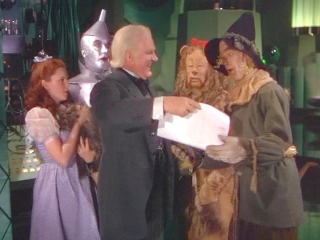
Is learning truly synonymous with exam success? Have we become so enamoured of the assessment of learning rather than learning itself that we, like the Scarecrow in The Wizard of Oz, would not consider ourselves truly learnèd unless we hold a diploma saying that we are?
image
Why, anybody can have a brain. That's a very mediocre commodity . . . great thinkers . . . think deep thoughts and with no more brains than you have. But they have one thing you haven't got: a diploma.

I shall leave the final word to my friend Sam Johnson:

“The great differences that disturb the peace of mankind are not about ends, but means. We have all the same general desires, but how those desires shall be accomplished will for ever be disputed.”
The Idler, December 1758

The Curse of Zombie-Ofsted

In his wonderful book, The Mismeasure of Man, Stephen Jay Gould writes of the fallacy

of ranking, or our propensity for ordering complex variation as a gradual ascending scale. Metaphors of progress and gradualism have been among the most pervasive in Western thought . . . ranking requires a criterion for assigning all individuals to their proper status in the single series. And what better criterion than an objective number? . . . one number for each individual . . . to rank people in a single series of worthiness, invariably to find that oppressed and disadvantaged groups — races, classes, or sexes — are innately inferior and deserve their status. In short, this book is about the Mismeasure of Man.

Humankind seems to have an inveterate propensity for sorting the sheep from the goats. There seems to be nothing we enjoy more than placing people, races, genders, things and classes in their allocated place on some putative “Great Chain of Being.”

The Great Chain of Being is a hierarchical worldview developed in mediaeval and Renaissance times but originating from Plato and the neoplatonists. In this view, everyone and everything has its place. An eagle is superior to the “worm eating” robin; the lion is superior to the domestic dog or cat; but those furry familiars have warrant to lord it over the wolf and rabbit because of their greater utility to Man.

In other words, according to this view, Man is the paragon of animals, but is himself subject to the authority of angels and Heaven. All shall be well if each being in the Great Chain knows its place and does its allotted duty.

I believe that the Great Chain of Being is an enduring but largely unconscious idea: we notice its presence like a fish notices the presence of water — that is to say, not at all. Our continuing propensity for ranking is a comfortable habit of thought that, regrettably, all of us slip into as easily as a favourite pair of slippers.

The other fallacy identified by Gould in The Mismeasure of Man is that of

reification, or our tendency to convert abstract concepts into entities (from the Latin res, or thing). We recognize the importance of mentality in our lives and wish to characterize it, in part so that we can make the divisions and distinctions among people that our cultural and political systems dictate.

And so it continues. For example, Regional Schools Commissioner Dominic Herrington recently wrote to a school to ask for evidence that at least 80 per cent of teaching at the school “is rated to be good or better”, including in English and maths (Schoolsweek.co.uk 6/11/15) — to my mind, demonstrating the fallacies of both ranking and reification simultaneously.

For goodness sake, not even Ofsted does that anymore!

However, the practice is, I suspect, still common in a large number of schools as part of their appraisal systems i.e. if you don’t get a “1” or a “2” in any one of your lesson observations then you “fail”.

The depressing truth is that even when Ofsted change their collective mind about an issue in response to evidence and reasonable argument (Yay! Go edu-bloggers!), their previous ideas and systems continue onward with almost undiminished energy, seemingly with a life and mind (or non-mind) of their own: Zombie-Ofsted, if you will.

To be fair to Ofsted, they have attempted to lay these walkers to rest by publishing clear and unequivocal guidance about their expectations about such nonsense as “minimal teacher talk” or “every lesson must include group work” and so on, but even such a well meaning stake-through-the-heart has made seemingly little headway against the strong winds of the Great Chain of Being.

Zombie-Ofsted marches, or lurches, ever onward.

image
Zombie-Ofsted marches -- or lurches -- ever onward

Like so much else in the crazy world of education these days, it makes the mind boggle. Or curdle. Or both.

The Helicopter Effect

Helicopter Parent
Image from https://commons.wikimedia.org/wiki/File:Helicopter_WikiWorld.png

Would you call 999 if you saw a mouse in your college accommodation? Two US students did; and not only that, but they requested counseling for post traumatic stress disorder.

Peter Gray argues that similar events are becoming more common. He writes:

[Because of ‘helicopter parenting’ we] have raised a generation of young people who have not been given the opportunity to learn how to solve their own problems. They have not been given the opportunity to get into trouble and find their own way out, to experience failure and realize they can survive it, to be called bad names by others and learn how to respond without adult intervention.

As teachers, I’m sure we all have tales of the ‘helicopter parents from hell’, but there seems to be something more going on than a few unrealistically demanding parents: there has been a veritable seismic shift in societal attitudes that has occurred over the course of a lifetime. Parents and families seem to be exerting more control over children’s lives. The default setting seems to have moved from the caring, loving but essentially “light touch” supervision of my childhood to what amounts to a species of neurotic control freakery.

My own free range childhood was similar to that described by Jerry Coyne in a thoughtful blog post commenting on Gray’s piece.

When I was a kid of 10 or so, I was allowed to walk to school on my own and, after school, ride my bike over to my friends’ houses, where we’d then take off in juvenile packs to explore our surroundings. There was no adult supervision save the order that we be home by dinner. That not only doesn’t happen any more, but parents who permit such roaming can (and have been) arrested.

And are schools and teachers contributing to this change?

I would say yes, some of the time.

One example is the question “Have you called home?” This is a very common one in my school and is frequently an entirely legitimate response to many issues. (It’s completely my own fault that it makes me smile because it reminds me of the Lewis Carroll line “And hast thou slain the jabberwock?”)

However, I do question its over-use with older students, particularly A-level students. In a perfect world, the conversation should be between the student and the teacher, not via the parent.

But shouldn’t we keep the parents informed, you ask? Well, yes, obviously. But not over-informed about each little tic and twitch.

And surely “I’ll tell on you to your Mum!” is a consequence that has the effect of tying the apron strings more tightly, rather than loosening them?

Let me emphasise that that I am not opposed to calling home per se, just that I think that we over use this consequence with older students.

Broadly speaking, I suppose that I am in favour of increasing the freedom of young people. Including, in the end, the freedom to fail.

You see, I believe in freedom, Mr Lipwig. Not many people do, although they will of course protest otherwise. And no practical definition of freedom would be complete without the freedom to take the consequences. Indeed, it is the freedom upon which all the others are based.
— Lord Vetinari from Terry Pratchett’s Going Postal

Engelmann and Direct Instruction (Part 3)

I’m going to begin this post by pondering a deep philosophical conundrum (hopefully, you will find some method in my rambling madness as you read on): I want to discuss the meaning of meaning.

image
Image from https://www.flickr.com/photos/christiaan_tonnis/15768628869

Ludwig Wittgenstein begins the Philosophical Investigations (1953), perhaps one of the greatest works of 20th Century philosophy, by quoting Saint Augustine:

When they (my elders) named some object, and accordingly moved towards something, I saw this and I grasped that the thing was called by the sound they uttered when they meant to point it out. Their intention was shewn by their bodily movements . . . I gradually learnt to understand what objects they signified; and after I had trained my mouth to form these signs, I used them to express my own desires.
Confessions (397 CE), I.8

image
Image from https://commons.m.wikimedia.org/wiki/File:Antonio_Rodríguez_-_Saint_Augustine_-_Google_Art_Project.jpg

Wittgenstein uses it to illustrate a simple model of language where words are defined ostensively i.e. by pointing. The method is, arguably, highly effective when we wish to define nouns or proper names. However, Wittgenstein contends, there are problems even here.

If I hold up (say) a pencil and point to it and say pencil out loud, what inference would an observer draw from my action and utterance?

image

They might well infer that the object I was holding up was called a pencil. But is this the only inference that a reasonable observer could legitimately draw?

The answer is a most definite no! The word pencil could, as far as the observer could tell from this single instance, mean any one of the following: object made of wood; writing implement; stick sharpened at one end; piece of wood with a central core made of another material; piece of wood painted silver; object that uses graphite to make marks, thin cylindrical object, object with a circular or hexagonal cross-section . . . and many more.

The important point is that one is not enough. It will take many repeated instances of pointing at a range of different pencil-objects (and perhaps not-pencil-objects too) before we and the observer can be reasonably secure that she has correctly inferred the correct definition of pencil.

If defining even a simple noun is fraught with philosophical difficulties, what hope is there for communicating more complicated concepts?

Siegfried Engelmann suggests that philosopher John Stuart Mill provided a blueprint for instruction when he framed formal rules of inductive inference in A System of Logic (1843). Mill developed these rules to aid scientific investigation, but Engelmann argues strongly for their utility in the field of education and instruction. In particular, they show “how examples could be selected and arranged to form an example set that generates only one inference, the one the teacher intends to teach.” [Could John Stuart Mill Have Saved Our Schools? (2011) Kindle edition, location 216, emphasis added].

Engelmann identifies five principles from Mill that he believes are invaluable to the educator. These, he suggests, will tell the educator:

how to arrange examples so that they rule out inappropriate inferences, how to show the acceptable range of variation in examples, and how to induce understanding of patterns and the possible effects of one pattern on another. [loc 223, emphasis added]

Engelmann considers Mill’s Method of Agreement first. (We will look at the other four principles in later posts.)

Mill states his Method of Agreement as follows:

If two or more instances of the phenomenon under investigation have only one circumstance in common, the circumstance in which alone all the instances agree, is the cause (or effect) of the given phenomenon.
A System of Logic. p.263

Engelmann suggests that with a slight change in language, this can serve as a guiding technical principle that will allow the teacher to compile a set of examples that will unambiguously communicate the required concept to the learner, while minimising the risk that the learner will — Engelmann’s bête noire! — draw an incorrect inference from the example set.

Stated in more causal terms, the teacher will identify some things with the same label or submit them to the same operation. If the examples in the teaching set share only one feature, that single feature can be the only cause of why the teacher treats instances in the same way. [Loc 233]

As an example of an incorrect application of this principle, Engelmann gives the following example set commonly presented when introducing fractions: 1/2, 1/3, and 1/4.

Engelmann argues that while they are all indeed fractions, they share more than one feature and hence violate the Method of Agreement. The incorrect inferences that a student could draw from this set would be: 1) all fractions represent numbers smaller than one; 2) numerators and denominators are always single digits; and 3) all fractions have a numerator of 1.

A better example set (argues Engelmann) would be: 5/3, 1/4, 2/50, 3/5, 10/2, 1/5, 48/2 and 7/2 — although he notes that there are thousands more possible sets that are consistent with the Method of Agreement.

Engelmann comments:

Yet many educators believe that the set limited to 1/2, 1/3, and 1/4 is well conceived. Some states ranging from North Dakota to Virginia even mandate that these fractions should be taught first, even though the set is capable of inducing serious confusion. Possibly the most serious problem that students have in learning higher math is that they don’t understand that some fractions equal one or are more than one. This problem could have been avoided with early instruction that introduced a broad range of fractions. [Loc 261]

For my part, I find Engelmann’s ideas fascinating. He seems to be building a coherent philosophy of education from what I consider to be properly basic, foundational principles, rather than some of the “castles in the air” that I have encountered elsewhere.

I will continue my exploration of Engelmann’s ideas in subsequent posts. You can find Parts 1 and 2 of this series here and here.

The series continues with Part 4 here.

More Physics Clangers

image

Teachingscienceinallweathers highlights some disappointing Physics errors on the DfE’s National Curriculum documents for Science which have remained uncorrected for over a year (see here, here and here).

This would be bad form on, say, a school website. For an organisation that is in charge of a national education system whose elected leaders do not hesitate to label schools as “coasting” and “lacking rigour”, it is unbelievably shabby and smacks of arrogant, lazy hypocrisy. And these documents are no longer drafts: the DfE website says that “these programmes of study are issued by law; you must follow them unless there’s a good reason not to. All local-authority-maintained schools in England must teach . . . key stage 4 from September 2016.”

Some of the persistent errors highlighted by Teachingscienceinallweathers (and others, including @DrDav, @HRogerson and @miss_m_w) are:

1. The formula for kinetic energy is given as “0.5 x mass x (acceleration)^2” instead of “0.5 x mass x (velocity)^2” [p.37]

2. The formula for weight is given as “gravity force = mass x gravity constant” instead of using the correct scientific terminology of “weight = mass x gravitational field strength”. As Teachingscienceinallweathers points out, the magnitude of gravitational field strength is anything but a “gravity constant”, even near to the Earth’s surface. Similarly, stating that “potential energy = mass x height x gravity constant (g)” [p.37] invites confusion between the constant “big G” the Universal Gravitational Constant (which is genuinely a constant) and “little g” which, as noted above, is not.

3. “Charge flow = current x time” [p.37]: the phrase “charge flow” is confusing in this context. Very often, the phrase “flow of charge” is used as a synonym for “current”. I would argue that “Charge transferred = current x time” would be preferable in this case.

4. “Interpret enclosed areas in distance-time and velocity-time graphs” [p.32]: the area enclosed by a velocity-time graph represents the change in displacement; the area enclosed by a distance-time graph represents . . . erm, nothing with any physical significance, as far as I know.

I would argue that the writers of science examination questions and science specifications have tended towards the prolix over the last two decades, and I, for one, would welcome the return to the more concise but rigorous style of writing of yesteryear when an exam question could begin “A monochromatic ray of light is incident on a plane mirror at an angle of 30 degrees to the normal…” and students were expected to draw an appropriate diagram because the language was clear, formal and unambiguous.

That may indeed have been the intention of the National Curriculum writers, but they are some way from achieving it. In fact, this document is nowhere close.

My own personal bête noire is:

explain with examples that motion in a circular orbit involves constant speed but changing velocity (qualitative only) [p.31]

There is no indication that the writers intend to restrict the meaning of orbit to the celestial sense, and so it seems that it refers to motion on a circular path in general. And therein lies the problem: it might be true in cases where the radius and angular velocity are constant, but the writers do not specify this. Are they considering the motion of an object whirled on a string? Motion in a vertical circle? Motion in a horizontal circle? They don’t say. It is a fair generalisation to say that it is hard to set up motion in a vertical circle that features uniform speed without variable torque to compensate for the transfer of k.e. to g.p.e. and vice versa.

“Explanations of circular motion restricted to examples involving constant speed to introduce the concept of centripetal acceleration as a result of changing direction of velocity” is far from perfect but is, I think, more useful than the original.

In short, those who call for rigour should display rigour.

Weasel Words In Education Part 6: Growth Mindset

It’s taken me a while to realise this, but “Growth Mindset” is essentially the repackaging of that perennial teacher favourite: “Must Try Harder”.

Suppose that the difference in “people who talk up innate ability” and “people who talk up hard work” maps onto a bigger distinction. Some people really want to succeed at a task; other people just care about about clocking in, going through the motions, and saying “I did what I could”.

Put the first group in front of an authoritative-looking scientist, tell them to solve a problem, and make sure they can’t. They’re going to view this as a major humiliation – they were supposed to get a result, and couldn’t. They’ll get very anxious, and of course anxiety impedes performance.

Put the second group in front of an authoritative-looking scientist, and they’ll notice that if they write some stuff that looks vaguely relevant for a few minutes until the scientist calls time, then whatever, they can say they tried and no one can bother them about it. They do exactly this, then demand an ‘A’ for effort. At no point do they experience any anxiety, so their performance isn’t impeded.

Put both groups on their own in private, and neither feels any humiliation, and they both do about equally well.

Now put them in real life. The success-oriented group will investigate how to study most effectively; the busywork-oriented group will try to figure out how many hours of studying they have to put in before other people won’t blame them if they fail, then put in exactly that amount. You’ll find the success-oriented group doing a bit better in school, even though they fail miserably in Dweck-style experiments.
[ . . . ]
So basically, you take the most vulnerable people, set them tasks you know they’ll fail at, then lecture them about how they only failed because of insufficient effort.

Imagine a boot stamping on a human face forever, saying “YOUR PROBLEM IS THAT YOU’RE JUST NOT TRYING NOT TO BE STAMPED ON HARD ENOUGH”.

— Scott Alexander, Slate Star Codex, 8/4/15 [emphasis added]

Recent research shows that children do better in classes where teachers ensure that the region around their cubital ginglymus has a organic epidermal integument attached. Watch this space for more on the Organic Epidermal Integument Elbow Set, next week.

image
Cubital Ginglymus Organic Epidermal Integument

h/t The Learning Spy, Why The ‘False Growth Mindset’ Reveals So Much

Academisation, Academisation, Academisation

Bogstannard Comprehensive School
Bogstannard Comprehensive School: “Not everybody fails”

MAN IN GLASSES (for it is he): Good evening, viewers. Tonight, we are going to examine the impact of the government’s controversial new education policies ‘on the ground’, so to speak, at one of the first schools in the country to undergo forced academisation in the latest tranche of institutions deemed to be ‘failing’ or ‘coasting’ by Government ministers.

WHILE M.I.G. SPEAKS, BACKGROUND SHOTS OF A TYPICAL COMPREHENSIVE SCHOOL BUILT IN THE 1970s APPEAR ON THE SCREEN.

WOMAN: Well, of course, the first we knew about the forced academisation was when the new management team from the SKARO Academy Chain arrived in their shiny new suits.

The new senior leadership team from the SKARO Academy chain arrive…

M.I.G.: And would you say that they’ve succeeded in driving up standards?

WOMAN: A little. The kids are a lot less scruffy since the Headteacher started exterminating anyone who had their top button undone. Or who didn’t know their target grades. Or didn’t make the expected level of progress. Or looked at SLT a bit funny. Mind you, they treated the staff in exactly the same way.

M.I.G: What? You mean that they held staff to the same exceptionally high standards as the children?

WOMAN: No, they exterminated them. Some of the older staff just couldn’t adjust to pushed around on castors with a sink plunger and an egg-whisk under their armpits whilst shouting “YOU WILL MAKE PROGRESS! OR! YOU! WILL! BE! EXTERMINATED!” in a loud, grating voice. But that’s part of the academy chain’s “corporate style” and one of the “non-negotiables”, as the Headteacher likes to call them. But the younger staff seem to be adapting well to new regime, especially those who entered on the SKARO Direct and EXTERMINATE First! routes. Actually, some of them seem to enjoy it . . .

THE CAMERA ZOOMS IN ON A SMALL Y7 CHILD STANDING ALONE IN THE PLAYGROUND. HE IS STANDING STIFFLY TO ATTENTION. EVERY FEW SECONDS, HE REFLEXIVELY AND REPETITIVELY CHECKS WHETHER HIS TOP BUTTON IS DONE UP. HIS EYES SWIVEL NERVOUSLY FROM SIDE TO SIDE. TUMBLEWEED BLOWS AROUND HIS FEET.

M.I.G.: Have the new leadership team exterminated many of the students?

WOMAN: A fair few. But as Mr Davros, the CEO of SKARO Academy, said in the newsletter, that we shouldn’t think of it as a form of ruthless mass murder, but rather as a “proactive measure to help ease the national pressure on school places”.

M.I.G.:  I understand there was some unpleasantness involving a surprise Ofsted inspection?

WOMAN: Not really. I mean, the lead inspector was a bit suspicious when he found that the majority of the SLT were descended from an extraterrestrial race of humanoids know as the ‘Kaleds’. He said that sounded, well, a bit ‘un-British’ if you catch my drift.

M.I.G.: And what the leadership team do?

WOMAN: Well, two little doors opened up in the dome on top of Mr Davros’ head and two little union jack flags popped out and he started chanting “BRITSH VALUES! BRITSH VALUES! YOU MUST HAVE BRITISH VALUES!” before leading everyone in a rousing rendition of ‘Land of Hope and Glory’.

British values
British values! British values! You must have British values!

M.I.G.: And what happened then?

WOMAN: Oh, they exterminated the Ofsted Lead Inspector.

M.I.G.: Really?

WOMAN: Yeah. He undid his top button while they were singing.

M.I.G.: And how did the staff react to this?

WOMAN:To the Lead Inspector being reduced to a small pile of smoking ashes by an extraterrestrial death ray? Stunned, I think. Followed by some quiet smiles and handshakes and someone saying “I didn’t know we could do that…” Mind you, some of the inspection team didn’t look too displeased either…

Engelmann and Direct Instruction (Part 2)

In Could John Stuart Mill Have Saved Our Schools?, Siegfried Engelmann and Douglas Carnine discuss the philosophical foundations of their acclaimed Direct Instruction programme (see Part 1). They write of their serendipitous rediscovery of Mill’s work and that they

came across Mill’s work and were shocked to discover that they had independently identified all the major patterns that Mill had articulated. Theory of Instruction [1991] even had parallel principles to the methods in [Mill’s] A System of Logic [published in 1843].

— location 543 Kindle edition

What Engelmann and Carnine are attempting to do is no less than develop a scientifically reliable model of education. In their view, learners learn by constructing inferences based on the evidence or examples presented by the teacher. In other words, learners use the rules of reason and logic (consciously or unconsciously) to develop general principles from specific examples by inductive reasoning.

To me, this is a fascinating idea. Have Engelmann and Carnine hit upon the elusive essence of what learning is? Is learning genuinely a matter of constructing inferences from evidence by formal or informal logical rules?

My view is that it certainly seems a plausible idea. In the light of my own experience and thinking it has a “ring of truth”, and I suspect that I am going to find this a profoundly influential idea for the rest of my career.

Many authors and thinkers have argued that human beings construct “mental maps” or conceptual models constructed by inductive reasoning from often limited information. Anthropologist Louis Liebenberg describes an example involving the !Xõ people of the central Kalahari Desert:

While tracking down a solitary wildebeest spoor [tracks] of the previous evening !Xõ trackers pointed out evidence of trampling which indicated that the animal had slept at that spot. They explained consequently that the spoor leaving the sleeping place had been made early that morning and was therefore relatively fresh. The spoor then followed a straight course, indicating that the animal was on its way to a specific destination. After a while, one tracker started to investigate several sets of footprints in a particular area. He pointed out that these footprints all belonged to the same animal, but were made during the previous days. He explained that the particular area was the feeding ground of that particular wildebeest. Since it was, by that time, about mid-day, it could be expected that the wildebeest may be resting in the shade in the near vicinity.

— quoted by Steven Pinker in How The Mind Works p. 193

The trackers were using miniscule traces of evidence and their knowledge of the environment to make inferences about the behaviour of (currently) unseen entities. In other words, they were using inductive reasoning to put together a tentative model of what their quarry was doing or attempting to do. (And I use ‘tentative’ in the sense that the model will be adapted and corrected in the light of further evidence.)

As do we all! I would suggest that all humans use similar techniques of inference, or ‘mental modules’ in Steven Pinker’s memorable phrasing, even with vastly different subject matter. Stephen Hawking and Leonard Mlodinow even go so far as to suggest that:

we shall adopt an approach that we call model-dependent realism. It is based on the idea that our brains interpret the input from our sensory organs by making a model of the world. When such a model is successful at explaining events, we tend to attribute to it, and to the elements and concepts that constitute it, the quality of reality.

The Grand Design p.9

And where does this leave us? If Engelmann and Carnine are correct (and I believe they are} then education becomes a matter of logic. They argue that a vital criterion in designing what they call “sound instructional sequences” is that sets of examples should “generate only the intended inferences”. They note

that logical flaws in instruction could be identified analytically, through a careful examination of the teaching. If we know the specific set of examples and the inference that the learners are supposed to derive from the instruction, we can determine if serious false inferences are implied by the program.

— location 1514

And I, for one, find that a highly engaging and strangely comforting thought.

(You can read Part 3 here)

Engelmann and Direct Instruction (Part 1)

We are art’s mercenaries,
firing our thought’s arrows
at the mystery of things
— R. S. Thomas, Paving

Engelmann comes highly recommended:

In his book Visible Learning: A Synthesis of Over 800 Meta-Analyses Relating to Achievement, the researcher John Hattie evaluates the success of a range of different teaching approaches. As the subtitle suggests, he synthesised the results of hundreds of different analyses of achievement and measured the effect of different factors . . . A specific Direct Instruction programme was developed by the American educator, Siegfried Engelmann, in the 1960s. It proved incredibly successful but also incredibly controversial because it contradicted so much of what theorists like Dewey and Freire advocated. Hattie specifically endorsed Engelmann’s programme.

— Daisy Christodoulo, Seven Myths About Education, location 751 Kindle edition

Later on in the book, Hattie confronts the dominance of empirically unsuccessful constructivist ideas in teacher training. He explains the effectiveness of Direct Instruction, a structured and unapologetically teacher-led method of instruction originated in 1960s America. Despite being shunned by the American education establishment, Hattie’s analysis shows that Direct Instruction has one of the largest effect sizes (0.59) for any teaching programme.

— Robert Peal, Progressively Worse, location 2689 Kindle edition

I was intrigued and wanted to find out more, so I recently read Siegfried Engelmann’s and Douglas Carnine’s book Could John Stuart Mill Have Saved Our Schools? which can be thought of as an introduction to the philosophical underpinning of Direct Instruction.

I claim no particular expertise in this field beyond that of a working teacher with a couple of decades of experience. I suppose that it is also appropriate at this point to disclose that my practice generally tends towards the traditional-didactic rather than the progressive end of the spectrum, so I am perhaps predisposed to be sympathetic to Engelmann’s ideas. Nevertheless, this blog will attempt to engage critically with his ideas and arguments.

Engelmann and Carnine open by saying that (unfortunately, in their opinion) education has historically been excluded from the domain of science. They suggest that the five principles of induction put forward by philosopher John Stuart Mill in his A System Of Logic (1843) would form a suitable basis for a scientific systematisation of effective educational practice. The efficacy of these principles when applied to education was not recognised at the time, not even by Mill himself, until Engelmann and Carnine rediscovered them in the 1970s.

I was unfamiliar with this aspect of Mill’s work, and it was a delight to be introduced to it. I was particularly struck by this bombshell from Mill:

In another of its senses, to reason is simply to infer any assertion, from assertions already admitted: and in this sense induction is as much entitled to be called reasoning as the demonstrations of geometry
— J. S. Mill, A System of Logic, location 175 Kindle edition

Philosophers have long debated the “problem of induction”. It is generally recognised that deductive reasoning (e.g. Socrates is a man; all men are mortal; therefore Socrates is mortal) is more dependable that inductive reasoning (e.g. every swan I have seen to date has been white; therefore every swan I will see in the future will be white).

However, it is a under-acknowledged truth that in our day-to-day lives (and in science generally) we rely primarily on induction and inference and, for the most part, they serve us well. What Mill is attempting to do is address the philosophical “second class status” accorded to inductive truths by formalising a set of rules that allow us to generate valid inductive inferences.

Engelmann and Carnine argue that these rules are of fundamental importance to the teacher as they allow her to construct a system of instruction that allows students to generate valid inferences and minimise false inferences:

In summary, the fabric of well designed instruction consists of details that promote specific inferences and rule out inappropriate inferences. Effective instruction is not born of grand ideas or scenarios that appeal to development or love of learning. It is constructed from the logic and tactics of science.
— S. Engelmann and D. Carnine, Could John Stuart Mill Have Saved Our Schools? location 1944 Kindle edition

One example they present is that of a constructivist approach to the teaching of prime numbers by getting students to lay out numbers of beans in rows and columns: students are invited to notice that some numbers (e.g. 7) cannot be laid out in rows of more than one bean which have equal numbers of beans. Englemann and Carnine argue that this activity does not accord with Mill’s principles because it will encourage students to generate a number of false inferences:

The false inference is that prime numbers are odd numbers. Imagine the consternation of the student who later discovers that 9 and 15 are odd, but they generate multiple rows. In contrast, 2 is even, but it is prime. A related false inference is that there is some form of predictable pattern for the occurrence of prime numbers, rather than the fact that some numbers are primes and others aren’t. Unless students had received previous instruction on what primes are, the bean counting has a potential of inducing false inferences; however, if students first learn the properties of prime numbers, the bean counting is a pointless activity. It simply provides validation that prime numbers are different from numbers that are multiples.
— location 1779 Kindle edition

I discussed this criticism with a Maths colleague who disagreed that the constructivist approach would necessarily generate false inferences — but more on that in a later post.

In summary, I am fascinated by the potential of Englemann’s and Carnine’s approach and intend to post more as I mull over its details and implications. Lord help me, but I could not help but be stirred by what could be interpreted as a call to arms:

[Our system] could certainly be improved by a concerted effort to do so. What it needs is a comprehensive critique by serious logicians and philosophers. It needs attention to its details so they can be refined or replaced to be more in accord with logic or empirical evidence.
— location 2591 Kindle edition

And perhaps more importantly, by working teachers too.

(Part Two here)

So You Say You Want A Revolution?

You know the power of words. We pass through periods dominated by this or that word — it may be development, or it may be competition, or education, or purity or efficiency or even sanctity. It is the word of the time.

— Joseph Conrad, Chance

A change is stealing over the educational world. I feel it in my water. The time of rigour, standards and excellence is past. The time of creativity, personalised curricula and and exam-factory approaches.

In other words, Sir Ken Robinson’s star is in the ascendant. Or so it would seem, at least from Shadow Education Secretary Tristram Hunt’s review of Sir Ken’s book.

He quotes Sir Ken:

Our school systems are now a matrix of organisational rituals and intellectual habits that do not adequately reflect the great variety of talents of the students who attend them. Because they conflict with these systems, too many students think that they are the problem; that they are not intelligent, or must have difficulties in learning.

H’mm. Based on this extract, this is vintage Sir Ken — and also a textbook case of the informal logical fallacy known as prejudicial language: emotive terms are used to link value and moral goodness to an acceptance of the proposition. It might even be true in certain instances — but as general description of our current schools system . . . in my experience, nah.

Rather worryingly (for me), Tristram Hunt finds this thesis “compelling”. We are, apparently,

currently operating a Fordist model of mass education that is failing to prepare young people for the dramatic socioeconomic demands of the digital age.

‘Fordist’, no less. Sounds bad, doesn’t it? Mass production bad, bespoke craftsmanship good followed by the reassuringly familiar Shift Happens! trope.

To me, this is not redolent of a rabble of rowdy revolutionaries so much as a middle class stitch up. It’s as if the Bolsheviks stormed the Winter Palace in order to get hold of the fish knives and forks. Or, possibly, they stormed IKEA instead. And when I say ‘stormed’ I mean ‘strolled purposefully towards the organic juicer section’.

I suspect that Sir Ken is a Roussean Romantic at heart: his ideal world would be a misty moorland populated by heroic Heathcliff-clones stomping, shouting and being Creative with a capital ‘C’; a world where no-one has to empty the bins, or build or maintain the ‘Fordist’ industrial infrastructure upon which so much romantic posturing depends.