In Could John Stuart Mill Have Saved Our Schools?, Siegfried Engelmann and Douglas Carnine discuss the philosophical foundations of their acclaimed Direct Instruction programme (see Part 1). They write of their serendipitous rediscovery of Mill’s work and that they
came across Mill’s work and were shocked to discover that they had independently identified all the major patterns that Mill had articulated.Theory of Instruction [1991] even had parallel principles to the methods in [Mill’s] A System of Logic [published in 1843].
— location 543 Kindle edition
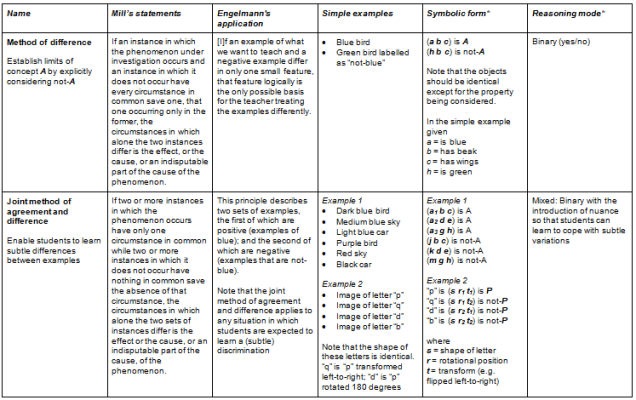
I think it’s worth looking in detail at the five principles of inference proposed by Mill, and how Engelmann and Carnine adapted them for use in educational contexts.
The five principles put forward by Mill are:
The Direct Method of Agreement
The Method of Difference
The Joint Method of Agreement and Difference
The Method of Residues
The Method of Concomitant Variations
In this post, I will focus on the first three.
“Non-canonical” statements and inferences are highlighted with an asterisk. These are my own suppositions and, although I believe they are supported by my reading of Mill’s and Engelmann’s and Carnine’s work, I cannot claim that they have direct textual support.
To further explain the simplified “symbolic form” I have developed to highlight what I think are the salient features in the argument:
A= “blue”
a = is blue
b = has beak
c = has wings
d = extends above the horizon
e = has clouds
f = has windscreen
g = has four wheels
Please note that the “symbolic form” is currently only a shorthand system, and any resemblance to the notation of formal symbolic logic is merely coincidental.
Links to Part 5 and the other parts of the series can be found here.
Napoleon’s generals not only had to be loyal, brave and skilled in arms (obviously enough), but the Emperor also demanded of them a more nebulously indefinable quality. When others in his entourage would laud the skills of a particular soldier, Napoleon would ask the pointed question: “Yes, but is he lucky?”
It seems to me that being lucky is the quality that, these days at least, is the one most valued in teachers by those in power above them. The old adage about success having many fathers but failure being an orphan was never truer than in today’s educational world. Examination results, or “outcomes”, are the bit-coin currency of choice in the go-getting world of “performance management” and “high stakes accountability”.
Forgive me, but I am awearied of all that talk. More and more I feel something akin to Duke Ellington’s response to long-winded analyses of the magic of jazz as being “talk that stinks up the room”.
In my career, I have faced Triumph and Disaster in terms of results. Although Kipling advised us to treat “those two impostors just the same”, the truth is that we don’t. Few human beings can. Our perceived Triumphs make us arrogant, the Disasters make us hostile and defensive.
And yet, I think I begin to see a pattern.
My triumphs occurred when I just got on with the business of teaching: turning up, teaching solid straightforward lessons, setting and marking regular homework. I remember one (internal) observer asking a student about their past paper practice question booklet, returned with a simple percentage grade (in red pen), “And how often are you set homework like this?” and the student answering matter-of-factly: “Every week”. I was so proud. That said, the observer still gave me a “3 (requires improvement)”, citing “lack of pace”, “no plenary” and “no feedback” (when they actually meant no written WWW/EBI comments). But I carried on regardless. And that year’s results were amongst my best ever.
My Disasters seem to occur when I am scrabbling manically to follow what is currently lauded as best practice. In other words, trying to copy what other schools do — or perhaps, more accurately, what other schools say that they do — badly.
Coincidence? Possibly.
So, am I a lucky teacher, in the Napoleonic sense? Sometimes, when I have the good sense to follow my experience and instincts, rather than fads and fashions.
So what about you, when faced with the russian roulette lottery of exam results (you do know it is just a lottery, right?): Are you feeling lucky, punk?
‘Sunlight’s a thing that needs a window
Before it enter a dark room.
Windows don’t happen.’
— R. S. Thomas, “Poetry For Supper”
For this post, I have decided to dispense with the abstract logic-chopping of some of the earlier posts in this series. (Although, I confess, I am quite partial to a nice bit of abstruse ratiocination now and again — in moderation, of course.)
Instead, I want to focus on what a teaching sequence using the principles outlined by Engelmann would actually look like in practice.
Some Basics
Firstly, the designer must have an expert-level understanding of the content to be taught.
[If] we are to understand how to communicate a particular bit of knowledge (such as knowledge of the color red, or knowledge about the operation of square root), we must understand the essential features of the particular concept that we are attempting to convey. [1]
The analysis of the knowledge system assumes that the designer will be able to create efficiency in what is to be taught if the designer understands the technically relevant details of the content that is to be taught. [2]
Secondly, a Direct Instruction sequence should be efficient; that is to say, it will aim to produce significant.results with the minimum effort.
The efficiency results from teaching only the skills and strategies that are necessary, and from designing strategies that apply to large segments of what is to be taught, rather than small segments. [2]
The goal is simply to teach as little as possible to provide thorough coverage of the content.[3]
Thirdly, there is no single “royal road” for Direct Instruction: two designers may map out entirely different routes while still being consistent with the guiding principles of D.I.:
[T]his efficiency does not imply general strategies for teaching something like beginning reading, critical analysis, or pre-algebra. As also noted, there is no single right way to achieve this efficiency; however, there are ways that are more efficient than others. [3]
Order and Efficiency
The guiding principles for ensuring efficiency are as follows:
[A]rrange the order of introduction of things to be taught for a particular topic or operation so that the more generalizable parts are taught first, and the exceptions or details that have limited application are introduced later. [3]
[However each] exception must be taught because if it is ignored, the learner may not learn it. [4]
The most efficient arrangement is to teach something and then [practice and review it] at a high rate.. . . Once taught, the operation should be used regularly. [5]
When a teaching sequence is developed using these principles, it may look very different from more familiar teaching sequences. For example, in a sequence for teaching basic fractions developed by Engelmann, the terms “top number” and “bottom number” rather than “numerator” and “denominator” were used.
The rationale for not using the “technical terms” is that they do not facilitate the instruction in any way, and they logically complicate the teaching by introducing a discrimination that is irrelevant to understanding fractions. [6]
Carnine and Engelmann argue that this allows learners to focus on what the numbers do rather than on what they are called. They are very insistent, however, that the correct technical terms will be taught — but not necessarily at the beginning as in a standard course.
This has led to some teaching sequences that are significantly different from the ones that most teachers are familiar with. Carnine and Engelmann comment that:
The point is that something may look quite simple but requires significant care in teaching, while something else (like the fraction relationship) may appear to be quite abstract but is quite easy to teach. The difficulty of what is taught is judged by the performance of students who are learning the material. [7]
Since D.I. courses seek to group together irregularities that are irregular in similar ways, Carnine and Engelmann say that this
. . . results in efficiency, but it may create a set of examples that are traditionally not grouped together. [8]
Thinking Into Doing
A maths teacher friend challenges a student who is intimidated by some difficult new learning with the question “Tell me what’s the most difficult thing that you’ve ever learned how to do?”
In my friend’s opinion, the most difficult thing that most people have learned is how to walk. He then goes on to assure the worried student that the same techniques that allowed her to learn to gad about on two feet from an early age will serve her well in maths (e.g. not giving up after the first fall, not minding looking a bit silly at times, learning from your mistakes, and so on).
I think it’s a nice analogy that can help students, and I’ve shamelessly lifted this tactic from him. However, as Carnine and Engelmann point out, learning a physical operation such as walking has one major advantage over learning all cognitive operations. The advantage is that the physical environment usually provides immediate, continuous and unambiguous feedback on physical operations.
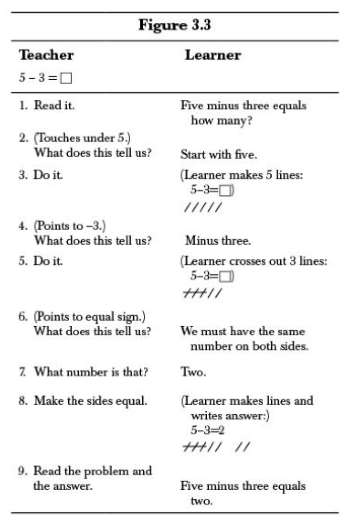
The physical environment, when viewed as an active agent, either prevents the learner from continuing or provides some unpleasant consequences for the inappropriate action.. . . [However the] physical environment does not provide feedback when the learner is engaged in cognitive operations. . . . To build adequate communications, we design operations or routines that do what the physical operations do. The test of a routine’s adequacy is this: Can any observed outcome be totally explained in terms of the overt behaviours the learner produces? If the answer is “Yes,” the cognitive routine is designed so that adequate feedback is possible. To design the routine in this way, however, we must convert thinking into doing. [9]
An example of Thinking Into Doing? From Theory of Instruction (1982) location 1273
The aim of Direct Instruction is to provide a measure of immediate, continuous and immediate feedback for cognitive operations that is analogous to that provided by the physical environment for physical operations. Another One In The Eye For Traditional Differentiation?
Direct Instruction stimulus material is meant to be carefully designed so as to be logically unambiguous. It should generate one — and only one — inference for all learners. This means that as long as students respond correctly to the material, we can assume that both high and low performers have learned the same inference:
The major difference between higher and lower performers is the rate at which they learn the material, not the way they formulate inferences. This difference does not support designing one sequence for higher performers and another for lower performers, but rather providing more repetition and practice for the lower performers. [10]
I don’t know about you, but to me this sounds absolutely great. If I may borrow a phrase from my fellow blogger, The Quirky Teacher: who’s with me?
Links
To access the previous blogposts in this series, click on the links:
Much is due to those who first broke the way to knowledge, and left only to their successors the task of smoothing it.
— Samuel Johnson, A Journey To The Western Isles Of Scotland (1775)
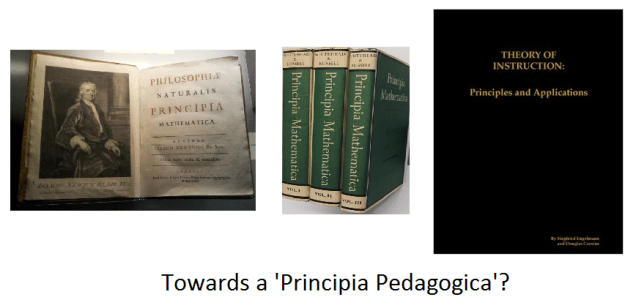
In 1982 Siegfried Engelmann and Douglas Carnine published their Theory of Instruction. This was some 300 years after Newton started the scientific revolution by publishing his Principia; and some 70 years after Russell and Whitehead in the Principia Mathematica attempted to show that the entirety of mathematics could be derived from the laws of logic (famously taking 300 pages to prove that 1+1=2).
In short, Engelmann and Carnine were attempting to start an educational scientific revolution. They wanted to replace the traditional liberal arts foundation of educational theory with a rigorously logical scientific foundation. Their Theory of Instructionis quite simply nothing less than an attempt to write a Principia Pedagogica.
Effective instruction is not born of grand ideas or scenarios that appeal to development or love of learning. It is constructed from the logic and tactics of science.
— S. Engelmann and D. Carnine, Could John Stuart Mill Have Saved Our Schools? Kindle edition, location 1944
In the opening section of the T.O.I., Carnine and Engelmann argue that human beings learn primarily, and in fact literally, from the power of example.
[Learners have the] capacity to learn any quality that is exemplified through examples (from the quality of redness to the quality of inconsistency) . . . This mechanism . . . is capable of learning qualities as subtle as the unique tone of a particular violin or qualities that involve the correlation of events (such as the relationship of events on the sun to weather on the earth).
— S. Engelmann and D. Carnine, Theory of Instruction: Principles and Applications,Kindle edition, locations 365-383
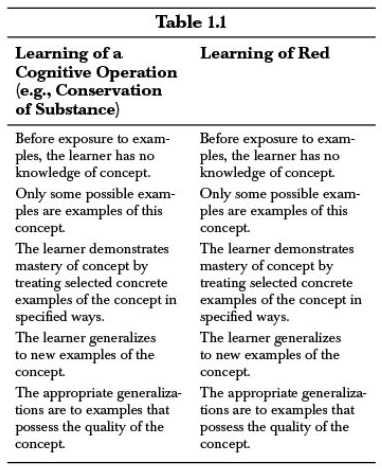
To this end, they propose a simplified (or minimalist, if you will) two step mechanism of how human beings learn:
The first step of the proposed learning mechanism is the presentation of a range of examples. For instance, to explain the concept of “red” an instructor would present examples of red objects; to explain the concept of “conservation of volume”, she would present instances of (say) a fixed volume of liquid being poured into containers of varying shapes.
The second step of the learning mechanism is when the learner mentally constructs a valid generalisation, or mental rule about the qualities or features common to the examples presented. Carnine and Engelmann argue that human beings naturally and immediately attempt to generalise or form such rules when presented with any new information.
From: T.O.I, Kindle loc 399
They do not attempt to argue that the whole of human behaviour can be reduced to this simple two step mechanism, but merely that by accepting this simple model, one “can account for nearly all observed cognitive behaviour” (T.O.I. Kindle loc 375)
Note that the first step is about what is to be learned, and the second step is about how it is learned.
In Carnine and Engelmann’s view, the first step is the responsibility of the instructor. The planning should focus on a rigorous logical analysis of the concept that is to be taught, and should not include any consideration of the likely behavioural response of the learner (e.g. whether she will find it “fun”).
The only factor that limits the learner . . . is the acuity of the sensory mechanism that receives information about [the concept]. (T.O.I. Kindle loc 380-1)
The second step is within the purview of the learner. However, this is also the point at which the instructor would use behavioural analysis to ascertain
. . . the extent to which the learner does or does not possess the mechanisms necessary to respond to the . . . presentation of the concept. [Then one should design] instruction for the unsuccessful learner that will modify the learner’s capacity to respond to the . . . presentation. This instruction is not based on a logical analysis of the communication, but on a behaviour analysis of the learner. (T.O.I. Kindle loc 348-352)
Teachers will, of course, be aware that this is not how we do things in our current educational system, especially as far as the standard techniques of differentiation are concerned.
Are Carnine and Engelmann correct? I’m not sure, but I find their ideas fascinating. Looking at them through the lens of my experience, I would go so far as to say that, intuitively at least, they appear to have the copper-bottomed “ring of truth” (as Richard Ingrams used to say) about them. At the very least, they are deserving of further study and attention.
Links
To access the other blogposts in this series, click on the links:
The change of religion in Scotland, eager and vehement as it was, raised an epidemical enthusiasm, compounded of sullen scrupulousness and warlike ferocity, which, in a people whom idleness resigned to their own thoughts, and who, conversing only with each other, suffered no dilution of their zeal from the gradual influx of new opinions, was long transmitted in its full strength from the old to the young . . .
— Samuel Johnson, A Journey To The Western Islands Of Scotland [1775]
Old Andrew writes of a recent case in Scotland where a teacher was barred from teaching for two years because, for example, she “did not refer to success criteria” and “failed to recap the learning intentions at the end of the lesson”(!)
Well, to some extent I have been there, done that and got the t-shirt. I have been on the receiving end of the ‘support’ that doesn’t feel particularly supportive. However, it has never reached the disciplinary stage; in part, I suppose, because I learned to ‘play the game’ and stick in a few card sorts and the like. Teacher, know thou thy observer!
But I feel I have known what might be termed the “epidemical enthusiasm” of True Believers in the now defunct ‘Axis of Old-style-Ofsted’ model. And, yes, there was indeed a time when it seemed that many who favoured that model conversed “only with each other” and that there was no hope of any dilution of their zeal.
It is depressing to think that these discredited ideas still hold sway in parts of our education system.
That said, it seems to me that this is not automatically a consequence of progressive ideals; rather, it seems to me a consequence of a totalitarian mindset — an inability to trim one’s ideological sails to the winds of empirical reality, especially when one is in a position of power or authority.
And that, I think, is something that each of us — Positive Traditionalist* or Positive Progressivist* alike — needs to guard against.
*See @heymisssmith’s excellent post for further explanation of what I think is a useful expansion of the traditionalist vs. progressivist terminology.
He wanted to say, oh, how he wanted to say: craftsmen.
D’you know what that means? It means men with some pride, who get fed up and leave when they’re told to do skimpy work in a rush, no matter what you pay them . . .
But you don’t care, because if they don’t polish a chair with their arse all day you think a man who’s done a seven-year apprenticeship is the same as some twerp who can’t be trusted to hold a hammer by the right end.
He didn’t say this aloud, because although an elderly man probably has a lot less future than a man of twenty, he’s far more careful of it …
— Terry Pratchett, Going Postal
“I have a dream . . .”
To me, the recent Educational Excellence Everywhere white paper reads like a managerialist’s dream. It has all the hallmarks of a document written by the kind of person for whom spending a whole morning composing a stiffly worded email equates to “kicking some serious arse”.
Consider this “illustrative example” of what things may be like when, at long last, the unwieldy behemoths known as MATs rule the Earth:
Evans Education Endeavours (EEE) is a strong MAT of six schools. EEE is performing well in published MAT measures … EEE is overseen by a small, skilled board which sets the overall strategy … A strong headteacher from one of the schools has stepped up to the role of Executive Head.
Another MAT, Shining Academies (SA), is struggling. It has nine schools, seven within the same county as EEE and two in another part of the country. SA is performing poorly in published MAT measures . . .The RSC [Regional Schools Commissioner] suggests to EEE that they should take on seven SA schools . . . and suggests that the Executive Head becomes the CEO . . . EEE’s central board is strengthened by a new non-executive director recruited via Academy Ambassadors. Parents’ views are sought throughout this process. The board restructures governance and leadership by establishing two ‘raising achievement’ boards, each holding an executive principal toaccount for a cluster of 6-7 schools, leaving school level bodies to focus on listening to and engaging parents. EEE uses its expertise to improve the newly joined 7 schools, improving outcomes for thousands of children.
(p.61)
Now truth be told, I’ve no great love (or hate, either) for local education authorities: in my experience they are just bureaucracies which can be either supremely helpful or wilfully obstructive depending, in large part, on the individuals that one happens to come into contact with.
The white paper seems to have the idea that by placing the bureaucrats in geographically-scattered offices with different wallpaper one can achieve so much more. I suppose that such ardent faith in the transformative power of bureaucratic structures is either endearing or terrifying, depending on one’s point of view. My own life experience, and a childhood reading of the works of C. Northcote Parkinson, lead me to believe differently.
“Godwin’s LAW? Actually it’s more a sort of guideline…”
But what of the rest of the white paper? For the life of me, and Godwin’s Law notwithstanding, the historical parallel that springs to my mind is that of Hitler and Obergruppenführer Felix Steiner. In 1945, Hitler was sealed in his bunker, vainly ordering phantom divisions that existed only on paper to attack and halt the rapidly approaching Red Army. He fully expected to execute a bold strategic master stroke that would result in total victory. “Wo ist Steiner? Where is Steiner?” Hitler kept demanding, wanting Steiner’s forces to be part of a pincer movement that would crush the Soviets.
Little did he know — or care — that the divisions that looked so mighty on paper were, in reality, outnumbered 10-to-1 by the Russians and were composed mainly of platoons of exhausted walking wounded without combat weapons. At times, they were even grouped by their wounds for administrative convenience, so there would be whole battalions of men with stomach wounds, and brigades of men who’d had their right arms amputated, for example.
Steiner refused to attack.
“Wo ist Steiner?”
I believe we are currently in Nicky Morgan’s “Wo ist Steiner?” moment. She apparently believes that a simple act of administrative legerdemain can conjure up legions of “talented teachers” ready to be thrown into the fray. After all, how can they not when, luckily, their performance can be scrutinised by “raising achievement panels”. Leadership is all, apparently. If we can get a few “can-do” CEOs and RSCs in there then everything will shape up nicely.
In reality, what she’s got is a tired, fed-up and rapidly diminishing core of veteran teachers. Our leaders seem to think that a lick of paint and a new general or two with the right attitude will sort everything out.
Sadly, I don’t think it will.
Now, like an apprentice staring at the work of a master, he read Reacher Gilt’s words on the still-damp newspaper.
It was garbage, but it had been cooked by an expert. Oh, yes. You had to admire the way perfectly innocent words were mugged, ravished, stripped of all true meaning and decency and then sent to walk the gutter for Reacher Gilt, although ‘synergistically’ had probably been a whore from the start. The Grand Trunk’s problems were clearly the result of some mysterious spasm in the universe and had nothing to do with greed, arrogance and wilful stupidity.
Oh, the Grand Trunk management had made mistakes – oops, ‘well-intentioned judgements which, with the benefit of hindsight, might regrettably have been, in some respects, in error’ – but these had mostly occurred, it appeared, while correcting ‘fundamental systemic errors’ committed by the previous management. No one was sorry for anything because no living creature had done anything wrong; bad things had happened by spontaneous generation in some weird, chilly, geometrical otherworld, and ‘were to be regretted’.
Prisoner: What do you want? Number Two: Information. Prisoner: Whose side are you on? Number Two: That would be telling. We want information . . . information . . . information! Prisoner: You won’t get it! Number Two: By hook or by crook, we will. Prisoner: Who are you? Number Two: The new Number Two. Prisoner: Who is Number One? Number Two: You are Number Six. Prisoner:I am not a number; I AM A FREE MAN!!! Number Two: [Laughter]
The looking glass world of Patrick McGoohan’s 1967 TV series The Prisoner has, I feel, many parallels with modern education. Our careers, our hopes and aspirations, even our very dreams, often depend on numbers . . . information, if you will. Or data as modern educational parlance would have it.
Some of the most important numbers in a teacher’s life are the (now happily defunct) single lesson Ofsted lesson gradings; although, not so happily, many schools still insist on using them for appraisal and performance management.
For the past few years I have mostly been Number Two. However, at times I have been Number Three (because one student copied an answer from another student and I didn’t notice — I kid you not!); and once a Number Four (because I asked the students to copy a model paragraph off the board — “We’ll have no copying in this school, sirrah!”)
“I AM NOT A NUMBER, I AM EXPERIENCED AND SKILLED INDIVIDUAL WHO DESERVES DUE MEASURE OF PROFESSIONAL AUTONOMY!!!” [Cue maniacal laughter from SLTs and the DfE as lightning flashes and thunder roars.]
Rob Coe ably summarises the problems with minimally-trained observers in this blog post. He writes:
…if your lesson is judged ‘Outstanding’, do whatever you can to avoid getting a second opinion: three times out of four you would be downgraded. If your lesson is judged ‘Inadequate’ there is a 90% chance that a second observer would give a different rating.
He mentions that observers tend to overestimate their own observational prowess. If you fall into this camp, and haven’t seen the clip before, do the selective attention test — go on, do it, I dare you!
As Richard Feynman said of the scientific method: “The first principle is that you must not fool yourself and you are the easiest person to fool.”
Too often, the high stakes observations we undergo end up enforcing educational fads rather than real good practice. As a colleague dryly observed to me the other day: “It shows that with one week’s notice and four hours preparation I can teach a lesson the way they want me to!”
Rob Coe makes some measured and sensible suggestions at the end of his blog post. However, for my part, I will finish with a further quote from The Prisoner and a bit of wishful thinking:
“I will not make any deals with you. I’ve resigned. I will not be pushed, filed, stamped, indexed, briefed, debriefed or numbered. My life is my own. I resign.”
— The Prisoner
The Borg: Strength is irrelevant. Resistance is futile. We wish to improve ourselves. We will add your biological and technological distinctiveness to our own. Your culture will adapt to service ours.
Capt. Picard: Impossible. My culture is based on freedom and self-determination.
The Borg: Freedom is irrelevant. Self-determination is irrelevant. You must comply.
Capt. Picard: We would rather die.
The Borg: Death is irrelevant.
— Star Trek: The Next Generation, The Best of Both Worlds Part 1 (1990)
There was a time when I would have danced a jig for joy at the thought of Ofsted being irrelevant.
However, that is no longer the case. Ofsted in recent times have taken a most unexpected lurch towards sweet reasonableness and common sense (at least in some aspects of their operations).
This has wrong footed a number of us, I can tell you. Some might argue that it is too little, too late — but late is better than never.
That it is a genuine sea change can be gauged from the fact that Ofsted has felt it necessary to publish an “Ofsted mythbusters” page. Amongst the highlights are: no individual lesson plans are required for inspections; no set amount of lesson observation evidence and no internal individual lesson gradings will be required; and, there is no — repeat, NO! — requirement for any particular type, frequency or volume of pupil book marking or feedback.
And yet, and what have a large number of schools and multi-academy chains chosen to do with this valuable document? That’s right, they have chosen to IGNORE this advice and continue with their previous systems and procedures: the La-la-la!-I’m-not-listening!-La-la-la! stratagem, if you will.
This isn’t a case of Zombie-Ofsted, as I erroneously suggested in previous post. This is a case of research-informed, actually quite sensible educational advice being wilfully and deliberately ignored by a range of educational institutions.
The New Blob* has come into its own and it’s watchwords are:
1. Double and triple marking (using pens of many colours!)
2. Graded lesson observations (#Cause the graders gonna grade, grade, grade, grade, grade!)
3. Outstanding (as in “Are you an outstanding teacher?” — see no.2 above)
His renascent intelligence finds now that we are confronted with strange convincing realities so overwhelming that, were he indeed one of those logical consistent creatures we incline to claim we are, he would think day and night in a passion of concentration, dismay and mental struggle upon the ultimate disaster that confronts our species . . . It will perish amidst its evasions and fatuities. It is like a convoy lost in darkness on an unknown rocky coast, with quarrelling pirates in the chartroom and savages clambering up the sides of the ship to do evil as the whim may take them.
— H. G. Wells, Mind At The End of Its Tether (1945), pp. 12, 15
Although I first read the book a long time ago, the profoundly depressing atmosphere of H. G. Wells’ last book has haunted me over the years. In this book, he brooded on what he saw as the imminent extinction of humankind. At times, the prose seemed less than coherent; but at others, it seemed lucid and recognisably Wellsian. The title says it all — it is what it is: the ruminations and lucubrations of a Mind At The End Of Its Tether.
In my estimation, there has been something in the air of the edu-blogosphere over the last few days that recalls the dark atmosphere of Wells’ book. What I think we’re seeing is a number of teachers at the end of their tether.
The last half-term was fraught. Not so much with the pupils as other things, notably the issue of marking . . . We have now been told that we must also expect children to respond to our marking with ten minutes’ worth of green pen every time books are returned – and then we must go back through their books and acknowledge or respond to their replies. This is in effect double or even triple marking . . . I doubt there is anyone who disagrees that marking is important. But this is not the way to do it. I simply cannot function at the intensity now being demanded; nobody can. [Emphasis added.]
The ideals I held when I went into teaching twenty years ago were centred around one idea: that education was liberation . . . Charter chains such as Doug Lemov’s Uncommon Schools network exert incredible amounts of control over their teachers, curriculum and students in the pursuit of narrowly defined ‘success’ . . . It feels as if a nuclear winter is descending. [Emphasis added.]
Different children every year are expected to perform better than children did the year before. This means that although every year the children change, the school is expected to improve, the children are not the reason for this improvement, the school is. This is not teacher centred or child centred education, it is school centred, and with statistical modelling it will be school eat school out there . . .
As grades are currency in the real world it is always good to hear of children doing well, getting on a course, getting an interview, getting a job that they wouldn’t have got were it not for that ‘B’…
But…
If the child is but a cog in an exam machine we can but wonder if the child that got on the course clutching their B to their bosom is the same child that the new course teacher expects them to be. The more a school or teacher does for a pupil in order to get them through the exam there has to come a point where the exam is not really down to the pupil at all. This means that the exam currency for the pupil is destabilised. [Emphases added.]
The edu-bloggers quoted are amongst the writers to whom I routinely turn when I need my pedagogic compass reset, my enthusiasm reignited or when I need my often unthinking acceptance of dogma or fashionable nonsense challenged (which is way more often than I’d care to admit).
Perhaps it is just the winter of our discontent, but to me there seems to be a larger number (than usual!) of edu-bloggers expressing disquiet at a pervasive, creeping rottenness at the heart of UK education. And, disparate and heterogeneous group though they are, I believe that edu-bloggers have their collective finger on the pulse of education.
Many moons ago — when I was younger, fitter and slimmer — I was lucky enough to attend a martial arts seminar with a famous martial arts master. His attitude and practice was anything but the mystical tosh spouted by some of his movie equivalents. Rather, his focus was intensely pragmatic: he had studied martial arts all over the world in order to find out what worked. This focus had been started by his early U.S. “police judo” training: if someone comes at you like this then you try this or this or this.
The reason I mention this that many teachers seem to hate the idea of a scripted lesson. To my mind, a scripted lesson doesn’t necessarily entail a series of reductive, robotic responses. Instead, it could simply be a list of suggested sequences and interactions that have been found to work historically.
I often — perhaps too often — write and use my own resources (“Use another teacher’s resources? Ugh! I’d rather use their toothbrush…! “)
But even I, the king of the animated PowerPoint and the Amadeus of the well-crafted worksheet, would consider using an externally written script if it demonstrably worked.
Whether Direct Instruction scripts really, really work in this sense, I can’t say. The proof of the pudding will be in the eating, or in the teaching.
And, as any actor could tell you, even the simplest script can still leave the actor with a wealth of choices…






 e=mc2andallthat