P is for Progressive, T is for Traditionalist, Z is for Zealot

The change of religion in Scotland, eager and vehement as it was, raised an epidemical enthusiasm, compounded of sullen scrupulousness and warlike ferocity, which, in a people whom idleness resigned to their own thoughts, and who, conversing only with each other, suffered no dilution of their zeal from the gradual influx of new opinions, was long transmitted in its full strength from the old to the young . . .
— Samuel Johnson, A Journey To The Western Islands Of Scotland [1775]

Old Andrew writes of a recent case in Scotland where a teacher was barred from teaching for two years because, for example, she “did not refer to success criteria” and “failed to recap the learning intentions at the end of the lesson”(!)

Well, to some extent I have been there, done that and got the t-shirt. I have been on the receiving end of the ‘support’ that doesn’t feel particularly supportive. However, it has never reached the disciplinary stage; in part, I suppose, because I learned to ‘play the game’ and stick in a few card sorts and the like. Teacher, know thou thy observer!

But I feel I have known what might be termed the “epidemical enthusiasm” of True Believers in the now defunct ‘Axis of Old-style-Ofsted’ model. And, yes, there was indeed a time when it seemed that many who favoured that model conversed “only with each other” and that there was no hope of any dilution of their zeal.

It is depressing to think that these discredited ideas still hold sway in parts of our education system.

That said, it seems to me that this is not automatically a consequence of progressive ideals; rather, it seems to me a consequence of a totalitarian mindset — an inability to trim one’s ideological sails to the winds of empirical reality, especially when one is in a position of power or authority.

And that, I think, is something that each of us — Positive Traditionalist* or Positive Progressivist* alike — needs to guard against.

*See @heymisssmith’s excellent post for further explanation of what I think is a useful expansion of the traditionalist vs. progressivist terminology.

I’ll Get My Coat: Educational Excellence Every Which Way But Loose

He wanted to say, oh, how he wanted to say: craftsmen.

D’you know what that means? It means men with some pride, who get fed up and leave when they’re told to do skimpy work in a rush, no matter what you pay them . . .

But you don’t care, because if they don’t polish a chair with their arse all day you think a man who’s done a seven-year apprenticeship is the same as some twerp who can’t be trusted to hold a hammer by the right end.

He didn’t say this aloud, because although an elderly man probably has a lot less future than a man of twenty, he’s far more careful of it …

— Terry Pratchett, Going Postal

“I have a dream . . .”

To me, the recent Educational Excellence Everywhere white paper reads like a managerialist’s dream. It has all the hallmarks of a document written by the kind of person for whom spending a whole morning composing a stiffly worded email equates to “kicking some serious arse”.

Consider this “illustrative example” of what things may be like when, at long last, the unwieldy behemoths known as MATs rule the Earth:

Evans Education Endeavours (EEE) is a strong MAT of six schools. EEE is performing well in published MAT measures … EEE is overseen by a small, skilled board which sets the overall strategy … A strong headteacher from one of the schools has stepped up to the role of Executive Head.

Another MAT, Shining Academies (SA), is struggling. It has nine schools, seven within the same county as EEE and two in another part of the country. SA is performing poorly in published MAT measures . . .The RSC [Regional Schools Commissioner] suggests to EEE that they should take on seven SA schools . . . and suggests that the Executive Head becomes the CEO . . . EEE’s central board is strengthened by a new non-executive director recruited via Academy Ambassadors. Parents’ views are sought throughout this process. The board restructures governance and leadership by establishing two ‘raising achievement’ boards, each holding an executive principal toaccount for a cluster of 6-7 schools, leaving school level bodies to focus on listening to and engaging parents. EEE uses its expertise to improve the newly joined 7 schools, improving outcomes for thousands of children.

(p.61)

Now truth be told, I’ve no great love (or hate, either) for local education authorities: in my experience they are just bureaucracies which can be either supremely helpful or wilfully obstructive depending, in large part, on the individuals that one happens to come into contact with.

The white paper seems to have the idea that by placing the bureaucrats in geographically-scattered offices with different wallpaper one can achieve so much more. I suppose that such ardent faith in the transformative power of bureaucratic structures is either endearing or terrifying, depending on one’s point of view. My own life experience, and a childhood reading of the works of C. Northcote Parkinson, lead me to believe differently.


“Godwin’s LAW? Actually it’s more a sort of guideline…”

But what of the rest of the white paper? For the life of me, and Godwin’s Law notwithstanding, the historical parallel that springs to my mind is that of Hitler and Obergruppenführer Felix Steiner. In 1945, Hitler was sealed in his bunker, vainly ordering phantom divisions that existed only on paper to attack and halt the rapidly approaching Red Army. He fully expected to execute a bold strategic master stroke that would result in total victory. “Wo ist Steiner? Where is Steiner?” Hitler kept demanding, wanting Steiner’s forces to be part of a pincer movement that would crush the Soviets.

Little did he know — or care — that the divisions that looked so mighty on paper were, in reality, outnumbered 10-to-1 by the Russians and were composed mainly of platoons of exhausted walking wounded without combat weapons. At times, they were even grouped by their wounds for administrative convenience, so there would be whole battalions of men with stomach wounds, and brigades of men who’d had their right arms amputated, for example.

Steiner refused to attack.

Wo ist Steiner

“Wo ist Steiner?”

I believe we are currently in Nicky Morgan’s “Wo ist Steiner?” moment. She apparently believes that a simple act of administrative  legerdemain can conjure up legions of “talented teachers” ready to be thrown into the fray. After all, how can they not when, luckily, their performance can be scrutinised by “raising achievement panels”. Leadership is all, apparently. If we can get a few “can-do” CEOs and RSCs in there then everything will shape up nicely.

In reality, what she’s got is a tired, fed-up and rapidly diminishing core of veteran teachers. Our leaders seem to think that a lick of paint and a new general or two with the right attitude will sort everything out.

Sadly, I don’t think it will.

Now, like an apprentice staring at the work of a master, he read Reacher Gilt’s words on the still-damp newspaper.

It was garbage, but it had been cooked by an expert. Oh, yes. You had to admire the way perfectly innocent words were mugged, ravished, stripped of all true meaning and decency and then sent to walk the gutter for Reacher Gilt, although ‘synergistically’ had probably been a whore from the start. The Grand Trunk’s problems were clearly the result of some mysterious spasm in the universe and had nothing to do with greed, arrogance and wilful stupidity.

Oh, the Grand Trunk management had made mistakes – oops, ‘well-intentioned judgements which, with the benefit of hindsight, might regrettably have been, in some respects, in error’ – but these had mostly occurred, it appeared, while correcting ‘fundamental systemic errors’ committed by the previous management. No one was sorry for anything because no living creature had done anything wrong; bad things had happened by spontaneous generation in some weird, chilly, geometrical otherworld, and ‘were to be regretted’.

Terry Pratchett, Going Postal

The Continuing Cult Of Classroom Observation

Prisoner: What do you want?
Number Two: Information.
Prisoner: Whose side are you on?
Number Two: That would be telling. We want information . . . information . . . information!
Prisoner: You won’t get it!
Number Two: By hook or by crook, we will.
Prisoner: Who are you?
Number Two: The new Number Two.
Prisoner: Who is Number One?
Number Two: You are Number Six.
Prisoner: I am not a number; I AM A FREE MAN!!!
Number Two: [Laughter]

The Prisoner (1967) opening sequence

The looking glass world of Patrick McGoohan’s 1967 TV series The Prisoner has, I feel, many parallels with modern education. Our careers, our hopes and aspirations, even our very dreams, often depend on numbers . . . information, if you will. Or data as modern educational parlance would have it.

Some of the most important numbers in a teacher’s life are the (now happily defunct) single lesson Ofsted lesson gradings; although, not so happily, many schools still insist on using them for appraisal and performance management.

For the past few years I have mostly been Number Two. However, at times I have been Number Three (because one student copied an answer from another student and I didn’t notice — I kid you not!); and once a Number Four (because I asked the students to copy a model paragraph off the board — “We’ll have no copying in this school, sirrah!”)

“I AM NOT A NUMBER, I AM EXPERIENCED AND SKILLED INDIVIDUAL WHO DESERVES DUE MEASURE OF PROFESSIONAL AUTONOMY!!!” [Cue maniacal laughter from SLTs and the DfE as lightning flashes and thunder roars.]

Rob Coe ably summarises the problems with minimally-trained observers in this blog post. He writes:

…if your lesson is judged ‘Outstanding’, do whatever you can to avoid getting a second opinion: three times out of four you would be downgraded. If your lesson is judged ‘Inadequate’ there is a 90% chance that a second observer would give a different rating.

He mentions that observers tend to overestimate their own observational prowess. If you fall into this camp, and haven’t seen the clip before, do the selective attention test — go on, do it, I dare you!

As Richard Feynman said of the scientific method: “The first principle is that you must not fool yourself and you are the easiest person to fool.” 

Too often, the high stakes observations we undergo end up enforcing educational fads rather than real good practice. As a colleague dryly observed to me the other day: “It shows that with one week’s notice and four hours preparation I can teach a lesson the way they want me to!”

Rob Coe makes some measured and sensible suggestions at the end of his blog post. However, for my part, I will finish with a further quote from The Prisoner and a bit of wishful thinking:

“I will not make any deals with you. I’ve resigned. I will not be pushed, filed, stamped, indexed, briefed, debriefed or numbered. My life is my own. I resign.”
The Prisoner

Ofsted Is Irrelevant, Sadly

The Borg: Strength is irrelevant. Resistance is futile. We wish to improve ourselves. We will add your biological and technological distinctiveness to our own. Your culture will adapt to service ours.

Capt. Picard: Impossible. My culture is based on freedom and self-determination.

The Borg: Freedom is irrelevant. Self-determination is irrelevant. You must comply.

Capt. Picard: We would rather die.

The Borg: Death is irrelevant.

Star Trek: The Next Generation, The Best of Both Worlds Part 1 (1990)

There was a time when I would have danced a jig for joy at the thought of Ofsted being irrelevant.

However, that is no longer the case. Ofsted in recent times have taken a most unexpected lurch towards sweet reasonableness and common sense (at least in some aspects of their operations).

This has wrong footed a number of us, I can tell you. Some might argue that it is too little, too late — but late is better than never.

That it is a genuine sea change can be gauged from the fact that Ofsted has felt it necessary to publish an “Ofsted mythbusters” page. Amongst the highlights are: no individual lesson plans are required for inspections; no set amount of lesson observation evidence and no internal individual lesson gradings will be required; and, there is no — repeat, NO! — requirement for any particular type, frequency or volume of pupil book marking or feedback.

And yet, and what have a large number of schools and multi-academy chains chosen to do with this valuable document? That’s right, they have chosen to IGNORE this advice and continue with their previous systems and procedures: the La-la-la!-I’m-not-listening!-La-la-la! stratagem, if you will.

This isn’t a case of Zombie-Ofsted, as I erroneously suggested in previous post. This is a case of research-informed, actually quite sensible educational advice being wilfully and deliberately ignored by a range of educational institutions.

The New Blob* has come into its own and it’s watchwords are:
1. Double and triple marking (using pens of many colours!)
2. Graded lesson observations (#Cause the graders gonna grade, grade, grade, grade, grade!)
3. Outstanding (as in “Are you an outstanding teacher?” — see no.2 above)

Ofsted is truly irrelevant, sadly.

* perhaps Edu-Borg might be a better description

Teachers At The End Of Their Tether

His renascent intelligence finds now that we are confronted with strange convincing realities so overwhelming that, were he indeed one of those logical consistent creatures we incline to claim we are, he would think day and night in a passion of concentration, dismay and mental struggle upon the ultimate disaster that confronts our species . . . It will perish amidst its evasions and fatuities. It is like a convoy lost in darkness on an unknown rocky coast, with quarrelling pirates in the chartroom and savages clambering up the sides of the ship to do evil as the whim may take them.

— H. G. Wells, Mind At The End of Its Tether (1945), pp. 12, 15

Although I first read the book a long time ago, the profoundly depressing atmosphere of H. G. Wells’ last book has haunted me over the years. In this book, he brooded on what he saw as the imminent extinction of humankind. At times, the prose seemed less than coherent; but at others, it seemed lucid and recognisably Wellsian. The title says it all — it is what it is: the ruminations and lucubrations of a Mind At The End Of Its Tether.

In my estimation, there has been something in the air of the edu-blogosphere over the last few days that recalls the dark atmosphere of Wells’ book. What I think we’re seeing is a number of teachers at the end of their tether.

For example, Teaching Personally writes:

The last half-term was fraught. Not so much with the pupils as other things,  notably the issue of marking . . . We have now been told that we must also expect children to respond to our marking with ten minutes’ worth of green pen every time books are returned – and then we must go back through their books and acknowledge or respond to their replies. This is in effect double or even triple marking . . . I doubt there is anyone who disagrees that marking is important. But this is not the way to do it. I simply cannot function at the intensity now being demanded; nobody can. [Emphasis added.]

From a different perspective, Heymissmith writes:

The ideals I held when I went into teaching twenty years ago were centred around one idea: that education was liberation . . . Charter chains such as Doug Lemov’s Uncommon Schools network exert incredible amounts of control over their teachers, curriculum and students in the pursuit of narrowly defined ‘success’ . . . It feels as if a nuclear winter is descending. [Emphasis added.]

Martin Robinson also writes:

Different children every year are expected to perform better than children did the year before. This means that although every year the children change, the school is expected to improve, the children are not the reason for this improvement, the school is. This is not teacher centred or child centred education, it is school centred, and with statistical modelling it will be school eat school out there . . .

As grades are currency in the real world it is always good to hear of children doing well, getting on a course, getting an interview, getting a job that they wouldn’t have got were it not for that ‘B’…

But…

If the child is but a cog in an exam machine we can but wonder if the child that got on the course clutching their B to their bosom is the same child that the new course teacher expects them to be. The more a school or teacher does for a pupil in order to get them through the exam there has to come a point where the exam is not really down to the pupil at all. This means that the exam currency for the pupil is destabilised. [Emphases added.]

The edu-bloggers quoted are amongst the writers to whom I routinely turn when I need my pedagogic compass reset, my enthusiasm reignited or when I need my often unthinking acceptance of dogma or fashionable nonsense challenged (which is way more often than I’d care to admit).

Perhaps it is just the winter of our discontent, but to me there seems to be a larger number (than usual!) of edu-bloggers expressing disquiet at a pervasive, creeping rottenness at the heart of UK education. And, disparate and heterogeneous group though they are, I believe that edu-bloggers have their collective finger on the pulse of education.

The canaries in the coal mine are speaking.

To Script Or Not To Script

Many moons ago — when I was younger, fitter and slimmer — I was lucky enough to attend a martial arts seminar with a famous martial arts master. His attitude and practice was anything but the mystical tosh spouted by some of his movie equivalents. Rather, his focus was intensely pragmatic: he had studied martial arts all over the world in order to find out what worked. This focus had been started by his early U.S. “police judo” training: if someone comes at you like this then you try this or this or this.

The reason I mention this that many teachers seem to hate the idea of a scripted lesson. To my mind, a scripted lesson doesn’t necessarily entail a series of reductive, robotic responses. Instead, it could simply be a list of suggested sequences and interactions that have been found to work historically.

I often — perhaps too often — write and use my own resources (“Use another teacher’s resources? Ugh! I’d rather use their toothbrush…! “)
But even I, the king of the animated PowerPoint and the Amadeus of the well-crafted worksheet, would consider using an externally written script if it demonstrably worked.

Whether Direct Instruction scripts really, really work in this sense, I can’t say. The proof of the pudding will be in the eating, or in the teaching.

And, as any actor could tell you, even the simplest script can still leave the actor with a wealth of choices…

They Wouldn’t Let It Lie: The Twelve Physics Pracs of Gove (Part 3)

image

One time a whole lot of the animals made up their minds they would go shares in building a house. There was old Brer Bear and Brer Fox and Brer Wolf and Brer Raccoon and Brer Possum — everyone right down to old Brer Mink. There was a whole crowd of them, and they set to work in building a house in less than no time.

Brer Rabbit was there too, of course, but he said it made his head swim to climb up the scaffold and build like the others, and he said too that he always got sun-stroke if he worked in the sun — but he got a measure, and he stuck a pencil behind his ear, and he went round measuring and marking, measuring and marking. He always looked so busy that all the other creatures said to each other that Brer Rabbit was doing a mighty lot of work.

And folk going along the road said that Brer Rabbit was doing more work than anyone. But really Brer Rabbit wasn’t doing anything much, and he might just as well have been lying by himself in the shade, fast asleep!

Brer Rabbit Gets A House by Enid Blyton

Of all the things that could be dumped overboard during a radical curriculum overhaul, the dreadful, unholy mess known variously as “controlled assessment” or “coursework” or “practical assessment” (but whose names are actually legion) would certainly get my vote.

So, I was actually faintly encouraged by the reformed A-levels insistence that students have to DO twelve “required” practicals, and that all schools have to provide is evidence that their students have DONE those practicals to allow a “practical endorsement” to be ticked on exam certificates. Assessment of students’ practical skills would be in the final examinations.

In my naivety, I thought that a set of properly written laboratory notebooks would be sufficient evidence for the practical endorsement to be awarded. I actually enjoyed explaining the protocols for keeping a lab book to our AS Physics group; for example, the idea that it should be a contemporaneous working document, replete with mistakes and crossings out — proper science in the raw, so to speak, warts and all. And not a suspiciously pristine, antiseptic and bowdlerised “neat” copy. And I thought our students responded gamely to the challenge, even down to worrying whether the pen with erasable ink counted as an ‘indelible pen” or not.

But, goddammit, the latest email from our exam board shows that the JCQ wouldn’t let it lie, they wouldn’t let it lie.

Now, we have to minutely “track” (dread word!) our students’ practical skills, verily even unto recording onto the Holy Spreadsheet if we have indubitable observational evidence of each student reading an Instruction sheet or not.

Oh deary deary me. It calls to mind Wilfred Owen’s memorable lines about being fit to “bear Field-Marshal God’s inspection”.

But it won’t be Field-Marshal God inspecting us. Instead, it will be a vast floppy-eared army of snaggletoothed practical-assessor-Brer Rabbits, hopping all over the land, measuring and marking, marking and measuring…

I give up: this seems to me like defeat, a return to the discredited and unlamented paradigm of controlled assessment. This is defeat, a totally avoidable defeat that has been snatched from the ravening jaws of victory…

The Twelve Physics Prac of Gove Part 1
The Twelve Physics Pracs of Gove Part 2
Bring Back POAE!

Safe Space

[Being a satire partly inspired by university campus “safe space” policies and this.]

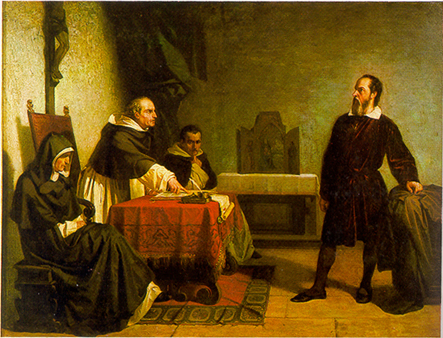
The Roman Inquisition recently posted this message on their Facebook page:

The Roman Inquisition Society stands in solidarity with the Geocentric Society. We support them in condemning the actions of the Astronomy Society in extending an invitation to Professor Galileo Galilei to speak on campus, and agree that hosting known geocentrophobes at our university creates a climate of hatred.

image
Galileo Facing The Roman Inquisition by Cristiano Banti

A spokesman for the Roman Inquisition Society told us that the publication of Galileo Galilei’s new book Dialogue On The Two Chief World Systems showed that Professor Galilei, was “nothing but a reactionary Heliocentrist of the worst stripe”.

image
Frontispiece of Dialogue On The Two Chief World Systems

The spokesman went on to say that an event where Professor Galilei would be able to speak “uninterrupted and unopposed, possibly for several whole minutes, on the supposed ‘reality’ of the Earth’s motion around the Sun” would be in direct contravention of stated Student Union policy which does not grant a platform for speech which could be interpreted as being “disruptive to social and community harmony”.

He closed by saying that: “Whilst we in the geocentrist community have always welcomed debate and challenge, it must be within the context of a positive conceptual framework, such as that put forward by that nice Professor Harry Stottle. After all, freedom of speech is all well and good, but don’t we geocentrists deserve our safe space too?”

Members of the Astronomy Society said that they had invited both the Roman Inquisition Society and the Geocentric Society to observe the moons of Jupiter through a telescope, but representatives of both societies had declined by sticking their fingers in their ears and shouting “La-la-la! Not listening! La-la-la!”

Educational Defeat Devices

image

The Volkswagen Emissions Test Defeat Device needs no introduction:

Full details of how [the defeat device] worked are sketchy, although the EPA has said that the engines had computer software that could sense test scenarios by monitoring speed, engine operation, air pressure and even the position of the steering wheel.
When the cars were operating under controlled laboratory conditions – which typically involve putting them on a stationary test rig – the device appears to have put the vehicle into a sort of safety mode in which the engine ran below normal power and performance. Once on the road, the engines switched out of this test mode.
The result? The engines emitted nitrogen oxide pollutants up to 40 times above what is allowed in the US.
BBC News 4/11/15

This perceptive post from cavmaths shows , I think, the danger of relying on widely used educational “best practice” short cuts. They can actually be deleterious to student understanding. In short, many of them are simply “educational defeat devices”, clever tricks designed to give a false impression of student performance under artificial test conditions, cheats that fall apart when tested in the real world.

PIXL: panacea or poison?

“How the understanding is best conducted to the knowledge of science, by what steps it is to be led forwards in its pursuit, how it is to be cured of its defects, and habituated to new studies, has been the inquiry of many acute and learned men, whose observations I shall not either adopt or censure”.
–Samuel Johnson, The Rambler, April 1750

A colleague described a recent visit to a highly successful science department that has drunk mighty deep of the PIXL well. I shall summarise some of her observations and comments below. My reactions varied from intrigued to puzzled to horrified, but in keeping with the Johnson quote above, I shall endeavour to urge neither adoption nor censure — at least until I have thought about it some more.

Item the first: textbooks are forbidden. Students are taught from in-house PowerPoints and worksheets which are made available online for individual study by students. My colleague reported that she visited several classes in the same year group, and all the teachers were teaching the same topic with the same PowerPoint — and were often on exactly the same slide at the same time! Reportedly, this system was set up because science leaders were not satisfied with the quality of lessons being planned by individual teachers. For myself, I couldn’t help but be reminded of the Gaullist education minister who claimed to know which page of which textbook children throughout France would be studying on that very day . . .

Item the second: science leaders have exhaustively analysed the GCSE exam board specification to produce the materials mentioned above. Every learning point is translated into “student friendly” language and covered in detail. My information is that a typical starter activity might be for students to copy down a summary of important information from a PowerPoint, before practising application using worksheets and past paper questions. These are often peer marked. Since planning and resource making have been centralised, the workload of the classroom teacher appeared to be more manageable than in many schools.

Item the third: students are regularly tested. Test papers are gone over with a fine tooth comb by the science team and areas of weakness identified. These are addressed in large, multiclass study skills sessions led by the head of science in the assembly hall, teaching from the front (brave woman!) using an old fashioned OHP and transparencies! (Sigh! Now that takes me back: I can almost smell the banda machine solvent as we speak.) Students are sat at exam desks for the session, and the hall is supervised by teaching staff and SLT (including the headteacher on the day my colleague visited). This is followed by a “walk and talk” mock (i.e. the answer is modelled by the Head of Science on her trusty OHP), followed by individual exam practice under exam conditions.

And so we come to the question: shall we adopt or censure these observations?

The truth is: I am not sure.

On the one hand, I can see how this might be a rapid and effective way to improve results, especially in a school with an inexperienced science team. And the part of me that actually likes writing schemes of work and resources would relish the challenge of developing such a scheme. And I’m told that percentage science pass rates improved significantly from the low teens to the high eighties . . . over the course of a single year! And you can’t really argue with such success, can you? (Actually, yes you can — see this post on the Halo Effect) Also as Lt. Worf of the starship Enterprise once observed: “If winning isn’t important, why keep score?”

And yet . .

Part of me rebels at such regimentation. Is this an example of the “mcdonaldisation” of education, the continuing process of deskilling the classroom practitioner? I genuinely hate to say this, but given this model maybe Sir Ken Robinson has a point; although this particular iteration seems to owe more to Taylorism rather that the nineteenth century workhouse.

Use another teacher’s PowerPoint? Ugh! I’d rather be forced to use his toothbrush . . .

And, while I grant that many examination questions are indeed fit for purpose and thoughtfully designed to expose misunderstandings and misconceptions, I cannot help the feeling that our examination system has become an overly-powerful tail wagging an emaciated dog.

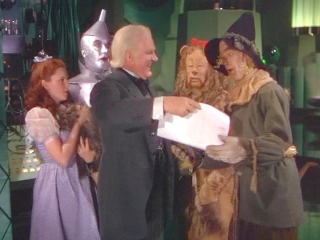
Is learning truly synonymous with exam success? Have we become so enamoured of the assessment of learning rather than learning itself that we, like the Scarecrow in The Wizard of Oz, would not consider ourselves truly learnèd unless we hold a diploma saying that we are?

image
Why, anybody can have a brain. That's a very mediocre commodity . . . great thinkers . . . think deep thoughts and with no more brains than you have. But they have one thing you haven't got: a diploma.

I shall leave the final word to my friend Sam Johnson:

“The great differences that disturb the peace of mankind are not about ends, but means. We have all the same general desires, but how those desires shall be accomplished will for ever be disputed.”
The Idler, December 1758