[I]t is ambition enough to be employed as an under-labourer in clearing the ground a little, and removing some of the rubbish that lies in the way to knowledge;- which certainly had been very much more advanced in the world, if the endeavours of ingenious and industrious men had not been much cumbered with the learned but frivolous use of uncouth, affected, or unintelligible terms, introduced into the sciences
John Locke, An Essay Concerning Human Understanding (1690)
OK, so I was wrong.
In a previous blog, I suggested a possible “diagrammatic” way of teaching energy at GCSE which I thought was in line with the new IoP approach. Thanks to a number of frank (but always cordial!) discussions with a number of people — and after a fair bit of denial on my part — I have reluctantly reached the conclusion that I was barking up the wrong diagrammatic tree.

The problem, I think, is that unconsciously I was too caught up in the old ways of thinking about energy. I saw implementing the new IoP approach as being primarily about merely transferring (if you’ll pardon the pun) the vocabulary. “Kinetic store” instead of “kinetic energy”? Check. “Gravity store” instead of “gravitational potential energy”? Check. “Radiation-pathway-thingy” instead of “light energy”? Check.
Let’s look at the common example of a light bulb and I will try to explain.
Using the old school energy transfer paradigm, we might draw the following:

In spite of its comforting familiarity, however, there are problems with this: in what way does it advance our scientific understanding beyond the bare statement “electricity supplied to the bulb produces light and heat”. Does adding the word “energy” make it more scientific?
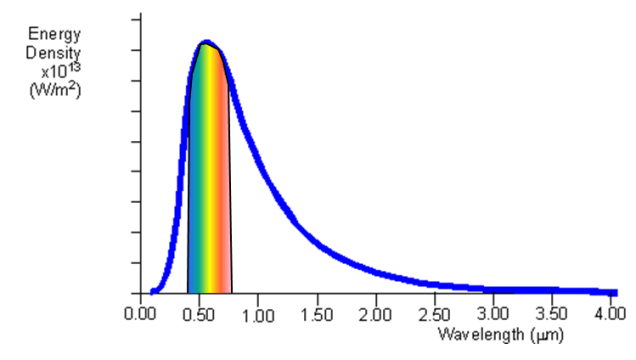
For example, when we are considering “light energy”, are we talking about the energy radiated as visible light or the total energy emitted as electromagnetic waves? It is unclear. When we are considering “heat energy” are we talking about the energy emitted as infrared rays or the increase in the internal energy of the bulb and its immediate surroundings? Again, it is unclear. In the end, explanations of this stripe are all-too-similar to that of Moliere’s doctors in The Imaginary Invalid, who explained that the sleep-inducing properties of opium were due to its “dormative virtues”; that is to say, sleep was induced by its sleep-inducing properties.
The problem with the energy transfer paradigm is that it draws a veil over the natural world, but it is a veil that obscures rather than simplifies.
The IoP, after much debate, collectively rolled up its sleeves and decided that it was time to take out the trash. In other words, they wanted to remove the encumbrance of terms that had, over time, essentially become unintelligible.
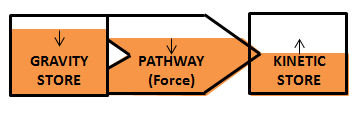
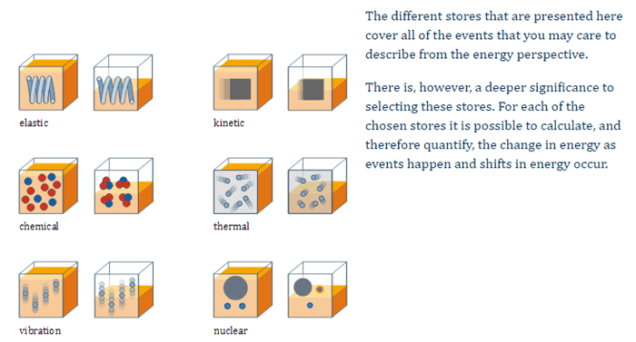
The new IoP model distinguishes between stores and pathways. For example, an object lifted above ground level is a gravity store because the energy is potentially available to do work. Pathways, on the other hand, are a means of transferring energy rather than storing energy. For example, the light emitted by a bulb is not available to do work in the same sense as the energy of a lifted weight. It is, within the limits of the room containing the bulb, a transient phenomenon. Many photons will be absorbed by the surfaces within the room; a small proportion of photons will escape through the window and embark on a journey to Proxima Centauri or beyond, perhaps.
Now let’s look at my well-meaning diagrammatic version of the energy transfers associated with a light bulb:
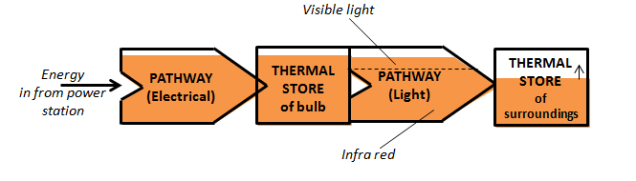
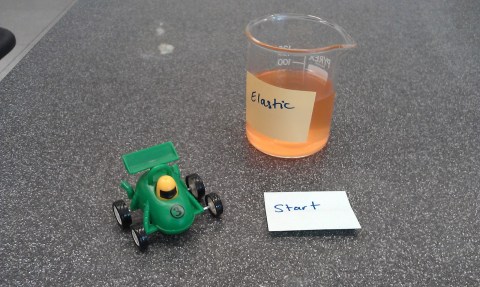
The stores are “leak-proof buckets” holding the “orange liquid” that represents energy. The pathways are “leaky containers” that enable energy to be transferred from one store to another. I have to admit, I was quite taken with the idea.
The first criticism that gave me pause for thought was the question: why mention the thermal store of the bulb? Surely that’s a transient phenomenon that does not add to our understanding of the situation. Switch off the electric current and how long would the thermal store be significant? Wouldn’t it be better to limit the discussion to two snapshots at the beginning (electrical pathway in) and end (radiative pathway out)?
The second question was: what does the orange liquid in the pathways represent? In my mind, I thought that the level might represent the rate of transfer of energy. Perhaps a high power transfer could be represented by a nearly full pathway, a low power transfer by a lower level.
But this led to what I thought was the most devastating criticism: why invent objects and assign clever (but essentially arbitrary) rules about the way they interact when you could be talking about real Physics instead?
Is there any extra information in the phrase “light energy” as opposed to simply the word “light”?
And that’s when I realised that I wasn’t helping to take out the trash; in fact, I was leaving the rubbish in place and merely spray painting it orange.
Now don’t get me wrong, I think there’s still a long road ahead of us before we become as comfortable with the IoP Energy newspeak as we were with the old paradigm. As a first step, I suggest all those interested should read and contribute to Alex Weatherall’s excellent Google doc summary to be found here. But I honestly believe that it’s a journey worth taking.
Opium facit dormire.
A quoi respondeo,
Quia est in eo
Vertus dormitiva— Moliere, The Imaginary Invalid (1673)












 e=mc2andallthat