Secular Pantheon? Oh noes!

I read Joe Kirby’s excellent blog regularly and find myself nodding happily in agreement with many of the points that he makes. However, his recent post Secular Pantheon: what can schools learn from religions? (following suggestions made by Alain de Botton) made me spit out my muesli in frustration. Richie Gale has also written a thoughtful response to Joe’s post, but was in broad agreement with its theme that schools could learn some useful lessons from religion.

I am not.

My main problem is with the claims made by Alain de Botton:

Probably the most boring question you can ask about religion is whether or not the whole thing is ‘true’. Unfortunately, recent public discussions on religion have focused obsessively on precisely this issue, with a hardcore group of fanatical believers pitting themselves against an equally small band of fanatical atheists. [ HuffPo 3/2/12]

While de Botton pats himself on the back for being so much more nuanced and accommodating than the “fanatical atheists” he decries, he is actually neither. I believe Jason Rosenhouse puts it nicely:

When someone says the truth or falsity of religions are their least interesting aspects, you can be sure you are reading the work of someone who thinks they are false. If there were a strong argument to be made on behalf of the truth claims of Christianity or Islam, say, that would not be boring at all. That would actually be a momentous contribution to humanity’s understanding of the world. [EvolutionBlog 8/3/12]

To me, de Botton’s world weary pose is comparable to that of an adult pressured by her children into presiding over a funeral service for a hamster.

I think it is more actually more respectful of religion to take their truth claims seriously enough to debate rather than sideline them with a twinkly eyed “Well, really, whether they’re true or not isn’t the point, is it?”

Joe approvingly highlights this sentence from de Botton:

We need institutions to foster and protect those emotions to which we are sincerely inclined but which, without a supporting structure and a system of active reminders, we will be too undisciplined to make time for.

Well, on the plus side, here de Botton at least talks about emotions rather than the empirically unverifiable spirit or soul. Emotions are undoubtedly important, and I’ll even accept the concepts of soul and spirit when used metaphorically.

But I would argue that emotional lives are far healthier when they are based on truth rather than falsehood. It may well be emotionally satisfying to conclude that you have not succeeded because the world is against you and always has been, but it is far healthier to have an emotional reaction based on the most accurate and honest assessment of the state of the world that you are able to produce, rather than retreat into any form of fantasy.

The plea for a “supporting structure and system” to address our chronic indiscipline is a simply a plea to return to the world of the child, to have someone or something in authority over oneself. Being an adult is hard work. Taking responsibility for oneself is hard. I am sure that shaking off that burden is an attractive thought for all of us, on occasion.

Perhaps de Botton is right, and most religious believers retreat into the comfort of their religious structure and system without worrying too much about its truth or falsity. However, I think that the majority of religious believers follow their religion because they genuinely (for good or bad reasons) believe it to be true.

They are not organizing their lives and defining their identities around religion because they find the rituals quaint and enjoy socializing at the receptions after services. They are doing it because they believe what their religion tells them about the world. [EvolutionBlog 8/3/12. Emphasis added.]

And therein, I think, lies the problem.
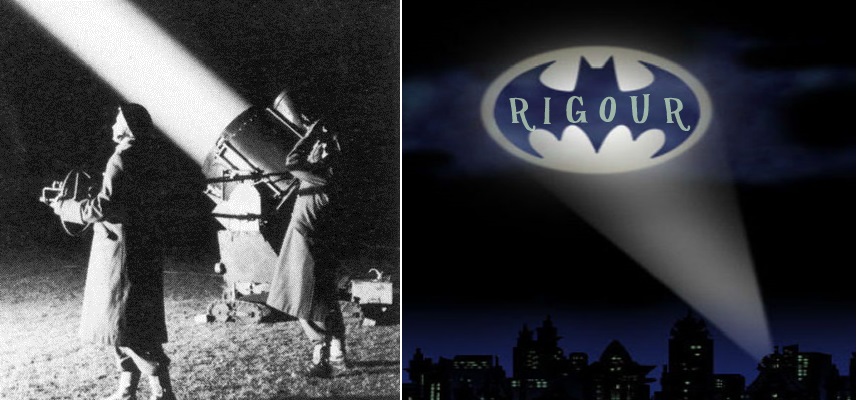
Weasel Words in Education Part 5: Rigour

A crack team of DfE boffins test the proposed new system for the management and oversight of the United Kingdom’s increasingly fissiparous school system.

Rigour, n.

1. The quality of being extremely thorough and careful.

2. severity or strictness.

3. (when pluralized) harsh and demanding conditions

In education (as in other walks of life) the word rigour is usually meant in sense (1) when applied to one’s own thinking or the thinking of one’s friends or allies: “I am being rigorous. However, you, sir, are merely pedantic.”

These days, sense (2) seems to require the insertion of a prefix, as in “The moderation of our controlled assessments was over-rigorous.”

Rigour is therefore a good thing, right?

However, in my opinion it seems to be used more and more as a talisman rather than as a genuine description.

Mr Gove told the Commons: “The new specifications are more challenging, more ambitious and more rigorous. That means more extended writing in subjects like English and history, more testing of advanced problem-solving skills in mathematics and science.”

The Independent, July 2013

I am not sure if Michael Gove* is using the word in sense (1) or sense (2) here. If he meant it in sense (2) then it is a rhetorical flourish to emphasise the idea that GCSEs will be more challenging. If he meant it in sense (1) then the promise of “extended writing [and] more testing” doesn’t tell me how the new exams will be more thorough and careful. This is not saying that the examination system does not need to be more thorough and careful, merely that “extended writing [and] more testing” won’t necessarily make it so.

Let me emphasise that I am not opposed to rigour. I like rigour and being rigorous, at least in sense (1). I would perhaps favour the words consistent and fair rather than use rigour in sense (2) in an educational context, but that’s a personal preference.

In short, I wish people would be more rigorous in their use of the word rigorous. You shouldn’t just use it because you think it sounds good. A is rigorous while B is not should mean more than I like A and dislike B.

And as a final thought, I strongly suspect that many of the people who are most keen to bemoan the lack of rigour in education would have to step out of the kitchen when push came to shove, as in this little vignette:

[I listened] to magazine columnist Fred Barnes . . . whine on and on about the sorry state of American education, blaming the teachers and their evil union for why students are doing so poorly. “These kids don’t even know what The Iliad and The Odyssey are!” he bellowed, as the other panellists nodded in admiration at Fred’s noble lament.

The next morning I called Fred Barnes at his Washington office. “Fred,” I said, “tell me what The Iliad and The Odyssey are.”

He started hemming and hawing. “Well, they’re … uh … you know … uh … okay, fine, you got me—I don’t know what they’re about. Happy now?”

No, not really. You’re one of the top TV pundits in America, seen every week on your own show and plenty of others. You gladly hawk your “wisdom” to hundreds of thousands of unsuspecting citizens, gleefully scorning others for their ignorance.

— Michael Moore, Stupid White Men (2001), p.58


* His successor Nicky Morgan look set to continue Gove’s use of the term.

Postscript: For the those (including myself) who are classically undereducated: The Iliad is an ancient Greek epic poem by Homer about the Trojan War. The Odyssey is another epic poem by Homer recounting the ten-year journey home from the Trojan War made by Odysseus, the king of Ithaca.

Weasel Words in Education Part 4: Robust

There are robust systems in place for the safe recruitment of staff, which assess their suitability to work with young people.

–OFSTED report (selected randomly), Oct 2013. p.6


In [a number of the] schools visited where science achievement had recently improved [there had been a] robust review by senior leaders, leading to a reduction in weaker teaching

OFSTED, Maintaining Curiosity in Science, November 2013. p.26 [emphasis added]

“Robust” is an increasingly common word in educational circles these days.

They say a picture is worth a thousand words. As a physicist, I would argue that a nice graph is worth at least five thousand.

image

It certainly seems that the setting up of Ofsted has significantly increased the usage of the word “robust”. In fact, the phrase “to infinity and beyond!” springs to mind when we view the precipitous increase after 1984. Now, it might be argued that this is merely conincidental: after all, correlation is not proof of causation.

This is true. But just for the record, an advanced Google search for the word “robust” on just the Ofsted website alone gets 87300 hits. (A similar search of the Ofgem website returns just 5790 results). When Google release a more up-to-date dataset, it will be interesting to see if the usage of “robust” will have increased or decreased during Sir Michael Wilshaw’s tenure. I know what possibility I’ll be putting my money on.

Robust adj.
When used in an educational context:
1. [of systems or processes] able to withstand or overcome adverse conditions
2. [of SLT or other interventions] uncompromising and forceful

What it actually means in practice:

    Robust adj.

  1. A system or process that is explained at tedious length in the staff handbook and that has least one desultory paper trail so that we can pretend that this thing happens as a matter of course: (A custom more honoured in speech than in observance, you might say.)
  2. A meeting during which SLT got (a) shouty; or (b) offered “support” that turned out to be profoundly unsupportive; or (c) both

.

As a final thought, UK education seems to be in the hands of people who like to use the word “robust” a lot. H’mmm, I feel a song coming on . . .

# If there’s something weird
# and it don’t look good
# Who ya gonna call?
# ROBUSTers!!!

Robusters

The Joy of Quotation Marks

A colleague of experimental psychologist Steven Pinker once joked that verbs were ‘his little friends’ as Pinker believed that the way they are used can give genuine insight into the hidden machinery of cognitive processes.

You know who my ‘little friends’ are? Punctuation marks. I think that they can often give the game away. Take this doozy:

The best secondary schools trusted the incoming ‘levels’ achieved by pupils in primary school as a starting point . . .
–OFSTED, Maintaining Curiosity in Science, November 2013, p.42

The writer asks schools to trust things called “‘levels'”, which the writer has deliberately placed in quotation marks. H’mmm, interesting. Now why would they choose to do that?

By my count, there are five reasons to use quotation marks:

1. Reported speech — this instance doesn’t seem to fit that usage.

2. When coining a new word or phrase — again, this usage is unlikely in this instance.

3. When referring to a word as a word — again, it doesn’t seem to be the intention here.

4. To indicate the title of a book or article — this is definitely not the case here.

By a process of elimination, this seems to leave only one plausible reason for the writer to choose to use quotation marks:

       5.   To imply that the quoted word or phrase is dubious.

So let’s be clear here: the writer is asking schools to trust things called “‘levels'” that he or she apparently considers dubious enough to wrap in ironic quotation marks.

In this paragraph, Ofsted are urging schools to trust what Ofsted themselves (going by their use of punctuation, at least) consider untrustworthy. What are they going to ask us to do next? Square the circle? Cut down the largest tree in the forest with a herring?

Now, where else have I seen ‘levels’ in quotation marks recently? Oh yes . . .

As part of our reforms to the national curriculum , the current system of ‘levels’ used to report children’s attainment and progress will be removed.  It will not be replaced.
–DfE, June 2013

Let me summarise: in June 2013, the DfE tells us that ‘levels’ are gone, but then in November 2013, Ofsted admonishes us for not taking ‘levels’ seriously enough.

Sigh. Education: does thy right hand know what thy left hand doeth? Ever?

As a teacher, my way forward is crystal clear: it’s time to get busy cutting down the largest tree in the forest. Now, where did I put that herring . . .

Meet The New Ofsted, Same As The Old Ofsted

During CPD training in school, the team was handed a bulging A4 booklet. So bulging, in fact, that the staples looked to be experiencing the same kind of tectonic stresses as the waistband of my work trousers during one of my ‘heavy’ phases.

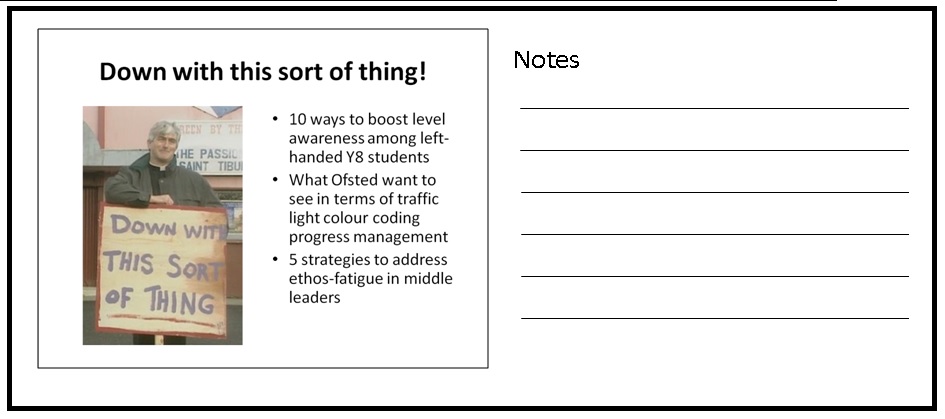
I am sure that all teachers have a been handed such a booklet at some point. It was a collection of Powerpoint slides — printed on that setting that produces a set of lines next to a shrunken facsimile of each slide. The lines are generously provided for the lucky attendee of external CPD to write “Notes”. (Somewhere in that corner of a higher dimension known as Tree Heaven, one tree turns to another tree and says “Bastards! They cut us down for that?”)

Handing us a copy of the Powerpoint, of course, serves a double purpose: (a) the external-CPDer can tick the “info. shared with dept.” box on the yellow CPD Impact Assessment Form; and (b) it keeps the team occupied for twenty minutes as we digest the slides. The document itself was no worse than many I’ve seen, but, sadly, no better either: Ofsted…Ten things to remember…Ofsted..five strategies to…more Ofsted…six sodding hats…yet more Ofsted…bloody Bloom’s bloody taxonomy…[epithets mine].

But I digress. The potted biography of the trainer was included: she was headteacher there and there and is an experienced Ofsted inspector. Now I’m sure she is a nice lady who means well and gets on with her colleagues and family and doesn’t kick her cat and takes good care of the hamster, but I couldn’t shake the feeling that this sort of thing is beyond a cottage industry now. Now it’s an industry — the school improvement industry.

Down with this sort of thing

It’s like we went to bed in the green, bucolic splendour of the 18th Century and woke up amidst the hideous, belching smokestacks of the Industrial Revolution.

And, for the life of me, I could not shake the feeling that some paragraphs written by George Orwell in the 1940s were particularily relevant:

The corruption that happens in England is seldom of that [conscious] kind. Nearly always it is more in the nature of self-deception, of the right hand not knowing what the left hand doeth. And being unconscious, it is limited . . . I do not suppose there is one paper in England that can be straightforwardly bribed with hard cash. In the France of the Third Republic all but a very few of the newspapers could notoriously be bought over the counter like so many pounds of cheese. Public life in England has never been openly scandalous. It has not reached the pitch of disintegration at which humbug can be dropped.

— George Orwell, England, Your England

I am sure that there is not a single Ofsted inspector in the country who can be bought across the counter for cold, hard cash like so many pounds of cheese. I even accept that a recent Ofsted rule change means that serving inspectors cannot run “what Ofsted want”-style courses anymore. (And about time too.)

But is it enough? Will there simply be a time-delayed revolving door between a stint as an inspector and joining the school improvement gravy train? I suspect that the niceties will continue to be observed, and that the fine old traditional British value of humbug will stop the development of situations that are openly scandalous.

As a colleague observed cynically: “The people writing this kind of thing are the exactly same kind of people who will be judging us, and can make or break our careers. Don’t do as they do, do as they say.”

I am and I will continue to do so. But, openly scandalous or not, I still think it stinks.

Why Mr Gradgrind, Thou Art Updated!

Why, Mr, Gradgrind, thou art updated!

“NOW, what I want is, Skills. Teach these boys and girls nothing but Skills. Skills alone are wanted in life. Plant nothing else, and root out everything else.” Mr Gradgrind paused for a moment.

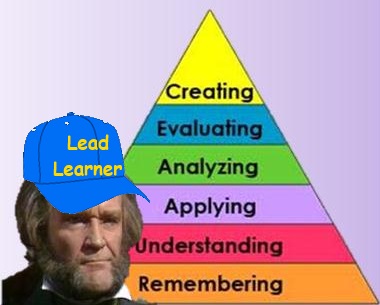
“And when I say ‘teach’ what I really mean is ‘facilitate’. This is the principle on which I bring up my own children, and this is the principle on which I bring up these children. Stick to Skills, sir!’ The scene was a plain vault of a school-room, decorated only with the multicoloured pyramid of Bloom’s Taxonomy on the far wall which the speaker’s square forefinger emphasized silently by pointing, in the approved “talk-less” neo-Gradgrindian manner.

“In this life, we want nothing but Higher Level Thinking, sir; nothing but Analysis, Evaluation and Creativity!” The speaker and the second grown person present both swept with their eyes the knots of little vessels then and there arranged in groupwork PowerTalk Circles (TM), ready to have imperial gallons of Conceptual Understanding facilitated into them until they were full to the brim, or at least until their personalised learning objectives could be self-actualized and triple cross-checked by peer assessment.

“Girl number twenty,” said Mr. Gradgrind, squarely pointing with his square forefinger, “as a starter, please go to the flipchart and analyse and evaluate what the concept of ‘horse’ means in the 21st Century within the context of productive economic citizenship. Please make full use of all the colours available to delineate your thought-clusters. You have two minutes.” Sissy Jupe blushed nervously but gamely walked over to the flipchart stand. Mr Gradgrind started a countdown timer on the interactive whiteboard.

The pips sounded and Sissy stepped away from the flipchart. She had drawn a picture of a horse. It was actually quite a good picture although it was wearing a hat and smiling in a decidedly unhorselike way. She had written “Dobbin is a quadruped” in very neat handwriting at the bottom.

Mr Gradgrind refrained from commenting with some difficulty. “Suggestions?”

A hand went up. “She should use the word ‘because’ in every sentence to encourage higher level thinking skills?”

“Yes, but . . .” conceded Mr Gradgrind , walking over the flipchart and putting a big red circle around the word quadruped. “More suggestions? Yes, Bitzer?”

“The sentence containing the word quadruped is a statement of a merely factual nature, sir,” said Bitzer, pulling a sour face as the word ‘factual’ left his mouth.

“Precisely!” roared Gradgrind . He turned towards the class. “And why should we bother to remember things when–”

“–we can look it up on Google!” chorused the class. Poor Sissy Jupe looked crestfallen.

“Bitzer, show us how its done.” The whey-faced lad tapped away on his iPad.

“Sir, horses are not quadrupeds! It says here on Wikipedia that they’ve got five legs.”

“One cannot always trust Wikipedia, boy!”

“The article was updated not seven and a half minutes ago by a contributor called Professor LOLZ, sir!”

Gradgrind gave Sissy Jupe a significant look. “Analysis, Evaluation and Creativity — that’s how its done! Consider: (1) the article is recent and up-to-date; (2) it’s written by an academic; and (3) Lolz sounds a bit German and they are a jolly efficient nation with an education system that is higher in the PISA rankings than ours! QED. Well done there, Bitzer!”

Sissy Jupe looked puzzled.”But . . . horsies have four legs, don’t they?”

Gradgrind warmed to one of his favourite themes: “In the fuddy-duddy old twentieth century, perhaps horsies did have four legs. But in the twenty-first century, are you going to rely on what your brain tells you or what the internet says? Shift happens. There’s going to be a lot of Chinese and Indian people about, some of them quite clever. Big numbers. Lots of new words and job titles with the word digital in them. Twenty-first century skills, sort of thing. Shift happens..”

Gradgrind became uncomfortably aware that his precis wasn’t having the same impact as the ‘Shift happens’ Youtube video itself usually did. “Consider, young Sissy,” he said, changing tack, “the skills of 21st century equestrianism are likely to be vastly different from the skills of 20th century equestrianism. If you had learned to ride a twentieth century horse, would you still be able to ride a twenty-first century horse?”

“Erm . . . yes?” offered Sissy, hesitantly.

“Of course not! You see, that’s why we’re not teaching you any stuff that might change in the near- to medium-term future, because that would be silly, wouldn’t it? Instead, we’re teaching you skills that will last a lifetime, like using internet browsers and how to use keyboard shortcuts on proprietary software to cut-and-paste. Because those skills will NEVER become obsolete, you mark my words!”

The second adult in the room, the normal class teacher, stepped forward, shaking his head in admiration. Speechlessly, he removed his mortar board and handed it over to Mr Gradgrind . Mr Gradgrind acknowledged the gesture with a grave and courteous inclination of the head, before throwing that tired old symbol of traditional teaching into the nearest wastebasket.

He drew two baseball caps from his pocket — they both had the words ‘Lead Learner’ embroidered upon them — and both of them reverently donned them. From somewhere, the opening bars of Mr Boombastic blared as they got on with chillin’ wid da kidz.

Sissy Jupe sighed and opened her book and started reading quietly: it had been a close run thing, but just for a minute there it had seemed as if someone was actually going to teach her something…

The Twelve Physics Pracs of Gove (Part Two)

A true-devoted pilgrim is not weary
To measure kingdoms with his feeble steps

–William Shakespeare, The Two Gentlemen of Verona


A picture [of reality]  . . .  is laid against reality like a measure  . . .   Only the end-points of the graduating lines actually touch the object that is to be measured  . . .   These correlations are, as it were, the feelers of the picture’s elements, with which the picture touches reality.

–Ludwig Wittgenstein, Tractatus-Logico-Philosophicus 2.141-2.1515


What they say of disc jockeys is also true of teachers: that someone, somewhere will remember some of your words forever; or, at least, for the duration of their lifetime. The downside is, of course, that you never know which of your words are going to be remembered. The wittily-crafted, near-Wildean aphorism pregnant with socratic wisdom — probably not. The unintentionally hilarious malapropism that makes you sound like a complete plonker — almost certainly.

To this day, I still remember Dr Prys’ sharp and appropriate response to a flippant comment (possibly from the callow 6th form me) about whether the scientific constants listed in the data book were truly trustworthy: “Look,” he said, “people have dedicated their whole lives to measuring just one of these numbers to one extra decimal place!” True devoted pilgrims indeed, mapping out the Universe step by tiny step, measurement by measurement.

I have written before on what I consider to be the huge importance of practical work in Physics education. Without hands-on experience of the hard work involved in the process of precise measurement, I do not believe that students can fully appreciate the magnificent achievement of the scientific enterprise: in essence, measurement is how scientific theories “touch” reality.

I am encouraged that parts of this view seem to be shared by the writers of the Subject Content guidance. (All hail our Govean apparatchik overlords!)

Of course, this has to be balanced with the acknowledgement that (as I understand it at least) teacher-assessed practical work will no longer count towards a student’s final exam grade. Many are concerned that this is actually a downgrading of the importance of practicals in Science and thus a backward step.

Sadly, they may turn out to be right: “We have to have this equipment for the practical/controlled assessment!” will no longer be a password for unlocking extra funding from recalcitrant SLTs (and from the exam budget too — double win!)

And, undoubtedly, some “teach-to-the-test” schools will quietly mothball their lab equipment (except for the showy stuff — like the telescope that no-one knows how to use — that they bring out for prospective pupil tours).

That would be sad, and although the DfE have, to be fair, nailed their pro-practical colours to the mast, we all know that the dreaded Law of Unintended Consequences may have the last laugh.

I would say it all depends on how the new A levels are actually put together. I will be attending some “launch events” in the near future. I will blog on whether I think we can expect an Apollo 11 or an Apollo 13 at that time.

In the meantime, I will be setting practicals galore as usual, as I’m old-fashioned enough to think that they give a lovely baroque feel to a scheme of work…

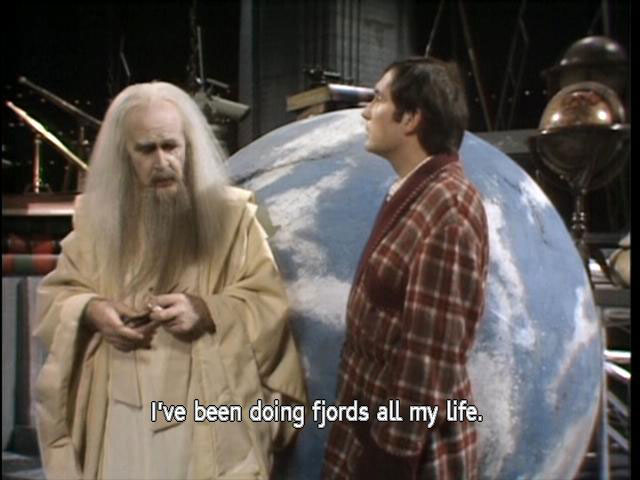
Look at me, I design coastlines, I got an award for Norway. Where’s the sense in that? None that I’ve been able to make out. I’ve been doing fiords all my life, for a fleeting moment they become fashionable and I get a major award. In this replacement Earth we’re building they’ve given me Africa to do, and of course, I’m doing it will all fjords again, because I happen to like them. And I’m old fashioned enough to think that they give a lovely baroque feel to a continent. And they tell me it’s not equatorial enough…
–Slartibartfast, from The Hitch-Hikers Guide to the Galaxy by Douglas Adams

image

Assessing Without Levels: the Lewis Carroll Perspective

An alternative look at assessment without levels…

As part of our reforms to the national curriculum , the current system of ‘levels’ used to report children’s attainment and progress will be removed.  It will not be replaced.

DfE, 2013


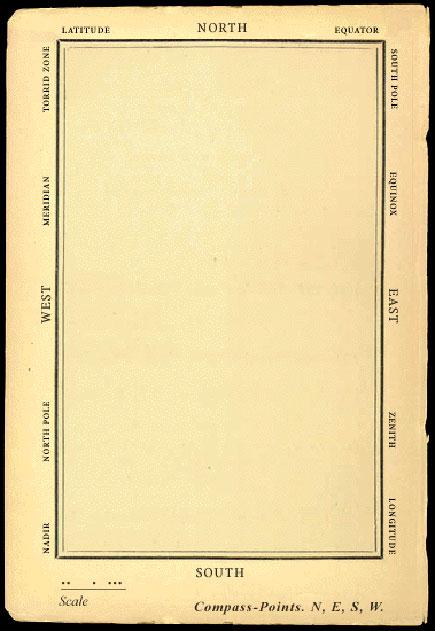
Bellman Map


He had bought a large map representing the sea,
Without the least vestige of land:
And the crew were much pleased when they found it to be
A map they could all understand.


“What’s the good of Mercator’s North Poles and Equators,
Tropics, Zones, and Meridian Lines?”
So the Bellman would cry: and the crew would reply
“They are merely conventional signs!


“Other maps are such shapes, with their islands and capes!
But we’ve got our brave Captain to thank:
(So the crew would protest) “that he’s bought us the best–
A perfect and absolute blank!”


— Lewis Carroll, The Hunting of the Snark

The Twelve Physics Pracs of Gove (Part One)

It’s not often that a DfE publication makes me feel like Kent Brockman, the newsreader from The Simpsons.

I’d like to remind them that as a trusted TV personality, I can be helpful in rounding up others to toil in their underground sugar caves.
Kent Brockman: “I, for one, welcome our new insect overlords.”

This feeling stems from reading the “Use of apparatus and techniques – physics” section from the DfE’s April 2014 Subject Content for AS and A level Biology, Chemistry, Physics and Psychology publication (p.23).

I had the rather novel feeling that it’s actually a sound list: and I, for one, welcome this intervention from our Govean-apparatchik overlords.

Why do I welcome this? Well, I feel that all too often we lose sight of the fact that, at its heart, Physics is, and must remain, a practical subject, the foundation of so much of the modern world.

Miroslav Holub’s poem “A Brief Reflection on Accuracy” paints a haunting and disturbing picture of what could be described as an entirely postmodernist, deconstructed and relativist (rather than relativistic) universe:

A certain soldier

    had to fire a cannon at six o’clock sharp every evening.

    Being a soldier he did so. When his accuracy was

    investigated he explained:

I go by

    the absolutely accurate chronometer in the window

    of the clockmaker down in the city.

   [ . . . ]

Oh, said the clockmaker,

    this is one of the most accurate instruments ever. Just imagine,

    for many years now a cannon has been fired at six o’clock sharp.

    And every day I look at this chronometer

    and always it shows exactly six.

[ . . . ]

So much for accuracy.
And fish move in the water, and from the skies
comes a rushing of wings while

Chronometers tick and cannons boom.

Without the grounding supplied by the art and science of measurement, I believe that we would all inhabit a castle-in-the-air universe as outlined above by Holub (whose experiences as an immunological research scientist are said to have influenced much of his poetry).


Is Holub’s nightmarish scenario even a remote possibility? Would we ever be in a world where “chronometers tick and cannons boom” but no-one actually checks the actual time by, say, looking out of the window to see if it’s daylight or not?

As with most nightmares, it’s probably closer than you think: “The sleep of reason brings forth monsters” as Goya suggested, and the steps that produce the monsters are often small, seemingly-harmless compromises of apparently little consequence.

One of my Y13 students, who has been attending a number of interviews for Physics courses, reports that some university departments have told him that “We spend a lot of the first year teaching students how to write formal laboratory reports as we find many of them have not learned how to do this during their A level courses.

Whaaa-aat? I nearly fell off my lab stool when Sam* told me this. In my opinion, that is unconscionable. “Oh, yeah,” Sam went on, “some of the students there said things like ‘Oh, our A level course content makes it unsuitable for practical teaching’.”


Opinions like that, if they genuinely reflect the views of the schoolteachers involved, are steps on the road to bringing forth monsters. Of course, it may not seem like a big deal to either the students or the teachers who are probably following what they see as a reasonable path of little resistance. But it is a big deal, it really is.

“And what did you say, Sam?” I asked.

“I said that we do a formal write up with a full analysis of experimental uncertainties every lesson.”

“Do we, Sam? Every lesson? Really?”
“Yeah, well,” said Sam with a smile, “I lied about that, didn’t I?”

“Exaggerated, Sam. I think you mean exaggerated.”

“Whatever you say, sir,” said Sam.

More on the 12 pracs of Gove in a later post..

* not his real name

What About the Wombles?

# Underground, overground, wombling free # The Wombles of Wimbledon Common are we.

Teachers know that every school is the same, and yet every school is different.

Every school is the same in the sense that they are set up to do ostensibly the same job: most of them have classrooms, teachers, desks, timetables and other things of that ilk. Every school is different in the sense that the culture, expectations and unwritten rules of each and every school is absolutely, completely, insanely and utterly unique.

Even the language, cant and argot of each school is unique. Even for the staff.

In one of my previous schools, the staff codeword for a “bottom set” student was “womble”. Although some might view such terms as demeaning to the students, I believe that the Head of Science who originated it actually used it with genuine affection and humour (try saying it with a Scottish accent through a thick beard for best effect), and I`d like to think that we used it in a like manner too. (I think that it’s certainly less judgemental than “muppet”, although I’m not sure why.)

Teaching a class of wombles is a skill in itself. There are times when you feel like the best teacher in the world: wow, you say to yourself, nearly everyone got that idea — I am a teaching genius!

And then next lesson comes around. Remember what we covered last lesson? you begin with a confident smile, willing and eager to move on. Cue: thirty blank looks and slightly-furrowed brows and you can see the thought “Huh? We were here last lesson…? We did something last lesson…?” forming in their brains. And you realise that you are still at square one. Or, possibly, square zero.

Not that I am suggesting that we should give up. I am game to try and keep trying and keep on trying.

The point I want to make is simply that so much of educational discourse ignores the both the existence and the needs of the wombles.

Part of the problem is that education in the UK is still very narrowly focused on academic achievement: if you don’t get into Oxbridge then you’re a failure. Oh, and it’s your fault. And your teachers, of course.

I cannot shake the feeling that what are we going to do about the wombles? is a question that is not asked often enough. We concentrate on the A*-C grades (and anyone who can be cajoled or armtwisted into getting a C), and are seemingly content to allow those getting below those grades to think of themselves as failures.

Not too long ago, I set up a talk by an Oxbridge admissions tutor for a group of very mixed ability inner city kids. My oh-so-well-meaning aim was very “growth mindset”: you can achieve anything you want if you work hard. The tutor was genuine, funny and charming and so were the undergrads from inner city backgrounds that she brought along. But my little Dweckian-soiree achieved the exact opposite of what I wanted. Hearing that a few GCSE grade Bs won’t necessarily completely scupper your chances of entry to an elite Oxbridge college isn’t what you want to hear when even a grade D seems a distant unattainable dream. My students feedback was that the event merely confirmed what they thought: this isn’t for me.

Now just because I have filed someone in the “womble” drawer doesn’t mean that they will be unsuccessful. One of the more encouraging — and yet humbling — recurring events in a teacher’s life is meeting past students who have moved on. Some of them will be parents, craftsmen, artists, pilots, business owners, chefs, firefighters and police officers. And as they chat amiably with you about schooldays past, their passing references to their life and career begin to make you feel like the womble.

And very often, they have warm memories of you not because of anything that you did, but because you had a sense of humour and were kind on occasions, and above all else, you tried.

And then you realise that, actually, those were the reasons why you liked some of them more than many of the lazy, tiresome, arrogant jerks in the top set: the wombles were often funny, kind and frequently tried hard.

After all, the truth is that each and every one of us is a womble to someone else.

Salieri : I will speak for you, Father. I speak for all mediocrities in the world. I am their champion. I am their patron saint. Mediocrities everywhere… I absolve you… I absolve you… I absolve you… I absolve you… I absolve you all!

Amadeus (1984) by Peter Shaffer